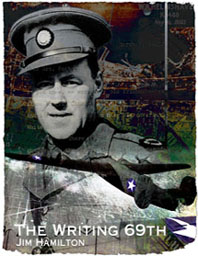
An Illustrated Summary of the Wilhelmshaven Mystery
May 2026: Author/illustrator Jim Hamilton has been researching the story of two women whose bodies washed up on shore near Wilhelmshaven, Germany during the summer of 1943. (For more on that, see the post below.) Described by the Germans as “female fliers” (one American and one British), the two women have never been identified. In a concise twelve pages, Hamilton recaps what he has discovered through civilian and military records. It is his hope that someday this mystery may be solved. You can read the summary here.
Cronkite and Rooney at the 1st U.S. Army Press Camp in 1944
September 2023: Alexander Braun, who offers tours through his company, Remember D-Day Tours, recently wrote about a press camp in Chateau de Vouilly, Normandy that included Writing 69th members Walter Cronkite and Andy Rooney. Braun's article, The 1st U.S. Army Press Camp at the Chateau de Vouilly, is a must-read for those with an interest in war correspondents and World War II.
The 80th Anniversary
February 2023: February 26, 2023 marks the 80th anniversary of the first and only mission of The Writing 69th.
Lt. Robert McPhillamey and Stalag Luft III
June 2022:
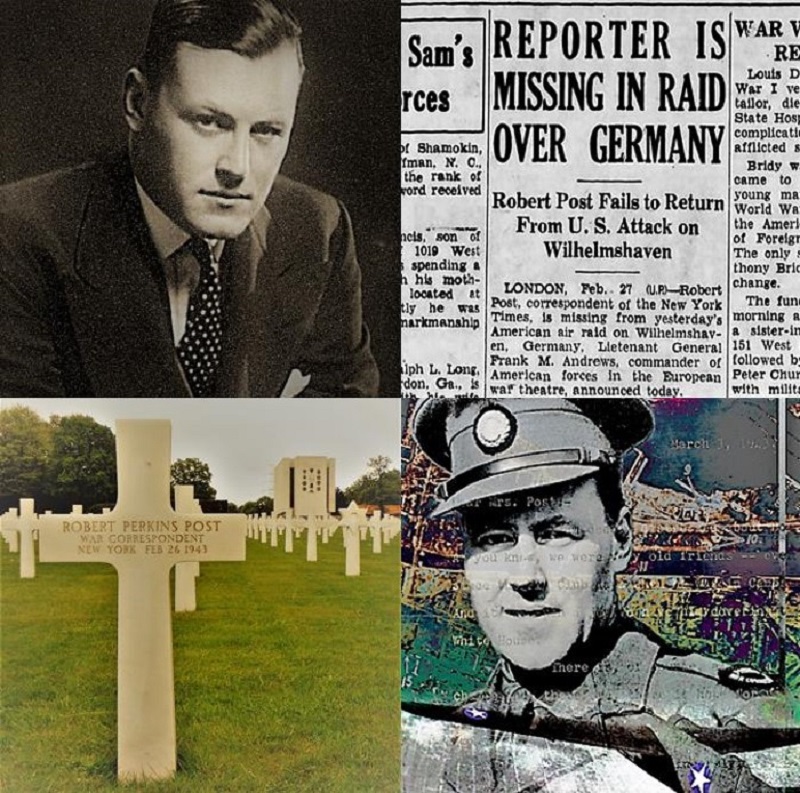
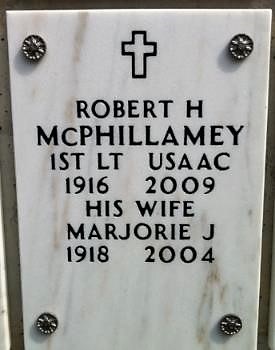
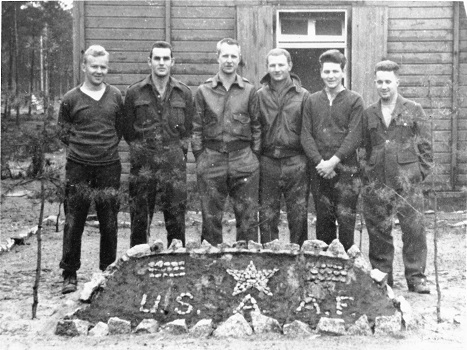
We heard recently from the niece of Robert McPhillamey. Lt. McPhillamey was the pilot of a 44th Bomb Group B-24 that was shot down on February 26, 1943. His was one of two 44th Bomb Group B-24s that were lost that day. The other was the one that carried New York Times reporter Robert Post. Lt. McPhillamey survived the crash and spent the rest of the war as a prisoner at Stalag Luft III. His niece, Jean Fetterhoff, reported that her uncle is buried (along with his wife, Marjorie) in Arlington National Cemetery in Washington, DC. McPhillamey lived in Washington after the war and was an attorney for the Department of the Interior for many years. Shown here are his grave marker as well as a picture of 44th Bomb Group members that was taken at Stalag Luft III. From left to right: Robert K. Walker, Wayne H. Gotke, Robert H. McPhillamey, Wilber E. Wockenfuss, Leo O. Frazier, and John T. Mooney (photograph courtesy of Wayne C. Gotke).
Alexander Braun Visits Post's Grave
September 2021:
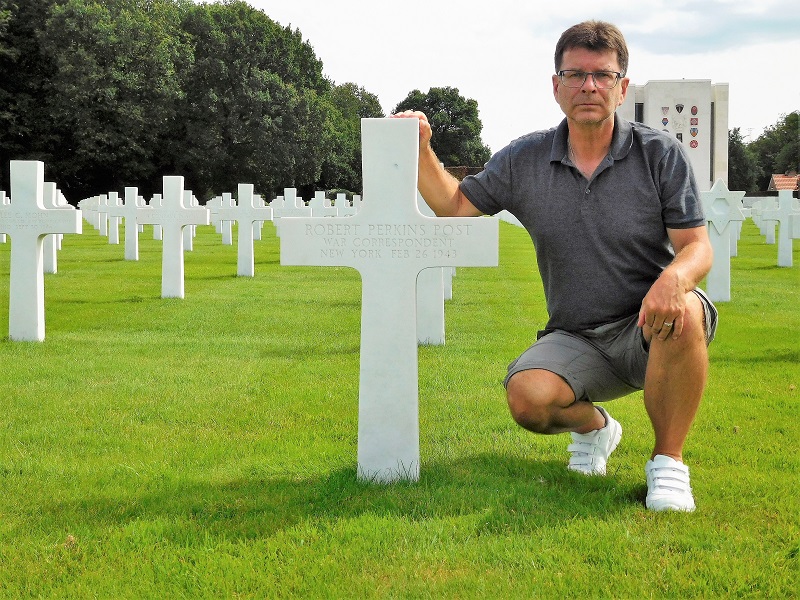
Alexander Braun, a good friend of the Writing 69th home page, recently visited the Ardennes Military Cemetery in Neupre, Belgium and stopped by Robert Post's grave (see photo below). Alexander is an expert on D-Day and offers one- and two-day tours of D-Day-related sites. You can check out his work at the Remember D-Day Tours web site.
The Veterans Memorial in Bayport, New York
August 2021:
Not very far from the Post family plot in St. Ann's Cemetery in Sayville, New York, Robert Post's name is also on the veteran's memorial in nearby Bayport in the Bayport Memorial Park. While it is true that Post died on a military mission, he was a newspaper reporter, not a veteran. Yet the fact that he died in combat (and the risk that he took in doing so) was enough for the Bayport town officials to include Post's name on the World War II plaque in Bayport Memorial Park.
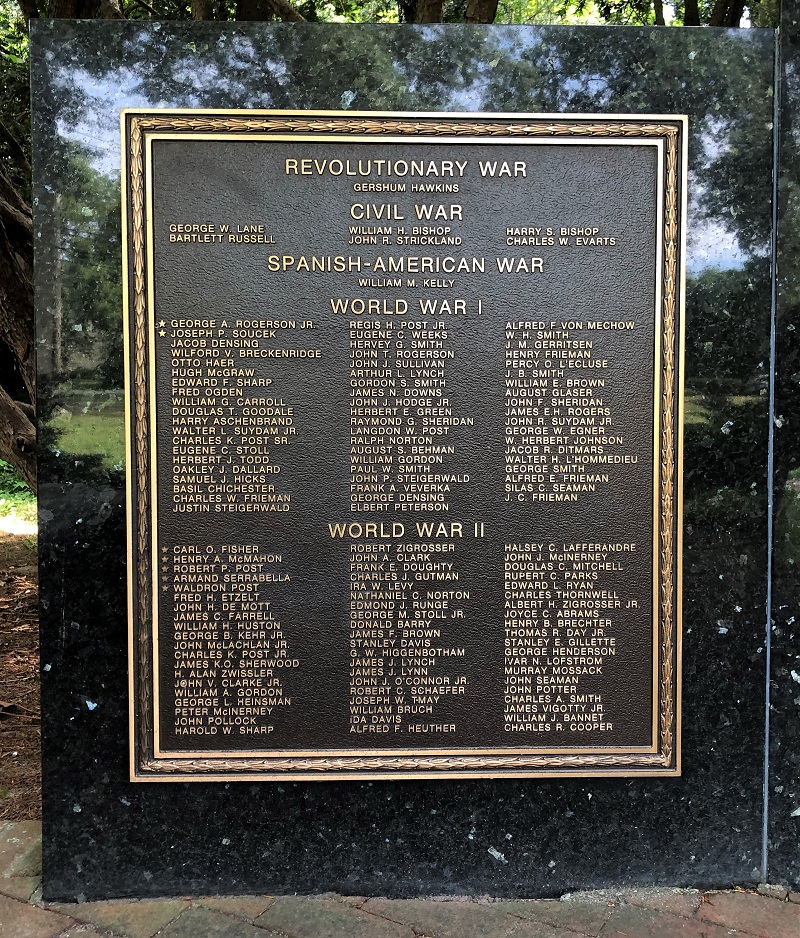
In addition to Post, there are five other Post family members listed on the World War I and World War II Bayport Memorial plaque:
- Charles K. Post Sr.: Robert Post's oldest brother who served in the Navy in World War I
- Regis H. Post Jr.: Robert Post's cousin, a West Point graduate who served in World War I
- Langdon W. Post Sr.: Robert Post's second oldest brother who served in the Army in World War I
- Waldron Post: Robert Post's third oldest brother, a Navy officer who was injured in the line of duty during World War II and died early in 1946
- Charles K. Post Jr.: Robert Post's nephew who served in World War II
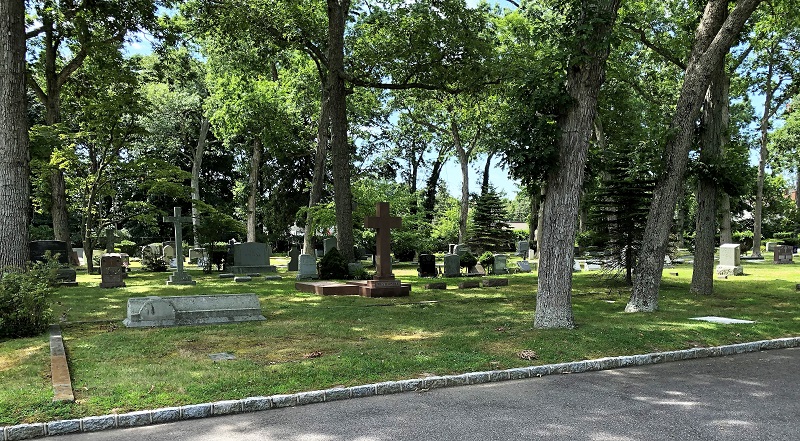
One other point: Though there is a memorial stone for Post in the Post family plot in St. Ann's cemetery (see below), he is not buried there. He is buried in the Ardennes Military Cemetery in Neupre (formerly Neuville-en-Condroz), Belgium along with the some of the other crew members. For details see here.
Why Did Capt. Adams Call His B-24 'Maisie'?
February 2021:
A clue to why Capt. Howard Adams called his plane 'Maisie' was provided recently by the son of navigator Wayne Gotke. He said that his father told his mother that the aircraft was named after Adams' mother, Mrs. Walter F. Adams (nee Mary Fannie Thomas). We are looking for confirmation that Adams' mother actually went by the nickname Maisie, but we believe it is very likely that she did, given that Maisie is a common nickname for a woman named Mary.
Navigator's Wedding Ring Found at Stalag Luft III
January 2021:
Wayne Gotke, the navigator on the 44th Bomb Group B-24 that Robert Post flew on, was one of two survivors of the crash. He was captured by the Germans and imprisoned at Stalag Luft III. According to a 2018 article in the Kerrville Daily Times, a team from the POW Camps Museum was conducting an archeological excavation at the site of the camp when they came upon a dirt-filled sink and drain from one of the barracks' bathrooms. In knocking the dirt out of the drain, a ring was discovered. It was inscribed with the words, "Ann to Wayne 1942" and the Hebrew word 'Mizpah,' which translates as 'watchtower' but when written on jewelry carries the meaning, 'May God watch over you.' With not a lot of information to go on, the POW Camps Museum team nonetheless was able to track down Gotke's son (also named Wayne) who lives in Kerrville, Texas. They returned the ring to him.
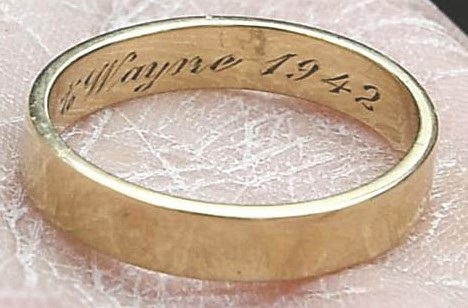
Photo credit: Tom Holden, Kerrville Daily Times
The Wooden Doll
January 2021:
Jim Hamilton, author of The Writing 69th, was the first runner up in a 'Flash Fiction' contest run by his alma mater, Amherst College. His entry was called The Wooden Doll:
It came to me out the sky, dropped 20,000 feet among the pieces of a doomed American bomber whose crew lay twisted and lifeless in our farmyard. The roof of our house on fire. The barn aflame. My parents and the neighbors helping to rescue our livestock. And one unfamiliar face: a Luftwaffe pilot in boots and flight suit leaning down to hand me a wooden doll he'd found in the wreckage of the plane he had just shot down.
A small airport lay adjacent to our fields, and he had landed there and rushed toward the flames, pulling a pig out of the burning pen, carrying furniture out of the house, and then, after the firemen arrived, pausing to examine the carnage. That's when he saw it, sitting unharmed between the pilot and co-pilot's seats in what remained of the cockpit. As the only girl in the vicinity, it's not surprising that he chose me. I accepted his gift without question. I was in shock. The anger came later.
The doll's name, which I did not learn until I had grandchildren of my own, was Maisie.
Hamilton noted, "Readers of The Writing 69th will recognize this scene. It is based on the events of February 26, 1943 in Bad Zwischenahn, Germany. The doll in question, which came into the possession of Leni Eilers, is at the center of this tantalizing mystery. Who did the doll originally belong to? Given that it was found between the pilot and co-pilot's seats (according to Heinz Knoke's diary), it is fair to assume that it belonged to Capt. Howard Adams. Adams called his B-24 'Maisie,' for reasons that are not 100% clear, though it seems likely that it was a reference to a series of Ann Sothern movies. Leni Eilers was actually given the doll and she kept it for many years, though its location today is unknown and is most likely lost."
Update: See here for new information on why Adams called his plane 'Maisie.'
The Wilhelmshaven Mystery
January 2021:
In May of 1945, New York Times reporters looking for information on Robert Post's fate came accross the graves of two women in a military cemetery in Wilhelmshaven.
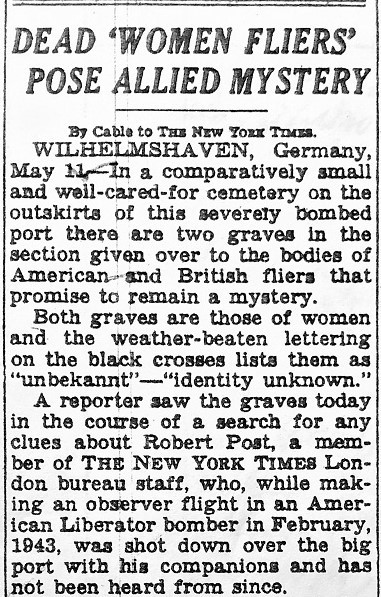
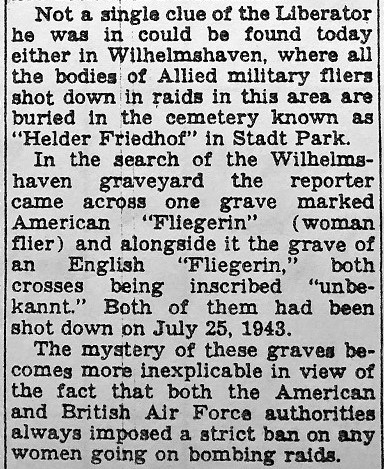
Described as 'Fliegerin' (female aviators), one of the graves was marked 'American' and the other 'English. In 1999, when the book The Writing 69th was published, the author guessed that the women might have been involved in espionage.
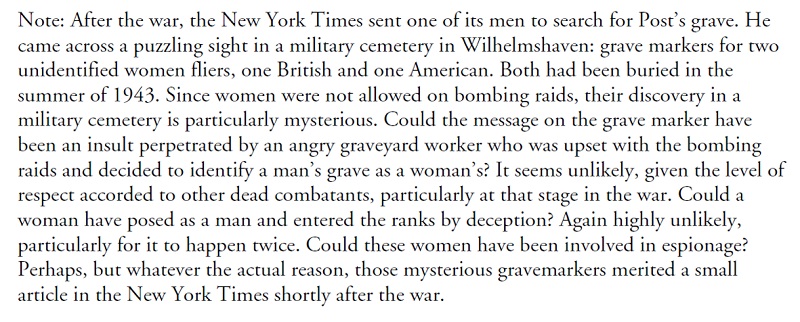
In the decades since, the search has continued for additional clues to this mystery, albeit with not much success. One noteworthy fact has emerged: the American flier was identified as an American because of her flight uniform.
Speculation is about all that is left at this point, but there appear to be four likely scenarios:
- They were spies: Possible, but if this is true, wearing flight uniforms would be an odd choice. Also, though there are lots of accounts of spies trying to enter occupied territory, not nearly as much has been written about spies trying to enter Germany.
- They were transport pilots: If true, these aviators would have had to have been hundreds of miles off course to have gone down off the German coast near Wilhelmshaven. In addition, the U.S. transport unit, Women Airforce Service Pilots (WASP) only served in the continental United States. There were no WASP casualties in Europe. It remains possible that they were involved in another Allied transport service, but it seems unlikely that they would be operating so close to enemy territory.
- They were members of Allied aircrews: This seems extremely unlikely as no women were allowed in these roles at the time. To have done this, they would have needed to avoid discovery of their gender, which seems highly unlikely (and even more unlikely for it to have happened twice in a short period of time).
- They weren't women: It is possible that they were actually men, but were called women in the cemetery logbook as an insult. Given that most dead Allied combatants were treated very honorably in Germany, this also appears unlikely.
One other clue that may ultimately lead to a solution to the mystery is through the U.S. Graves Registration Company that discovered Post's body in Bad Zwischenahn. Their records are available at the National Archives, but they are not digitized and are currently unaccessible due to the pandemic.
Where Were the Members of the Writing 69th on D-Day?
June 2019:
As the world commemorates its 75th anniversary, here's what the members of the Writing 69th were doing on D-Day:
- Homer Bigart was in Italy in May of 1944 when Cassino fell to the British. He did not participate in coverage of D-Day and left for the Pacific in the fall of 1944.
- Walter Cronkite flew on a mission with a 303rd Bomb Group B-17 bomber on D-Day.
- Gladwin Hill flew over the Normandy beachhead in a B-26 on D-Day.
- Paul Manning was aboard the LST-325 when it made a trip to the Utah beachhead on June 15th.
- Andy Rooney landed on Utah Beach several days after the first assault wave.
- Denton Scott was in Cairo writing for the military magazine Yank.
- William Wade flew on a B-26 mission on D-Day.
- Robert Post of the New York Times had died on February 26, 1943 and was buried in a churchyard in Bad Zwischenahn. His body would eventually be recovered by the Grave Registration unit and reburied in the Ardennes Military Cemetery in Neupre, Belgium.
About D-Day, Andy Rooney wrote (in his book My War): "There have only been a handful of days since the beginning of time on which the direction the world was taking has been changed for the better in one twenty-four hour period by an act of man. June 6, 1944 was one of them."
William Wade May Have Flown with the 306th Bomb Group
December 2017:
One of the unanswered questions surrounding the Writing 69th is: Which bomb group did William Wade fly with? The aircraft he was assigned to aborted and returned to base. When contacted many years ago Wade did not recall which bomb group it was. So far we have not been able to find his name on any crew lists for February 26, 1943. Yet our efforts to solve this mystery have likely narrowed the possible groups to the 305th and the 306th. The latest evidence indicates that it was likely the 306th (though final confirmation is still lacking). See below for an update.
Capt. Howard Adams' Diary
May 2016:
A family member posted the text of Capt. Howard Adams' diary on a legacy page. Adams died on February 26, 1943 when his B-24 was shot down over Germany. He was the pilot of the 44th Bomb Group aircraft carrying New York Times correspondent Robert Post. The diary is notable for covering Adams' flight across the Atlantic and the tragic early days of the 44th Bomb Group.
Update (August 2024): The link to the legacy page is no longer active so we have posted a PDF of Capt. Howard Adams' diary here.
The Childhood Home of Robert Post
January 2016:
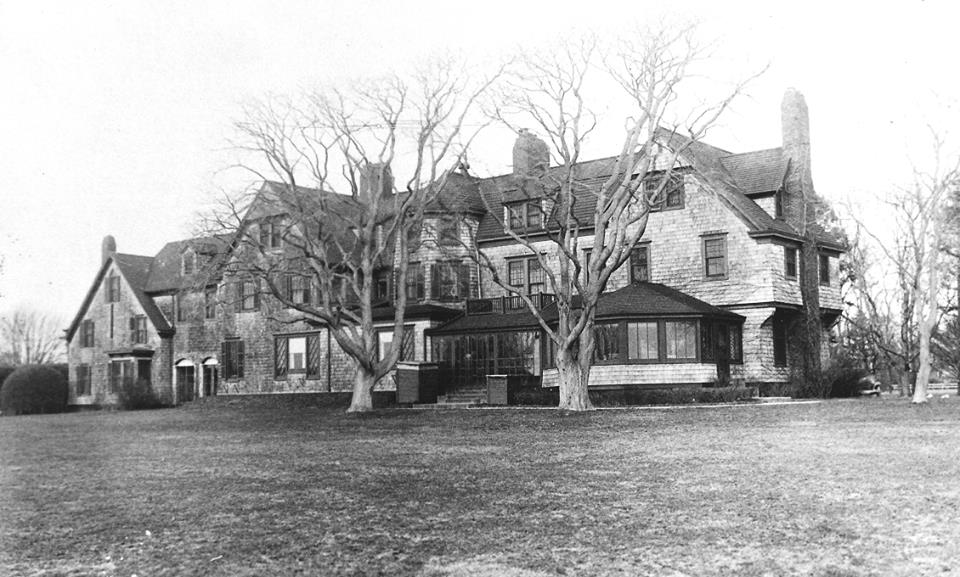
This photo from the Bayport Heritage Association appears in the book "Long Island Historic Houses of the South Shore" by Christopher M.
Collora (Arcadia Publishing, 2013). It is Strandhome, where Robert Post lived in his youth. Built in 1887 by William Foster from a design by Isaac Green, it was acquired in 1890 by Charles Post (Bob Post's grandfather).
Post was born in Bayport in 1910 and it seems likely that he was born in this mansion. Strandhome no longer exists. The Post family sold the property in 1953 and the house was demolished and the property subdivided. Strandhome was not too far from St. Ann's Church in Sayville. The cemetery there contains the graves of many Post family members as well as Bob Post's memorial marker (he is buried in Belgium in the Ardennes Military Cemetery at Neupre). (See more on the Post family plot below.)
Kind Words from John MacVane about Robert Post
September 2015:
John MacVane, a reporter for the NBC radio network, wrote a book about his experiences in London during the war (On the Air in World War II, William Morrow, 1979). On page 58 he writes that he, Ed Beattie of the United Press, and Robert Post were summoned to the British Air Ministries on May 7, 1941 with the opportunity to accompany a bombing mission ("preferably against Berlin" was how MacVane put it). Nothing came of that opportunity, but later, on page 63, MacVane makes this comment about Post: "If he lived, he would, I believe, have become one of the bright stars on the New York Times."
A Visit to the Post Family Plot
July 2015:
A business trip took me to Long Island recently so I stopped at St. Ann's cemetery in Sayville, New York to have a look at the memorial marker for Robert Post. The marker is adjacent to the main roadway that runs through the center of the cemetery. If you enter from the gate by the church, it will be on the left hand side about 40 yards after the road curves to the left. The marker sits among stones for other family members, including Post's mother and father.
I noticed a change this time. Someone had attached a small shiny circular silver emblem to the stone. The emblem has a large V on it, as well as an American flag. The word 'American' is at the top and the words "Let us not forget those who served" surrounds the V. It's the kind of emblem that is placed on veterans' graves so that the caretakers know to put a flag there. The irony, though, is that Post wasn't a veteran, even though he died on a military mission.
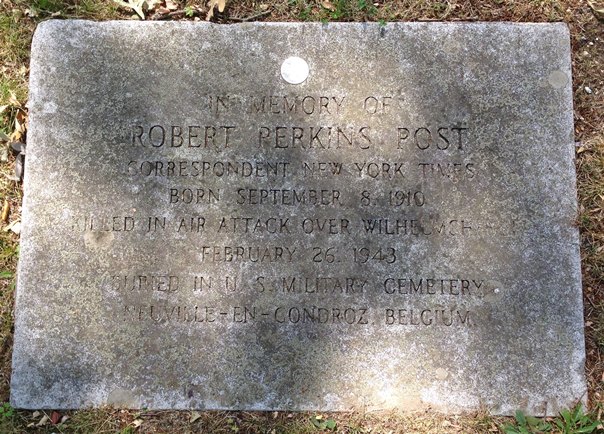 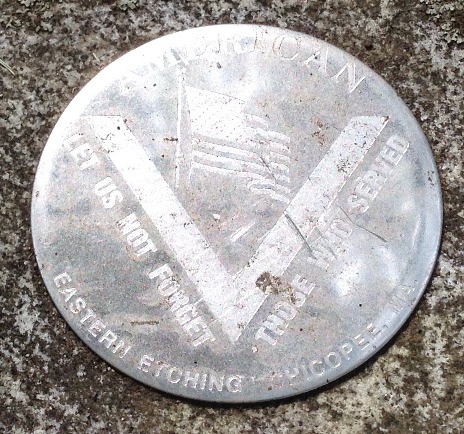
It seems right to have him honored in this fashion, even though he wasn't in the military. He saw his war reporting as a substitute for military service. He had been told that he was more valuable to the country reporting on the war than serving in the military. And he certainly risked his life by going on this mission. So even though he wasn't a veteran, I think he deserves a flag.
Bob Post's Premonition
May 2015:
Another source for Bob Post's premonition has surfaced. In Jean Nicol's Meet Me at the Savoy she writes:
One afternoon, Bob wandered into the office while I was wrestling with my expense account.
"I am doing my 'swindle sheet'," I said, without lifting my head from the welter of bills on my desk. Expense accounts were a subject Bob and I discussed with a great deal of ribaldry and, when he did not reply, I looked up in surprise.
"Are you depressed, Bob?" I asked.
"Well, no, not exactly," he said slowly. "But you know how all the boys are raring to go on a bombing raid over Germany? Well, they picked another lot to-day and I'm one of them. It isn't that I don't want to go," he paused and looked out of the window, "but you see, Jean, I know that I am not coming back."
The Savoy Hotel
April 2015:
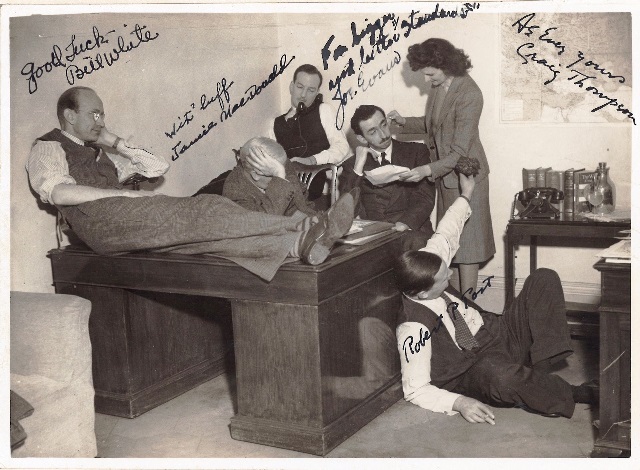
Robert Post, along with many other journalists, lived at the Savoy Hotel in London during World War II. Recently, the archivist at the Savoy sent this amusing signed photograph showing the publicity manager of the Savoy, Jean Nicol (later Jean Tangye) with four admiring journalists:
- Bill White, Reader's Digest
- Jamie MacDonald (Bob Post's colleague at the New York Times)
- Joe Evans of the Herald Tribune
- Craig Thompson (also of the New York Times)
- Bob Post (with cigarette in hand, appears to be handing her a carnation)
It turns out that Post came up with the idea to create a Savoy Hotel newspaper called the Savoy Standard, which Nicol edited. Nicol also wrote a book about those times entitled Meet Me at the Savoy.
Tomas Hauschild Update
October 2014:
A December 2013 article in the German-language publication NWZ Online describes Tomas Hauschild's long recovery from the injuries he suffered in June of 2010. We are pleased to report that he is much improved and able to return to work in a support role with his old unit.
Memorial Day Writing 69th Presentation
April 2014:
Plans are in place for a Writing 69th presentation in Duxbury, Massachusetts at the Village at Duxbury (290 Kingstown Way) on Monday May 26th (Memorial Day) at 2 pm. Jim Hamilton will speak about his book, The Writing 69th, which tells the true story of a group of World War II journalists (including Walter Cronkite and Andy Rooney) who accompanied an 8th Air Force bombing mission to Germany.
WWII Bomb Blast in Germany Kills a Construction Worker
January 2014:
A construction worker in Euskirchen, Germany lost his life on January 3rd when he encountered a World War II bomb unexpectedly while operating an excavator. Many others were hurt, including two with critical injuries. This is another sad example of the ongoing consequences of the air war. You will remember that a good friend of the Writing 69th home page, Tomas Hauschild, was injured in a June 2010 blast that killed three of his bomb disposal squad co-workers.
Here are links to the BBC and CNN stories on the accident. The BBC article notes that such deaths are rare, but there have been at least four deaths in Germany (including the 2010 incident involving Tomas) and that seems like quite a lot to me, particularly when the cause is bombs dropped nearly seventy years ago.
Update (April 2014): Another deadly World War II bomb blast, but this time it's in Bangkok.
Photos and Grave Locations of 'Maisie' Crew Members
December 2013:
A new addition to the Writing 69th home page includes photos and grave locations of the members of the 44th Bomb Group, 66th Squadron crew of B-24 #41-23777 (nicknamed 'Maisie' by Capt. Howard Adams, its pilot). This was the aircraft that Robert Post was on when it was shot down over Germany on February 26, 1943.
The William Wade Mystery: Which Bomb Group Did He Fly With?
October 2013:
Of the six Writing 69th members who participated in the February 26, 1943 raid, one was on an aircraft that turned back early on in the mission. William Wade wrote that he was with a B-17 group but it is not known which one. There were only four B-17 groups in England at the time: the 91st, the 301st, the 303rd, and the 306th. It had to be one of those. Cronkite flew with the 303rd, as did Homer Bigart. Gladwin Hill was with the 305th and Andy Rooney was with the 306th. Hollywood film director William Wyler, who trained at the same time as the Writing 69th, was assigned to the 91st. Assuming that at least one journalist had been assigned to each B-17 group, it seemed a likely possibility that Wade had been with the 91st Bomb Group. Mission records on the 91st Bomb Group web site indicated that at least two aircraft aborted. Could Wade's have been one of them? It was certainly worth asking. The 91st Bomb Group historian, however, checked the records and could find no mention of a William Wade on the crew lists for the February 26, 1943 mission. This eliminates the 91st as a possibility and points to the 303rd, 305th, and 306th. Of these, the 303rd is probably the least likely since it is known that two journalists definitely flew with them. Based on what is known now, the 305th and 306th only had one.
Update: By process of elimination it appears that the 305th was the group that William Wade flew with. The 91st, the 303rd, and the 306th have all been counted out. Wade's name does not appear on any of their crew lists. Still though, it would be ideal to have confirmation from the 305th, and we are in the process of trying to find someone who has access to their crew lists.
Update (December 2017): Still no luck finding the crew lists for the 305th, but new information indicates that William Wade may have flown with the 306th. In a dispatch called 'St. Nazaire Trip Provides Thrills' (published in multiple newspapers on February 17, 1943) Wade writes about being at an air base after a raid. He speaks with Sgt. E.E. Smith, Sgt. Robert Liscavich, and Lt. Eugene J. Pullock. He also mentions an aircraft named 'Big Operator' (which turns out to be #42-3406 based on 306th Bomb Group records). All of this points toward the fact that Wade was at the 306th's base and therefore greatly increases the likelihood he Wade flew with the 306th Bomb Group. Records on the 306th Bomb Group's web site indicate that three aircraft aborted on February 26, 1943. These were piloted by Lt. Walter N. Smiley, Lt. William E. Friend, and Capt. Earl C. Tunnell. It would seem likely that Wade was on one of these aircraft. We're working on confirming this.
A Live Hero
October 2013:
The following entry appeared in Editor & Publisher in 1943 not long after Robert Post was lost on the Wilhelmshaven mission. It was titled 'A Live Hero.'
We got a real kick out of Ernie Pyle's dispatch Wednesday from the Central Tunisian Front telling how he turned down a bid to go on a bombing mission. Scripps-Howard's grey-haired roving reporter, now a war correspondent, showed as much courage in declining to risk his neck unnecessarily, to our mind, as dozens of reporters did when they went on such missions.
Pyle said it was a tough decision to make, and we heartily agree. "I knew the day of that invitation would come," he wrote, "and I dreaded it. Not to go brands you as a coward. To go might make you a slight hero or a dead duck."
There's real wisdom in Pyle's statement that he didn't see any sense in going after numerous other correspondents had extracted the heroics from bombing missions. "I'd be in the way," he reasoned, "and if I got killed my death would have contributed nothing."
That Pyle's decision was the right one was confirmed by the fliers who invited him. "Anyone who goes, when he doesn't have to, is a plain fool," one of them told Pyle.
"My sole purpose in going would be to perpetuate my vanity," Pyle rationalized. "And I've decided to hell with vanity."
Pyle has set a precedent which we hope his fellow correspondents will follow. The press casualty list is too high now.
In its editorials around the time, Editor & Publisher waffled between praising the bravery of those who trained to go on such missions, and questioning the necessity of sending so many reporters on a single mission. Could they have sent the members of the Writing 69th off on a series of missions sequentially? Possibly, though all would have wanted to be on the first one. Ironically in Pyle's case his decision to avoid the Tunisian bombing mission did not keep him safe, since as we all know he was killed by a sniper's bullet in the Pacific towards the end of the war.
Note: My thanks go out to the reference librarian at the Ventress library in Marshfield who pointed me to the Boston Public Library's collection of Editor & Publisher. Also, thanks to Timothy Gay and his book, which included the Cronkite letter mentioning that a brief Writing 69th account was published in the pages of Editor & Publisher.
Detailed Writing 69th Accounts Published in Two Recent Books
October 2013: Two books published within the last year and a half provide fascinating accounts of the Writing 69th training and mission:
- Assignment to Hell by Timothy Gay - This book chronicles five World War II correspondents (Walter Cronkite, Andy Rooney, A.J. Liebling, Homer Bigart, and Hal Boyle), three of whom, as readers of this page will know, were in the Writing 69th. The book includes a lot of interesting details, including a photo of a 1960s reunion of the group.
- Cronkite's War by Walter Cronkite IV and Maurice Isserman - Based on Walter Cronkite's World War II letters home to his wife Betsy, the cover has the shot of Cronkite in front of the B-26 USO. The chapter on the Writing 69th is of some interest, though due to the fact that Timothy Gay was given access to Cronkite's letters, most of the new and interesting nuggets of information are covered in in Gay's Assignment to Hell. (Note: Walter Cronkite IV is Cronkite's grandson.)
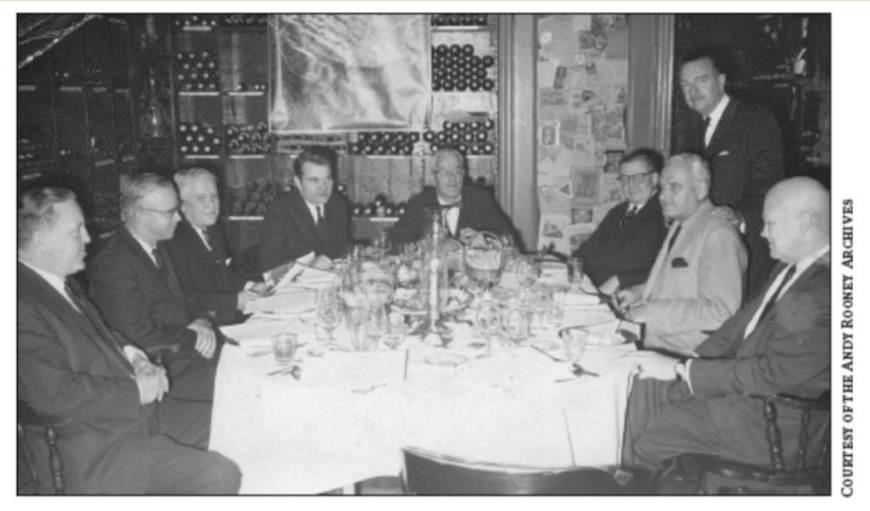
From left to right: Not identified, Paul Manning, Hal Leyshon, Andy Rooney, Gladwin Hill, Homer Bigart, Walter Cronkite (standing), Jack Milady, Jack Redding
The photo caption in Assignment to Hell reads: "A mid-1960s reunion of the fabled 'Writing 69th.' Former USAAF media relations maven Hal Leyshon sits to Rooney's right; to Leyshon's right is former CBS correspondent Paul Manning. At the head of the table is former Associated Press correspondent Gladwin Hill, archrival of Cronkite (standing). Bigart sits to Hill's left. Two other former USAAF officials, Jack Milady and Jack Redding, sit in front of Cronkite." Two of the surviving Writing 69th members are missing: William Wade and Denton Scott.
Cronkite Photo Update
June 2013: William (Rick) Bragg, Chief Master Sergeant, USAF-Retired, has provided some additional information on the Walter Cronkite B-26 photo. He writes: "TSgt Ceibert Clyde 'CB' Bragg was the Flight Engineer/Top Turret gunner on the B-26, and he is my father (deceased). He never went by his first name, [he used] either the initials 'CB' or his middle name, Clyde. The B-26 crew in the photo did fly Walter Cronkite on the 'U.S.O.' that day, but that was not their primary aircraft; instead, their B-26 was the 'Honest Injun'. The 'Honest Injun' was out-of-service for repairs the day of the Cronkite flight, so they relieved the crew of the 'USO' for the mission. Dad never spoke about his combat experiences until the mid-1990's. It was then that I learned of Dad flying with Walter Cronkite. It was one of his 'claims to fame' and he spoke fondly of that particular mission. That picture sits on the shelf of my living room as part of the legacy of my father and his crew.
"As an aside, according to Dad, the 'Honest Injun' was a double entendre on the fact that the pilot, Captain Nye, was Native American and the engines of the aircraft were trustworthy. They were sure to get to where they were going and to return because of the 'Honest Injun'. Dad flew 63 combat missions on the 'Honest Injun'. (See this link for more on Honest Injun (41-34695 RJ-B Honest Injun B-26C-6-MO) and other 454th Bomb Squadron B-26 Maraunders.) It was my father's legacy that inspired me to spend 26 years in the United States Air Force. While I may have out ranked Master Sergeant 'CB' Bragg eventually, I never rose to the level of service or greatness that he and his crew gave the United States of America."
Our thanks to Rick for his heartfelt comments, and also for his and his Dad's service to our country.
Can Anyone Identify this World War II Correspondent?
June 2013: Russ Askey, the son of a 95th Bomb Group navigator, sent us the photo below and says that it was taken at Station 119, Horham (U.K.), home of the 95th Bomb Group. The photo was probably taken in the summer of 1944. This photo also appears on the website of the 95th Bomb Group Memorials Foundation, 95thbg.org. Based on the uniform, the gentleman is a U.S. war correspondent, but who is he? If you can provide the answer, please send us a note.
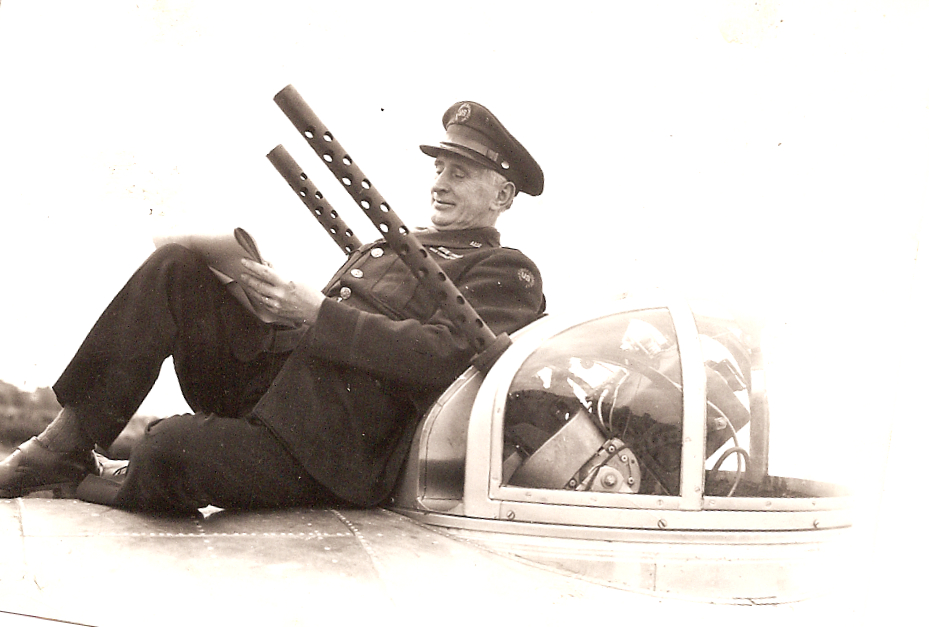
From other photos taken at the same time it is clear that the aircraft was parked on a pad used by the 95th Bomb Group's 336th Bomb Squadron not very far from St. Mary's church in Horham.
Experts Cast Doubt on Crash Site Photos
March 2013: A number of World War II aviation experts including Roger Fenton and Stephen Adams are convinced that the crash site photos shown below are the wreckage of a B-17, not a B-24. In one of the photos, the resemblance to a B-17 tail (rather than being a B-24 cockpit, as I had suggested) is supported by pictures of other B-17 tails. The wings also appear to be from a B-17, based on the placement of the aileron. Puzzling though, is Herr Behren's assertion that he could identify one of his farm buildings in the background. Yet no one I have shown these images to is of the opinion that they are a B-24. Remaining unknown are where the photos came from and which downed aircraft they actually represent. Tomas Hauschild, who discovered the photos, told me that one of Klaus Behren's neighbors had the photos in an album. I am reaching out to Tomas to identify that person and learn where they got the photos. Thanks to the members of the 44th Bomb Group Facebook page for their help in this matter!
It Was 70 Years Ago
February 2013: As the 70th anniversary of Robert Post's death approaches, it's worth reiterating why this story is of such interest. The mesh of connections is one big reason. Post was a member of the Writing 69th, a short-lived title for a group of war correspondents covering the 8th Air Force in England during World War II. Trained to fly as observers on bombing missions, the death of one of them (Bob Post of the New York Times), signaled the end of the use of the name 'Writing 69th.' The members of the Writing 69th included some of the best-known names in journalism: Homer Bigart, Walter Cronkite, and Andy Rooney among others. Another fascinating coincidence was that the 44th Bomb Group B-24 that Post was in was shot down by a Luftwaffe ace named Heinz Knoke, who wrote about it in his book I Flew for the Fuehrer. Very recently, photos of the wrecked B-24 have surfaced (see more on this below). The full story is told in the book, The Writing 69th, which is available through Green Harbor Publications.
Is Percy Knauth in this Picture?
August 2012: One of the open questions on the Writing 69th Unanswered Questions page is "Who are the people in this picture?" The photo (see below left) was taken in London in the late 1930s or early 1940s. Four of the eight people have been identified. James McDonald is the third from the left, Raymond Daniel is in the center facing McDonald, Robert Post is third from the right, and David Anderson is on the far right. All of them worked for the New York Times. After reading Howard K. Smith's book 'Last Train from Berlin' (1942) and seeing Percy Knauth mentioned as someone who worked for the New York Times during that period, I'm beginning to wonder if he might be the person on the far left. A picture of Knauth (see below right) bears some resemblance, but is by no means conclusive. Can anyone help confirm this (or help identify anyone else in this picture)? If so, please write.
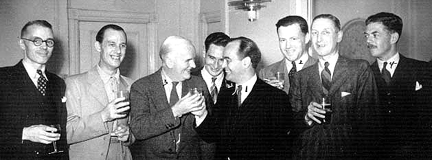 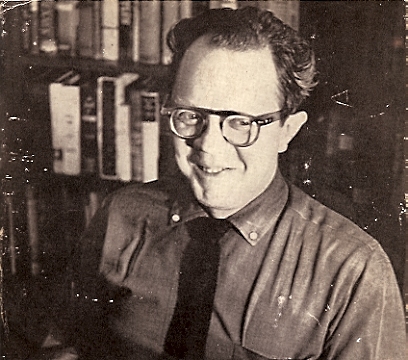
Update (September 2012): By a remarkable coincidence, a good high school buddy of mine (Wilton High School, class of 1974) turns out to be Percy Knauth's nephew. He has looked at the picture and concluded that it could not be his uncle. Thank you Stephen! Though I'm sorry to hear that the identity of that person in the photograph remains unknown, at least it has been resolved that it's not Percy Knauth.
Some Last Comments about Douglas Brinkley's Cronkite Biography
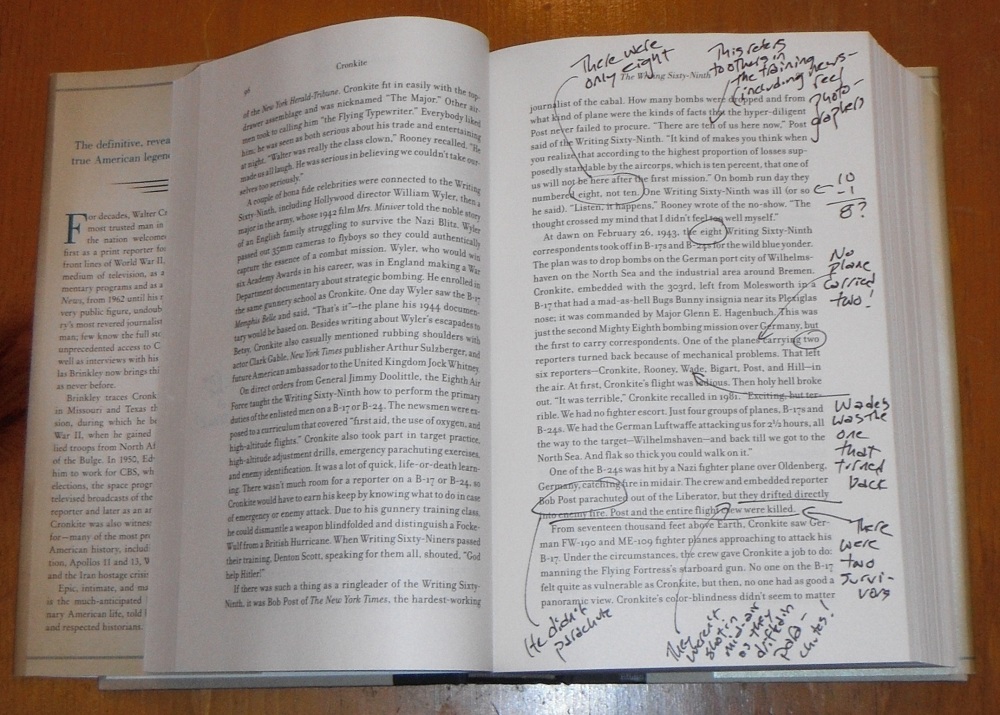
August 2012: Here is what I have written on the opening page of my copy of Douglas Brinkley's Cronkite: "A warning: Should you choose to read this book (and I hope you won't), know that it is seriously flawed - the Writing 69th chapter alone includes numerous errors and one stunning fabrication." If you have a copy of Brinkley's book, I encourage you to mark it up in the same way.
For purpose of clarity I am providing an annotated version of the offending page. (Note to anyone from Harper Collins: I think that reproducing one spread as criticism counts as fair use. If you disagree, please feel free to contact me. I'd love to hear from you.)
I will end my complaining with one last comment: My e-mail and letter to Professor Brinkley went unanswered. To say that I feel ignored is an understatement. Add to that the mysterious disappearance from the Boston Globe web site of my posted comment about James Rosen's review, then it starts to feel more like a conspiracy. (My e-mail to the Boston Globe about this also went unanswered.) James Rosen, on the other hand, responded very quickly, though there is little that he can do at this point.
Cronkite, Honest Injun, and U.S.O.
August 2012: The grandson of C.B. Bragg, a flight engineer on the B-26 crew that Cronkite flew a mission with, recently contacted The Writing 69th home page about a bit of a mystery regarding Walter Cronkite's flight on a 323rd Bomb Group B-26. The grandson, Robert E. Southard IV, noted that Cronkite and the crew were photographed in front of a B-26 with the name 'U.S.O.' on its nose (see below), but he says that wasn't his grandfather's aircraft. Southard says the crew always flew 'Honest Injun' (a point Southard's grandfather noted with pride). Why was the picture taken in front of 'U.S.O'? Southard is not sure, but wonders whether it could have been a subtle way of promoting the U.S.O. Then again, it is possible that the crew was assigned a different plane for just this mission. By the way, Southard notes that Honest Injun's serial number was 41-34695. Follow this link to the 'Honest Injun' photo.
James Rosen's Review of Douglas Brinkley's Biography of Walter Cronkite
July 2012: In the June 30th Sunday Boston Globe Ideas section, James Rosen, chief Washington correspondent for Fox News, wrote
a relatively positive review of Douglas Brinkley's recent biography of Walter Cronkite. Below is the comment I posted in response to his review.
The "definitive biography of Walter Cronkite" sounds like high praise but maybe not since there is only one other Cronkite biography that I know of ('Walter Cronkite His Life and Times' by Doug James, 1991). My concern with Brinkley's book is that in the chapter on the Writing 69th (the group of war correspondents who trained and then flew on an 8th Air Force bombing mission over Germany) Brinkley gets the facts entirely wrong concerning the death of New York Times correspondent Robert Post and the crew of the B-24 he accompanied. In doing so he seems to have followed Doug James' lead while ignoring other well documented sources, including a first-person account of one of the surviving crewmembers (Brinkley states incorrectly that everyone on the aircraft died). On top of all that, he even gets the number of Writing 69th members wrong, and in trying to justify the mix-up he actually makes up a non-existent bomber carrying two Writing 69th journalists. He may be an "acclaimed" author who "bravely scaled the Evidentiary Mountain" but in my opinion his research is shoddy and the result is deceptive. I can only speak to the inaccuracy of Brinkley's chapter on the Writing 69th, but to me this casts significant doubt upon the entire book.
P.S. If you are looking for my comment on the Boston Globe web page you won't find it. It showed up when I first added it, but for whatever reason it is no longer there.
Continued Disappointment about Brinkley's Cronkite Biography
June 2012: I continue to be amazed and disappointed by the errors in the Writing 69th chapter in Douglas Brinkley's biography of Walter Cronkite. On one unfortunate page (pg. 97) Brinkley manages to get a slew of facts wrong including:
- The number of journalists in the Writing 69th
- The number who actually participated in the mission
- The nature of Bob Post's death
- The number of crewmembers who parachuted from Post's B-24
- The number of survivors from Post's B-24
- The bombing mission's primary target
On top of all that he makes up a story about an aircraft that turned back with two journalists aboard. Where did that come from? It surprises me that a fact checker never questioned Brinkley's math or any of these other points.
Brinkley says that there were ten people in the Writing 69th. Not true, there were eight, though I can see how he got confused (not that it's an excuse) but Bob Post did make a reference to ten, yet he was including others who took part in the Writing 69th training. These were newsreel cameramen and filmmakers, not war correspondents, and they weren't part of the Writing 69th.
Brinkley goes on to say that one Writing 69th member was sick, two turned back, and six participated. That adds up to nine, not ten, but either way he's wrong. In fact, of the eight members only five completed the mission. As readers of The Writing 69th should know, William Wade's aircraft turned back due to mechanical difficulties and two others missed the mission for illness or other reasons. That leaves five of the original eight.
Given how extensively The Writing 69th is referenced in Brinkley's book, it's clear that he or his researchers read it, but apparently they either forgot or overlooked key facts. What is particularly disappointing is that I would have been delighted to have reviewed this chapter prior to publication. If I had done so, these errors could have been avoided.
Getting the Facts Wrong in the New Cronkite Biography
June 2012: You may have heard about the new Cronkite biography by Douglas Brinkley. I certainly was curious, and of course I immediately looked to see what he had to say about the Writing 69th. It turns out there is an entire chapter on the topic. I'll come back to this subject in greater detail at a later date, but what stunned me was that Brinkley writes that Post and the crew parachuted out of their stricken B-24 and all of them were killed in mid-air by gun fire. This is wrong on so many levels that it's hard for me to understand how the author could have botched it so badly. First off, the entire crew wasn't killed. There were two survivors. The post-war accounts acknowledge this fact. And no first-hand witness source that I have found makes any mention of parachuting survivors being shot in mid-air.
Elsewhere in the chapter, Brinkley quotes The Writing 69th as a source, yet if he'd actually read it he'd know that Wayne Gotke and Jim Mifflin survived. In addition, Wayne Gotke's account makes no mention of any other crewmembers besides Mifflin parachuting. Witness accounts on the ground also support the fact that only two parachutes were seen. Heinz Knoke, who shot down the B-24, wrote that he saw one other crewmember exit the plane, but with a burning parachute. Leni and Gerd Eilers tell of crewmembers broken bodies on the ground with unopened parachutes. Given that the plane exploded in mid-air there is no reason to believe that anyone had a reasonable chance to jump. Wayne Gotke writes that he was blown out of the aircraft when it exploded.
Brinkley cites a 1943 Strategic Bomber Command report as the source for the 'everybody parachuted' story. I have not seen this report but I will find it. Yet it puzzles me why Brinkley would take on face value a report made in 1943 before all the facts were known. At most, three parachutes came from the B-24 Post was on. Another B-24 went down around the same time, and did have more parachute jumpers, but even in that case the entire crew did not survive. (Note: One of those killed in that B-24, Rexford Lippert, is buried in the Ardennes military cemetery not far from Robert Post.) The only other place I have seen anything resembling the story that Brinkley relates is in a Cronkite biography by Douglas James called Walter Cronkite: His Life and Times. James did not provide a source for his outlandish claim that Post was gunned down in mid-air. Maybe he had seen the same misleading report that Brinkley references.
The nature of Bob Post's death is a small detail in Brinkley's Cronkite biography but it's a very important one in the story of the Writing 69th. I was really looking forward to this new Cronkite biography, but this lack of attention to some important facts related to the Writing 69th makes me question the veracity of anything in the book.
A Visit to the Ardennes Military Cemetery
May 2012: I traveled to Neupre (formerly Neuville-en-Condroz), Belgium this week to see the final resting places of Robert Post and some of the crew of Captain Adams' B-24. They are interred at the the Ardennes Military Cemetery. If you should visit, they are in plot B, row 33, graves 5 through 10 as follows:
Capt. Howard Adams (B-33-5)
S/Sgt. Donald Bowie (B-33-6)
S/Sgt. Scott Brewer (B-33-7)
2nd Lt. William Hannan (B-33-8)
Robert Post (B-33-9)
2nd. Lt. Stanley McLeod (B-33-10)
Rexford Lippert, another 44th Bomb Group member who died on February 26, 1943, is also here (B-17-15). A large percentage of those buried here are airmen, many from the 8th Air Force.
I met with Alan Amelinckx (the superintendent), Jeffrey Hays (the assistant superintendent), and Vincent Joris (cemetery associate). They were very helpful and though I am not related to Post or the others, they treated me as if I were a next of kin visiting a fallen loved one. Alan walked with me to the grave site, rubbed sand in the engraved letters so that they would photograph better, and played Taps on the carillon that is part of the memorial. It was a very moving experience.
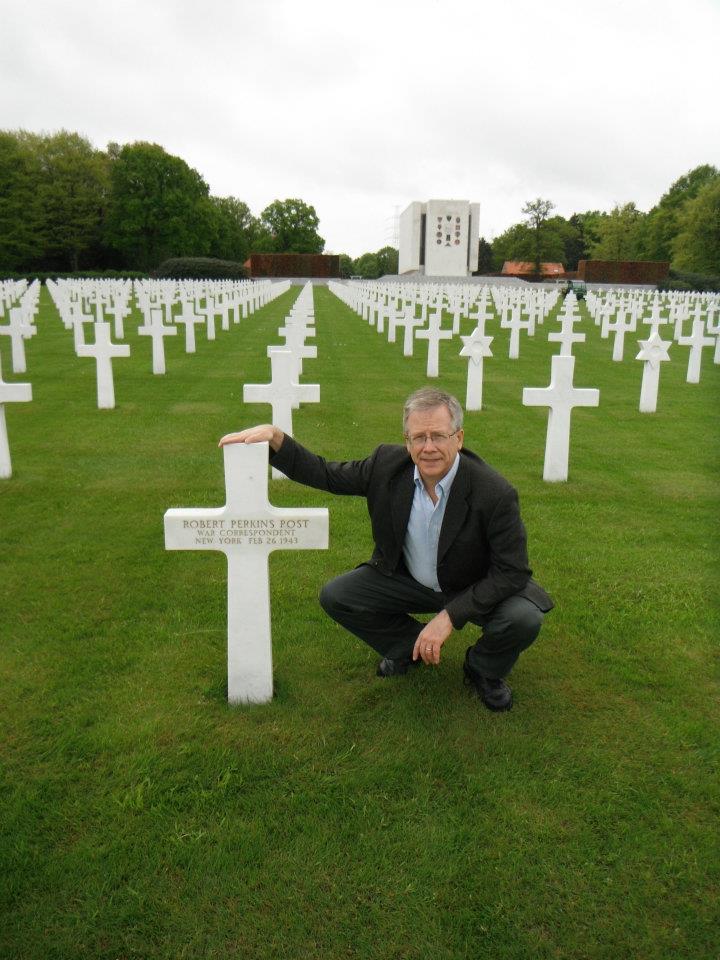
If you have the chance to go to Belgium I highly recommend a visit to this cemetery. See www.abmc.gov for additional information.
Andy Rooney Also Flew with the 385th Bomb Group
March 2012: An article in the March 2012 edition of the 8th AF News corrects a mistatement in the December 2011 issue. They clarify that Andy Rooney flew with the 385th on October 8, 1943 in a B-17 called "The Fighting Cock" (serial number 42-3397). The previous confusion was whether Rooney had flown that day on the B-17 "Lady Liz" (serial number 42-5902). In fact, it was another Stars and Stripes writer, Bud Hutton, who flew on "Lady Liz." Hutton co-authored the book "Air Gunner" with Rooney. "The Fighting Cock" was lost on December 5, 1943. For those following this 395th Bomb Group, 551st Bomb Squadron aircraft, the missing air crew report (MACR) is #2164.
Andy Rooney's Stars and Stripes Articles on the February 26, 1943 Wilhelmshaven Mission
November 2011: Recently I saw an Internet posting by the niece of Bill Casey, the pilot of the 306th Bomb Group B-17 that Andy Rooney accompanied to Wilhelmshaven on February 26, 1943. She was looking for information on her uncle and I had microfilm printouts of Rooney's Stars and Stripes articles about the mission so I scanned them for her. I am sure that others would be interesting in seeing those articles too so I am posting a PDF of them here.
Andy Rooney, the Last of the Writing 69th, Dies at 92
November 2011: Andy Rooney died on Friday, November 4, 2011, a few weeks after complications following surgery. His death came a month after he gave his last Sixty Minutes commentary for CBS. Here's a quote from the article he wrote for Stars and Stripes after the Writing 69th's only mission:
Peeling out of the sun came shining silver German fighter planes, diving at one bomber in the formation and disappearing below the cloudbanks as quickly as they had come. They seemed tiny, hardly a machine of destruction, and an impossible target...From that time until three and one-half hours later, when we were half way home, no one had to look far to see a German fighter.
I will always be grateful to Andy Rooney for the marvelous letter he sent in reply to my inquiry about Bob Post and the Writing 69th. Another fond memory: He gave me the greatest compliment that a proofreader can hope for, that is, 'a good catch' for spotting an obscure error in the first edition of his book, My War. He was also the one who put me in contact with Paul Manning, another Writing 69th member, who I might never have met otherwise. Thank you, Andy!
More Thoughts on the Crash Site Photos
October 2011: The photos that we believe to be crash site images of the B-24 that Robert Post was in (see below) have been examined by researchers at the U.S. Air Force Museum in Dayton, Ohio and they cannot confirm that the aircraft in the pictures is a B-24. They believe that the images of the wings are from a B-24 yet they strongly suspect that the photo of wreckage that looks like a B-17 tail is in fact a B-17 tail. Still, they admit that they cannot conclusively state that it is a B-17 tail. Though this is not the conclusion we were hoping for, we thank the researchers for taking the time to review the images.
As you look at the last photo, consider these points:
- On the left you can see what appears to be the trailing edge of an elevator with the fabric burnt or torn off. This would tend to support the theory that this is the trailing edge of a B-17's left stabilizer. Or could it be an aileron from the right wing of a B-24 twisted back on itself?
- The vertical stabilizer (if it is that) would seem to have lost the rudder. Where would the rudder attach? Are any of those marks visible? If this is in fact the left wing of a B-24, the metal ends abruptly right about where the left inboard engine would be.
- A description written by the German pilot who shot the aircraft down suggests that the aircraft blew apart in mid-air and that the pilot's seat was found a distance away from the rest of the wreckage (see Heinz Knoke's account). Therefore could we be looking at just the remaining right half of the cockpit windows? If so, why doesn't this aircraft have the long horizontal right hand window like other B-24D's we've seen?
- Where did the top turret go? Would it fit where there is a slight curve in the metal above the cockpit?
- What is sitting on the wreckage at the bottom center of the photo? Is that identifiable wreckage? Could it be another aileron or elevator?
- The trees in the background of this image are very similar to those in the background of the other two photos. The lighting also suggests that these three images were taken at the same time. Is there anything in any of these photos that confirms that this wreckage is a B-24 (or for that matter, a B-17)? Are the oxygen tanks in the wing photos identifiable as B-17 or B-24 tanks? (Note: The researchers at the Air Force museum believe that both aircraft would use the same type...)
If you have any ideas about how to identify the aircraft in these photos, please send an e-mail to jim@greenharbor.com.
Update: It has become clear that these images are of a B-17, though it is not known which one.
Andy Rooney's Last Regularly Scheduled '60 Minutes' Commentary
October 2011: Sunday October 2nd was Andy Rooney's last scheduled '60 Minutes' commentary. CBS did a retrospective on Rooney and then he did his commentary. Some interesting points:
- Rooney said that he doesn't sign autographs and rarely responds to reader letters. It was basically out of character then that the responded to my letter about Robert Post and the Writing 69th (even more surprising, he called me). This was likely a matter of good timing, since my letter arrived as he was working on his memoir, "My War." It was more in character that he ingored my more recent letter about the training photographs (see below).
- CBS showed a photo of Rooney with three or four airmen in front of a bomber called 'Mission Belle'. This aircraft appears to be a 385th Bomb Group B-17 and the picture was likely taken later in the war, though prior to April 1944 when this aircraft flew its final mission.
- The CBS release about his retirement (though they didn't call it that) said that Rooney was on the first American bombing mission over German soil. I don't think that's true, though it is frequently repeated. I believe that the first American bombing mission over Germany was a January 1943 mission to Wilhelmshaven. The celebrated mission that he definitely was on was to Wilhelmshaven on February 26, 1943. I'd be very surprised if he was on both of those missions. I think it's just a mix-up. Whenever Rooney wrote about his Wilhelmshaven trip it was always the February 26th one.
Jack Nye and Honest Injun
July 2011: The photo below of the B-26 "Honest Injun" was sent to us by Allen Berry (Jack Nye's nephew). Nye piloted the B-26 that Walter Cronkite accompanied on February 1944 mission. See more on this below. Nye is in the back on the right. Arthur Brand (front left) and Ceibert Bragg (front center) are easily identifiable from the photo shown below. Less easy to identify are the other two in the photo. Most likely they are: Norman Rosner (back left) and Enrique Zepeda (front right). Thank you to Allen for sharing this image!
Update: We heard from someone who was able to identify Norman Rosner as the person in the upper left of this photograph (he's wearing his officer's cap). The person who supplied this information is Jaime Steve, who noted that Norman Morton Rosner, who was known by his family and many others as 'Rock,' was the bombardier/navigator on two B-26 Martin Marauders: 'Lady Luck' and 'Honest Injun.' He was the younger brother of Adolph C. 'Ace' Rosner, Jr. Norman lived to the age of 90 and was buried at Arlington National Cemetery on Nov. 19, 2010. Rock's brother Ace died at age 94 and their older brother Larry died at age 96. They are buried side-by-side at Arlington.

Tomas Hauschild Update
December 2010: Follow this link for an update on Tomas Hauschild who was injured in June in a World War II bomb explosion.
Additional Photos from the Training Session
September 2010: Here are two other photos from the Writing 69th training session. These came to us many years ago courtesy of Robert Elliott, the 92nd Bomb Group's historian.
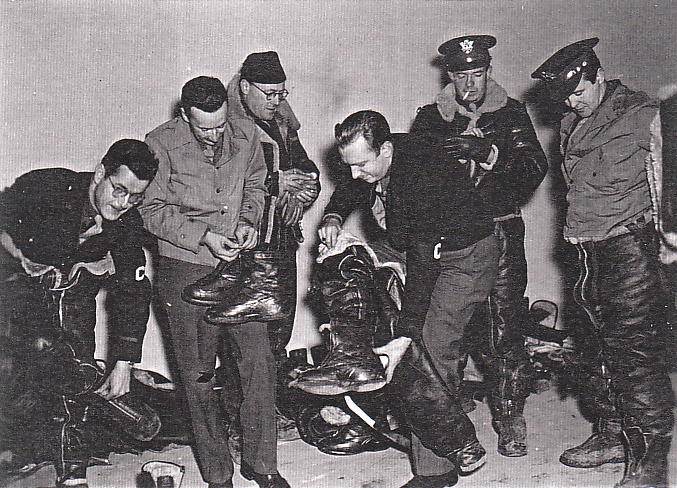
This is the most often published shot of the Writing 69th, though it only includes six of the eight. The two military men, Andy Rooney and Denton Scott, were left out. From left to right it's Gladwin Hill, William Wade, Robert Post, Walter Cronkite, Homer Bigart, and Paul Manning.
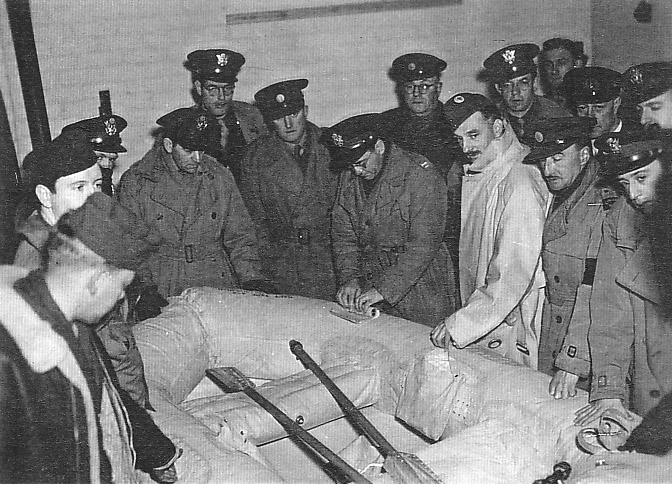
Surrounding an inflatable raft is a large group that includes the journalists, the newsreel cameramen, and others. Though hard to tell, the first person on the left could be Andy Rooney. Behind him is Paul Manning. We cannot identify the person behind Manning. Movie director William Wyler is probably the one at the point of the raft. Behind him is Gladwin Hill. Newsreel cameraman Jim Wright is next. The person rolling up the paper looks a little like Bob Post, but is probably too short to be him. Ken Gordon and Jack Ramsden, two of the newsreel cameramen, are next, then Homer Bigart. We cannot identify the man behind Bigart nor the one next to Ramsden. George Oswald, a newsreel cameraman, is the third person from the right, his face partially obscured. William Wade is leaning in from the far right with Walter Cronkite over his shoulder.
An Update on the Newsreel Cameramen
August 2010: We heard this week from a granddaughter of one of the newsreel cameraman. She identified her grandfather, George Oswald, in the photo on our Unanswered Questions page. He is also identifiable (sitting next to Walter Cronkite) in the photo on the Training page. At least two other photos exist from that training session. We will post them before long.
Tomas Hauschild Injured in WWII Bomb Blast
June 2010: A German newspaper reported this week that Tomas Hauschild, a great friend of the Writing 69th home page, was injured in the blast of a World War II bomb that he and other members of the German Explosive Ordnance Disposal Service were in the process of disarming. Three from the team died in the explosion, which took place on June 1st in the city of Gottingen. Tomas is in the hospital in stable condition after an operation. He has shrapnel injuries from the explosion and burns to his arms, legs, and face. Our thoughts, prayers, and best wishes go out to Tomas and his family.
Update (June 2010): Tomas has been in touch and reports that he is home from the hospital! We're very glad to hear that he is on the mend and wish him all the best for a speedy recovery.
Update (December 2010): Tomas continues to suffer from the effects of the explosion and reports that he will have an operation on his left ear in December. (He has already had a similar operation on his right ear.) We continue to wish Tomas the best for his physical and emotional recovery from this horrific accident.
Update (May 2014): A December 2013 article in the German-language publication NWZ Online describes Tomas Hauschild's long recovery from the injuries he suffered in June of 2010. We are pleased to report that he is much improved and able to return to work in a support role with his old unit.
Crash Site Photos!
April 2010: In an amazing development, Tomas Hauschild has discovered three photos that are believed to be of the crash site of the B-24 bomber that carried Robert Post and Capt. Adams' crew. These images were in a photo album kept by a neighbor of Gerd Behrens. The first two images show the wing of what appears to be a B-24. The third is a tangle of wreckage, that looks at first glance like a B-17 tail section, but we believe it to be the B-24's nose and cockpit (assuming that the remains of a wing have been twisted nearly vertically).
Update: It was probably too much wishful thinking that led us to believe that this was a B-24. Most observers believe this is a B-17 tail section.
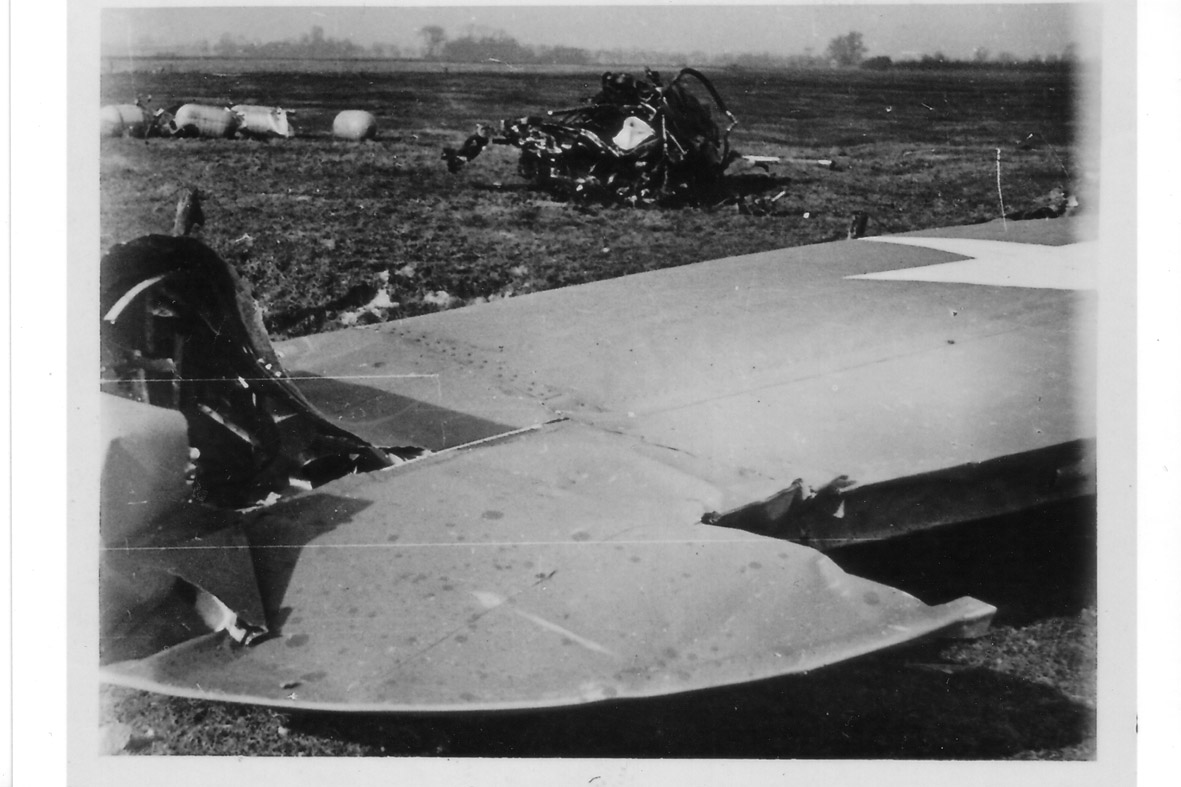
Are these oxygen tanks in the distance?
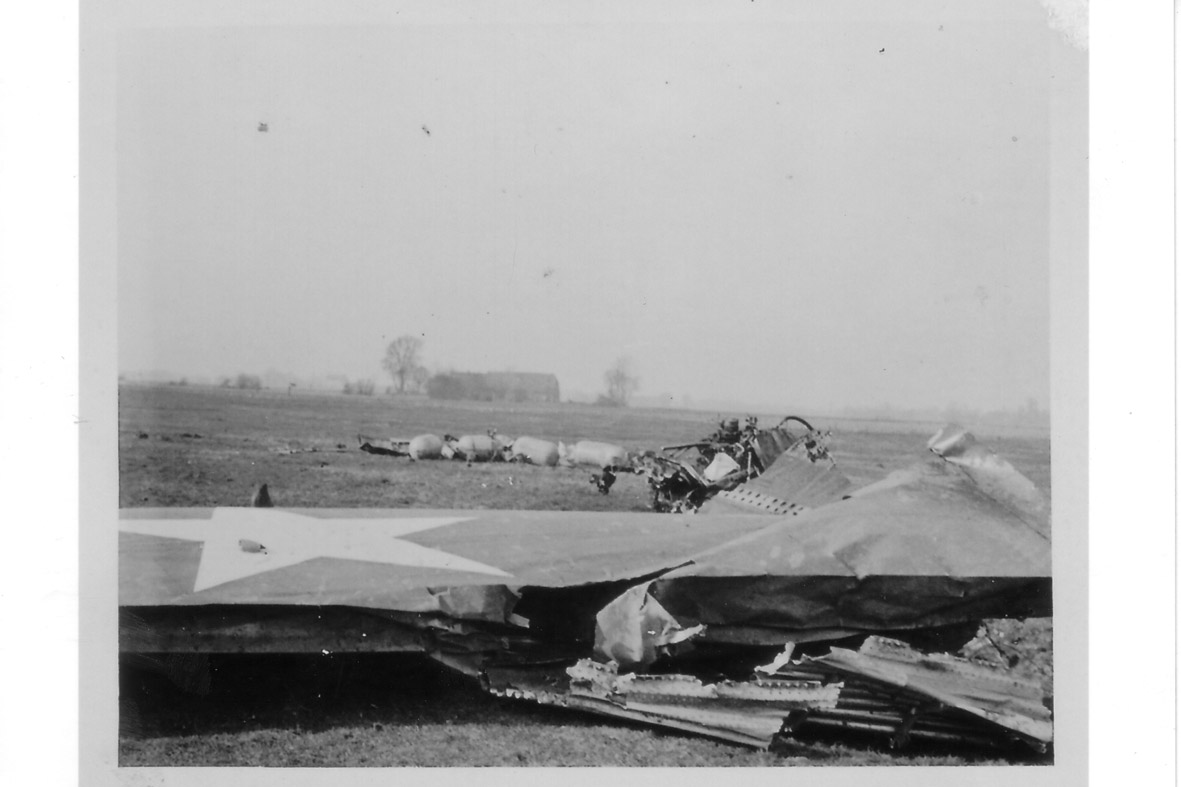
The house on the horizon has been identified by Gerd Behrens, so it is very likely that this is Capt. Adams' B-24.
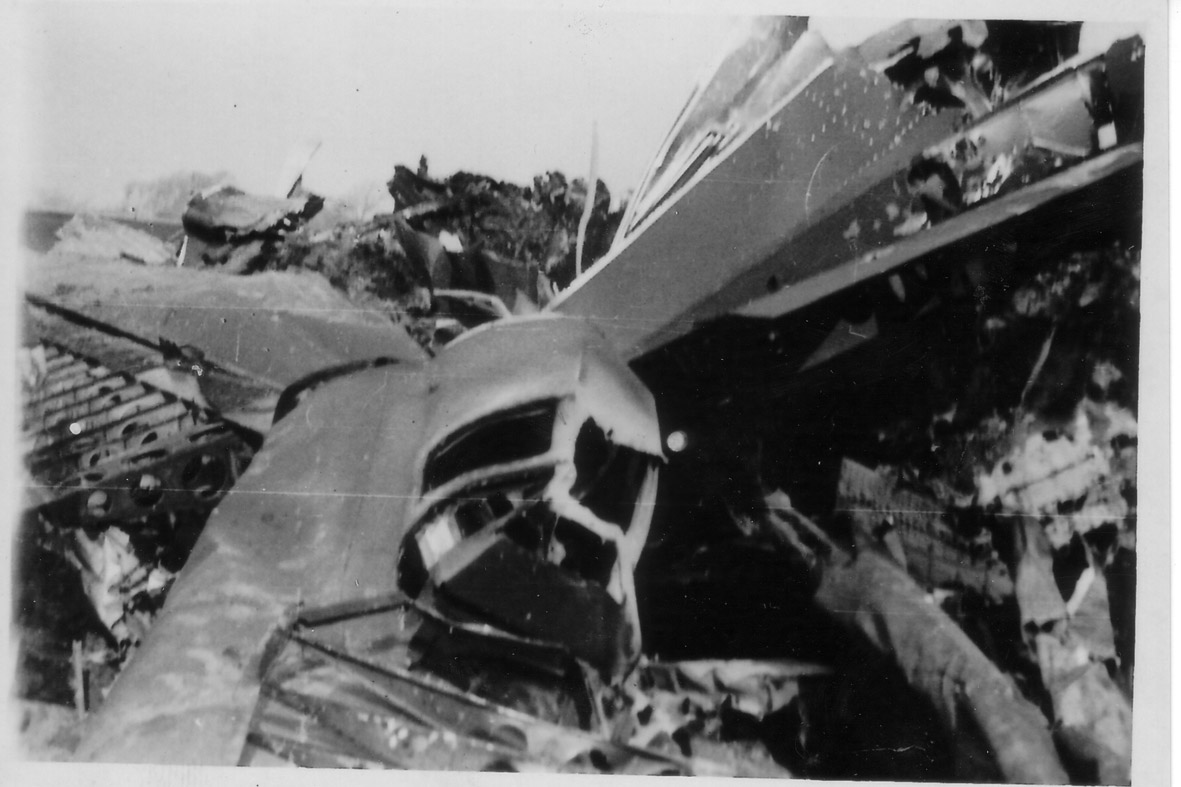
This image is not easily recognizable as a B-24. Can someone provide insight on this? Some think this is a B-17 tail rather than a wrecked B-24 cabin with the left wing pushed up vertically (as we suspect it is). Update: It has become clear that these images are of a B-17, though it is not known which one.
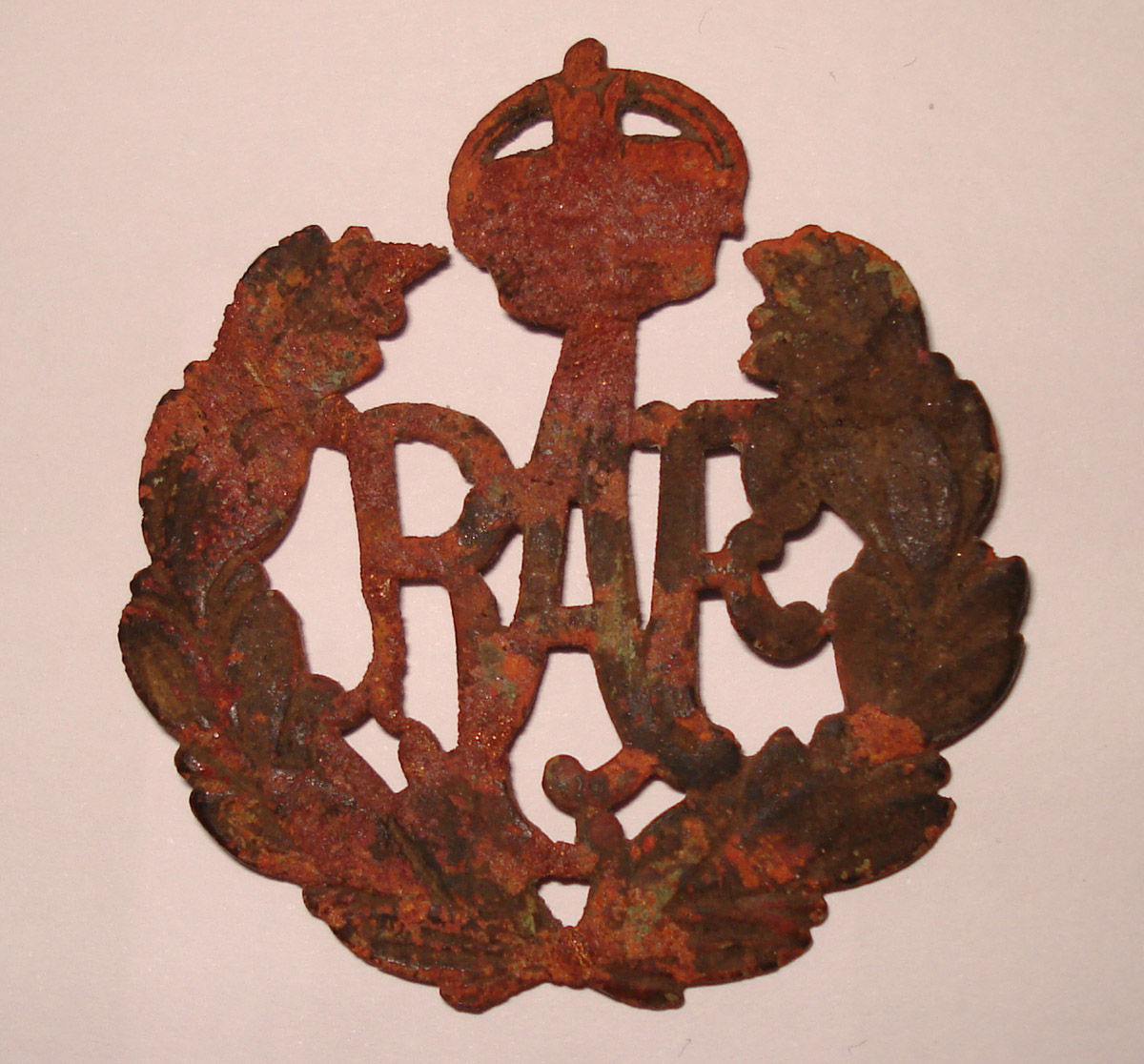
This last image appears to be an Royal Air Force cap badge. It was discovered near the crash site. The question has been asked, how might it have gotten there? Can anyone help identify this? If you have any ideas about any of these photos, please send an e-mail to jim@greenharbor.com. Update: This is an RAF enlisted man's cap badge.
Images of the House Set on Fire by a Crashing B-24
February 2010: There are no existing photos, that I know of, of the crashed B-24 that carried Robert Post and Capt. Adams' crew. A while back, however, Tomas Hauschild provided several photos that Gerd Behrens gave him. These photos show the aftermath of the fire that was caused by the burning fuel that fell from the B-24.
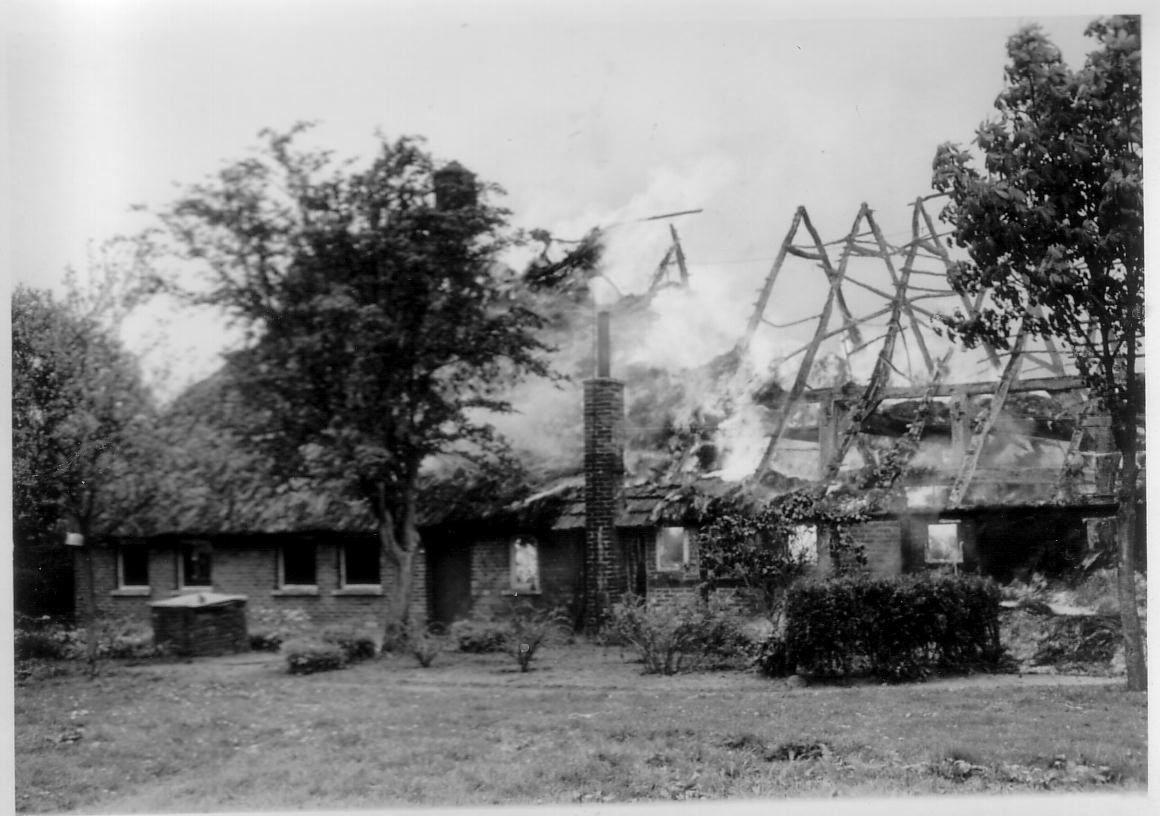
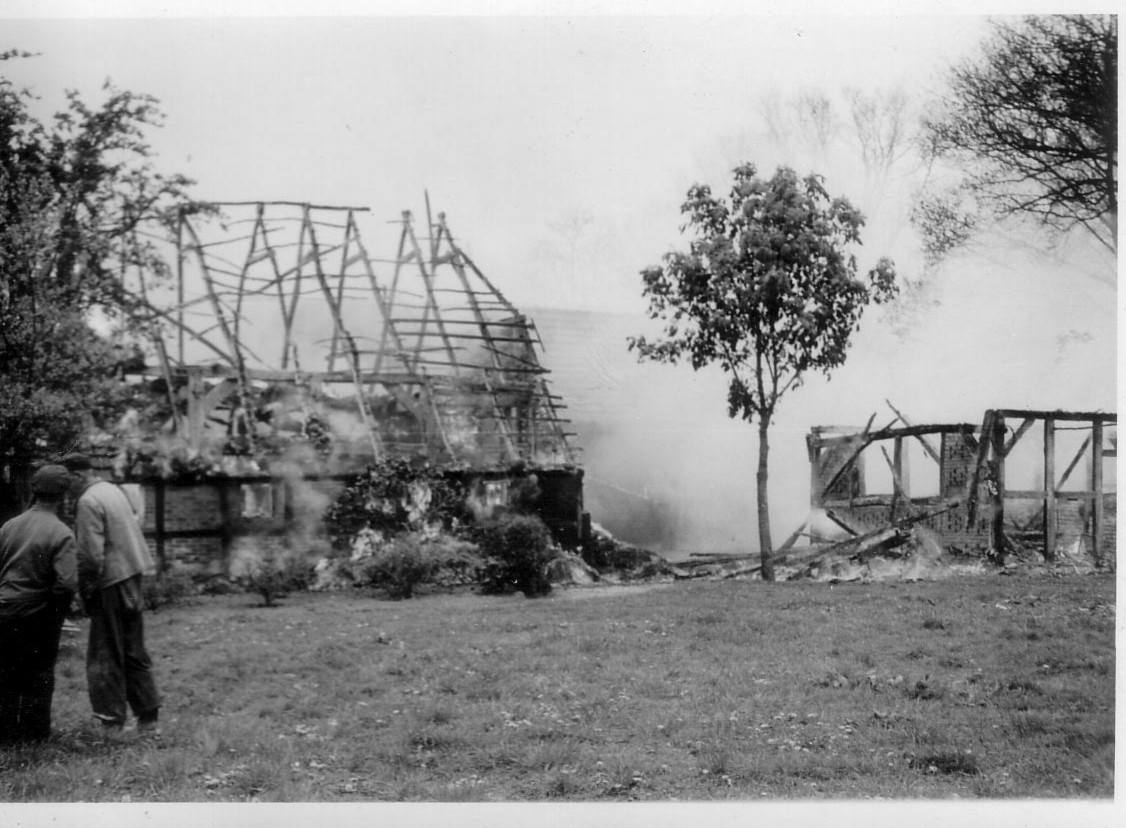
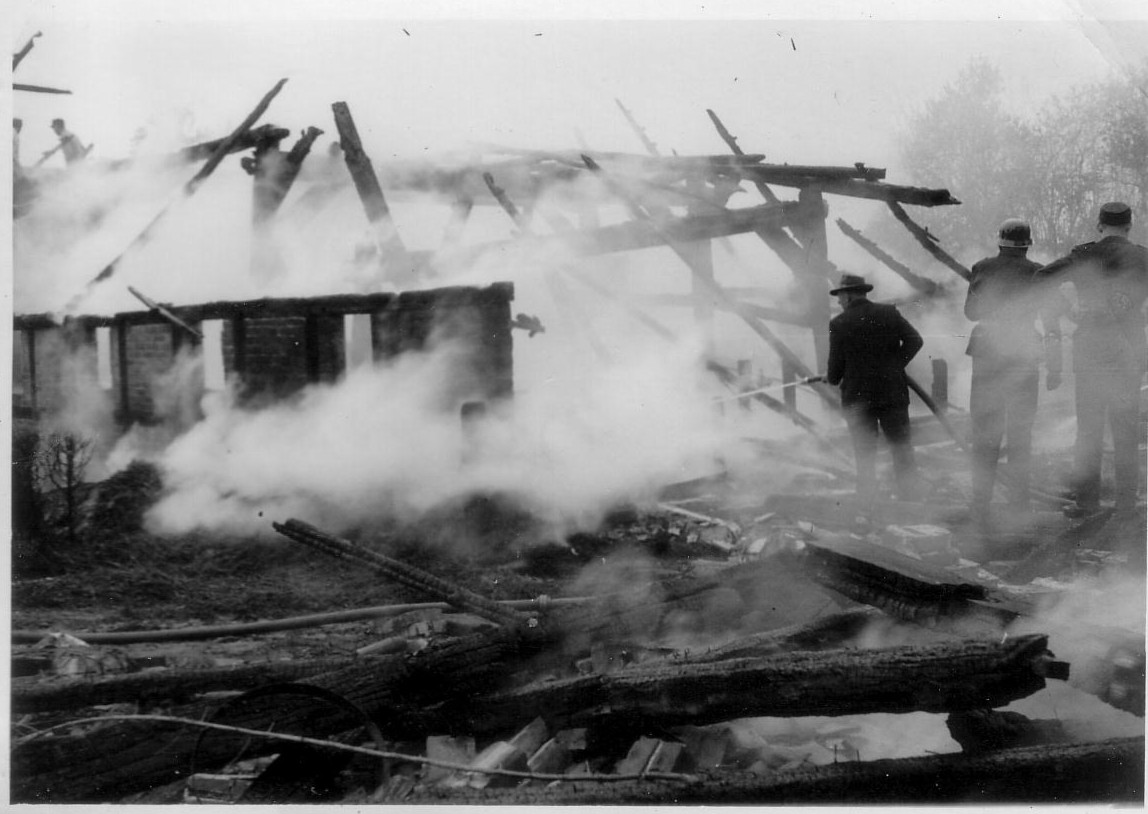
I assume that these photos were taken by a civilian. The B-24 wreckage would have fallen on the other side of the house, out of view of these photos.
Living History Reenactor Creates a Writing 69th Patch Replica
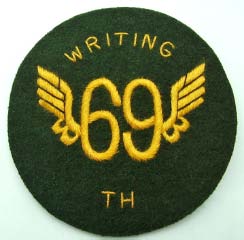
January 2010: Allen Ambridge is a living history reenactor from the United Kingdom. He created this replica of the Writing 69th logo for the war correspondent uniform he uses for his presentations. Allen does not have a web site but if you are interested in contacting him, let me know, and I will put you in touch with him.
Update on the Newsreel Cameramen
November 2009: The Writing 69th home page has a Questions page and on that page there's a query about five newsreel cameramen who participated in the training along with the Writing 69th members. No progress was made on this for years until we stumbled across the British Universities Film & Video Council's News On Screen web site, which includes biographies of each cameraman. Through the help of Linda Kaye of the BUFVC we were directed to an on-line repository of Movietone film. You have to register to get access to this, but it's worth doing. In the Movietone archive there is footage by one of the cameramen, J.L. "Jack" Ramsden, probably taken late in February of 1943. Once you are in the archive, search for story number 43422 ('Flying Fortresses'). At around the 2 minute 10 second mark, you see Ramsden himself on film. Late in the sequence (4 minutes 37 seconds) you see a shot of a shot-up tail fin with 124617 on it. This turns out to be the B-17 Southern Comfort of the 305th Bomb Group's 364th Bomb Squadron. (Trevor Williams has a very interesting web site on this aircraft.) So it appears likely that Ramsden was assigned to the 305th after the training session. There is no indication that he flew on Southern Comfort, but he did take a shot of it on the ground.
It's possible that one or more of the five cameramen took part in the February 26, 1943 raid and that footage exists from that mission, but not all of the footage is accessible today via the web. As we learn more about these newsreel cameramen we will provide updates. Many thanks to Linda Kaye and Trevor Williams for helping us make these discoveries. See the Questions page for a photograph and some additional details, including links to the cameramen's biographies.
Film of Heinz Knoke's "I Flew for the Fuhrer"
November 2009: Tinus le Roux of South Africa is producing a film (using live actors combined with computer graphics) based on Heinz Knoke's book "I Flew for the Fuhrer." He has chosen three days in the life of Knoke and is basing it on the English translation of the book. One of the days he has chosen to include is February 26, 1943, the date of the Writing 69th mission. You can see a one-minute trailer on YouTube. It is a non-commercial venture intended for private use.
Update (January 2009): You can now see the full movie on YouTube (completed in December 2009).
An Actual Photo of Cronkite with the 303rd Bomb Group
August 2009: The mystery of the B-26 photo having been solved (see below), it's now time to show an actual image of Walter Cronkite with the 303rd Bomb Group. The photo below shows Cronkite with a group of 303rd Bomb Group airmen before a D-Day mission on a B-17. Cronkite flew in Shoo Shoo Baby (#42-97311 of the 303rd Bob Group's 427th Bomb Squadron). From left to right the men are the bombardier, 1st Lt. F.E. Umphress, Jr., the pilot, Capt. Robert W. Sheets, Walter L. Cronkite of the United Press, unidentifiable crew member with his back to the camera, and the engineer, T/Sgt. Francis X. Neuner. The full crew is listed below. The image is autographed, having been sent by Cronkite to Bob Sheets in 1997, the same year that Cronkite published his autobiography "A Reporter's Life." The inscription reads: "For Captain Bob Sheets - With a lifetime of gratitude for getting us back! Walter Cronkite"
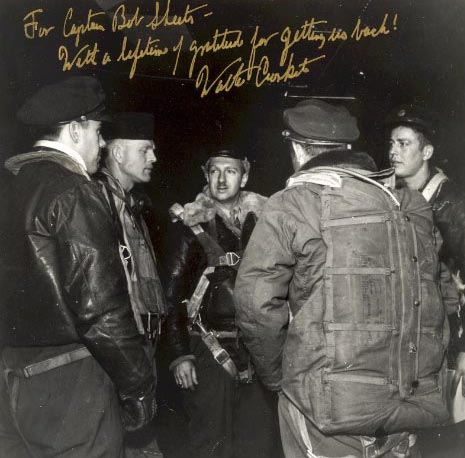
The entire crew was: Capt. Robert W. Sheets (pilot), 2nd Lt. Darwin D. Sayers (co-pilot), 1st Lt. Kenneth L. Olsen (navigator), 1st Lt. F.E. Umphress, Jr. (bombardier), T/Sgt. Francis X. Neuner (engineer), S/Sgt. Earl J. King (ball turret gunner), T/Sgt. Andrew G. Benevento (radio operator), Sgt. Tom C. Sullens (tail gunner), S/Sgt. Leonard C. Smith (left waist gunner), S/Sgt. James F. Donnelly (right waist gunner), and Walter L. Cronkite.
Thanks to Sally Wiggins (Bob Sheet's daughter) and Gary Moncur, 303rd Bomb Group historian, for providing this photo and the relevant details.
Thoughts on a Famous Cronkite Photo
July 2009: The Bettmann/Corbis photo (http://pro.corbis.com/) shown below is accompanied by the following caption: "After a stint in radio that ended 1939, Cronkite was sent by United Press International to cover the war in Europe. His exploites include flying with the 303 Bomber Group over Germany, above, parachuting into Holland with the 101st Airbonre, and landing at Normandy during the invastion by Allies." In addition to the obvious typos, the caption is inaccurate in saying that the photo shows him with the 303rd Bomb Group. Although they don't state it, this implies that the photo was taken before the February 26, 1943 Wilhelmshaven mission, which he did fly with the 303rd. The problem is that the aircraft behind him is not a B-17. It is clearly a B-26, which also explains why there are only a handful of crewman when a B-17 crew would be double the amount. Can someone help identify the proper bomb group? It shouldn't be too hard to find a B-26 bomber named "U.S.O." The photo was likely taken before a mission on or around the time of D-Day. If you have the answer, please let us know. Update: See below the photo for a full answer.
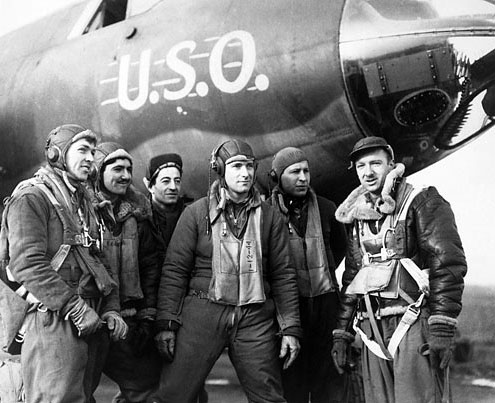
Update: The aircraft is a B-26 Martin Marauder called "USO" (serial #41-31951). It flew with the 323rd Bomb Group's 454th Bomb Squadron. The pilot was 1st Lt. Jack W. Nye. The date of the mission was February 9, 1944 and the target was a V-1 rocket site in Freval, France. The crew members have been identified. The men in the photo are, from left to right: T/Sgt. Ceibert C. Bragg (flight engineer), S/Sgt. Enrique Zepeda (tail gunner), S/Sgt. Arthur W. Brand (radio operator), 1st Lt. Norman M. Rosner (bombardier), 1st Lt. Jack W. Nye (pilot), and Walter Cronkite.
Many thanks Roy Bozych, the 323rd Bomb Group's historian, for his research on this photo. Thanks also to Gary Moncur for making the connection between the photo and this bomb group. Gary is the 303rd Bomb Group's historian.
Walter Cronkite, dead at 92
July 2009: Walter Cronkite died on Friday, July 17, 2009 at his home in New York City of cerebrovascular disease. He was 92. One of the best tributes that can be made to Cronkite is something that Harrison Salisbury wrote about him. Salisbury, who was Cronkite's United Press boss at the time of the Writing 69th mission, said that wild elephants couldn't have kept Cronkite from taking part in the mission. It was that level of determination that drove Cronkite to success throughout his career. Andy Rooney, now the only surviving member of the Writing 69th, used to kid his friend about the "purple prose" that Cronkite chose for the lead sentence of his Wilhelmshaven story ("American Flying Fortresses have just come back from an assignment to hell..."). Rooney wrote, "When I want to remind Cronkite that he is mortal man, I quote him a few sentences from his United Press story that day."
Veteran's Day Presentation, 2008
November 2008: For those who are interested, here is the the dog tag story presentation that Jim Hamilton gave on November 8, 2008 as part of a program at Ventress Memorial Library in Marshfield, Massachusetts. The PDF file is not huge, but at 700KB it may take a little while to download and open.
Scott Brewer's Dog Tag Is Found in Germany
January 2008: Scott Brewer, a gunner on the B-24 carrying New York Times reporter Robert Post, died on February 26, 1943 along with Post and other crew members. Brewer's dog tag, which lay in a field for nearly 65 years, was recently found by Tomas Hauschild, a German from nearby Borbeck. Hauschild has an unusual profession. He works for an explosive ordnance disposal unit that is called in when unexploded World War II munitions are found. The area around Bad Zwischenahn was heavily bombed during World War II because of a nearby airfield. Hauschild found the dog tag with a metal detector on January 18, 2008, not far from the farm where the aircraft's wreckage came down. Hauschild contacted Green Harbor Publications hoping that we could help him return the dog tag to one of Brewer's relatives, none of whom had been located at that point.
Green Harbor Publications contacted Tim Woodward, who writes for the Idaho Statesman (Brewer's home town was Boise). Woodward wrote two marvelous columns on the topic:
Did you know Scott Everhart Brewer?
Scott Everhart Brewer's mystery is solved
As a result of Woodward's articles, a number of family members have been located! In May of 2008 the Brewer family received the long-lost dog tag.
In reviewing Brewer's war record for details on his family, a sad fact came out. Brewer's father, Paul B. Brewer, died on March 6, 1943, two days before Brewer's mother, Louise E. Brewer, received the telegram informing her that her son Scott was missing in action. One other tantalizing fact is that Brewer, though his dog tag was missing, was identified by a yellow link metal bracelet with his name, address, and home town. The bracelet was also inscribed with the name "Mary." Brewer's mother received a letter from the army offering to send her the bracelet, but warning her that it was damaged by fire, and saying that they did not want to send her something that might be distressing to her. She thanked them for their offer but decided she would rather not have it sent to her. Brewer's surviving relatives have a few theories about who this Mary might be (perhaps it was his grandmother, his aunt, or a girlfriend) but no one is certain.
William Wade, member of the Writing 69th, dead at 87
March 2006: William Wade died of a heart attack on March 24, 2006 in Oakland, California. He was 87. Wade was a journalist, war correspondent, and member of the Writing 69th. Here is the link to his obituary in the San Francisco Chronicle. I will always be grateful to Bill Wade for his thoughtful responses to my letters and for the photographs he shared when I was writing the book. He told me that when Homer Bigart died the Writing 69th group photo was reproduced along with the obituary. Friends in New York and California had seen the picture and called him to say so. I'm sure that many people today are having fond memories of Bill Wade. Wade's death leaves only two living members of the Writing 69th: Walter Cronkite and Andy Rooney.
Remembering Tex McCrary
August 2003: Tex McCrary died on July 29, 2003 at the age of 92. Tex was an 8th Air Force public relations officer (PRO) at the time that the Writing 69th was formed. I contacted Tex while researching "The Writing 69th" and had a memorable phone call with him one day more than five years ago. Reading his obituary I was reminded of something he told me during that call. In 1944 McCrary co-wrote a book called "The First of the Many" about his experiences as one of the early members of the 8th Air Force in England. When I talked to him that day, he joked that if he ever wrote his memoirs, he would call it "The Last of the Few." His good-humored comment is a sobering reminder of how many of our World War II veterans are dying every day.
|