|
Free FallThe Free Fall Research Page |
|
|
Free FallThe Free Fall Research Page |
Here are some answers to questions we have received about falling. If you would like to have your question answered, send an e-mail to Jim Hamilton.
|
Do people falling long distances feel calm? Alicia Western, a character in Cormac McCarthy's 2023 book Stella Maris, ponders: "You could say that fear of falling is...primitive, but climbers who have fallen to what they believed to be their deaths universally report calm and acceptance. Why is that?" |
It is hard to say whether this is "universally" true since a person's feeling may change at different points during their descent. We can, however, learn something from what some long-fall survivors wrote about their experiences. Here's a sampling:
|
From this selection of reminiscences it does not appear that being calm and accepting is universal. Certainly someone who has been thrown from an exploding plane without a parachute will have at least a few moments of terror, maybe many more, before they resign themselves to their fate. |
Will a bullet fired and a bullet dropped from the same height hit the ground at the same time? Ron asks: "I have heard that if someone fires a gun in a level position & another person drops an object at the same height, ball/rock, both will hit the ground at the same time." |
Mythbusters looked at this and actually confirmed that it was true, although in fairness they said that there was a very slight difference. The difference, it turns out, is related to air resistance. This Wired article that goes into the math in great detail. |
How fast was I traveling and what was the impact force when I hit the ground? Jesse Vidito writes in with a couple of questions: "About 5 years ago while working for an industrial stainless steel engineering company experienced a fall of 40 feet inside of a stainless steel silo with a steel bottom. I still consider myself lucky because I did not break anything nor did I land on the 4-foot tall 1/8-inch wide fin at the bottom that would have been like hitting the blade of a deli slicer. Here is my question. Actually it is two questions. I fell 40 feet straight down and hit a steel floor. At the time I weighed 260 lbs. bare weight plus another 15 lbs. of clothing, harness, etc. Let's call it 260 lbs.
|
Our response: "Thanks for writing! Glad you had no serious injuries from your fall. Our speed estimate for a 40-foot fall is about the same as yours, somewhere between 20 and 30 miles per hour. That is based on a standard chart for an average-sized person. The math behind this is more complex than our math skills are capable of handling. You are bigger than an average person and you might have fallen slightly faster because your feet were pointed straight down. All that being said, the actual number will not vary a lot in a 40-foot fall between a smaller and a larger person. | As for the force of the impact, that is another tough mathematical equation and we do not have the necessary math skills to provide an estimate, but really, even with a figure, what does it mean? You need something to compare it too, right? From your experience, getting hit by an automobile is not as bad as a 40-foot fall onto a steel surface. Was the force of the car hitting you less than 12,400 lbs. of impacting force? Could be. | Does anyone have the mathematical tools to calculate the difference in force between hitting the ground from a 40-foot fall and getting hit by a sedan at 30 miles per hour? If so, please write to us. | May 2020 update: One of our correspondents writes: "I'm certainly not a math wiz, but I think there's more to the question than simply numbers. The calculation of 20-30 mph is almost surely within range, although the range is broad. As the tank was fully anchored, whatever forces were generated, were almost certainly fully absorbed by the body -- bones, ligaments, muscles and whatever biologists can name any other human structures (but mostly bones IMHO). | "When the individual involved reported that being hit by a car at a higher speed with a lot more mass (Force = Mass x Velocity) and suffering less bodily effect, I think that it's not a valid comparison. In the auto collision, his body had 'room to move' which could dissipate energy before it encountered any other solid object. (Here I assume his feet were not anchored to the pavement.) There was time/space for body elasticity to absorb energy from the collision, and when he hit the ground the impact was probably spread over a wider surface than landing on his feet alone in his tank fall, where the impact force would be transferred through bone up his spine to his shoulders and skull with no chance for muscles and ligaments to cushion the blow (absorb the energy)." |
How likely is it to survive a 1,000 foot freefall? An e-mail from a Free Fall Research Site fan asks: "How likely it is to survive a 1,000 feet free fall?" |
The writer continues: "Nothing below except rocks and a shallow river." | There's more: "Let's say you hit a moving train, can the train obsorb your impact and help you survive? Or, at 1,000 feet are your chances too poor to survive?" | And there were some follow-up questions: "Would like a 30 mile-per-hour wind be enough to help you survive? What if you landed on a roof of a small building?" | Here's our response: In regard to your first question, the probability of surviving a 1,000 foot fall is certainly less than 1% but it is hard to know for sure how much less. There are quite a few examples of people surviving falls that long, but many, many more have failed to survive after falling that far. How many? Who knows. | As for falling into rocks and shallow water, in our experience tracking long-fall survival we have found that falling into water is not a particularly helpful factor. It has been described this way: "...falling on water at high speed is like falling on concrete, except concrete won't swallow you after breaking your bones and rendering you unconscious." In your example, the water is shallow and rocky. That is not a good location to fall into. | As to your question about the moving train, there is no reason to believe that hitting one would be of any help. After a fall of 1,000 feet, the faller wouldn't have quite yet reached terminal velocity, but they would be going really fast, around 110 miles per hour. Landing on a soft surface (snow, bushes, mud, etc.) or a sloped one helps, because it allows more time for the faller to slow down. As they say, it's not the falling that kills you, it's the stopping. The horizontal velocity of a train would do nothing to counteract the downward velocity of the faller. | As for a 30 mile-per-hour it would not help, even if it were blowing straight up. But an angled roof can help. There are multiple long-fall survival stories of folks falling onto roofs or other angled surfaces. |
If an aircraft engine separated from a plane at 20,000 feet and fell onto a house, what would the force of impact be and what damage would it do? This question comes from an author who is working on a short story. She writes "Would you be able to tell me the speed of an 8,500 pound object dropped from 20,000 feet and its force at impact?" |
She explains: "In the story I have an aircraft dropping an engine which goes through the roof of a house, through the second floor, into the ground floor, and embedding itself in the basement floor, at what depth I don't know." | Our response is that she needs a mathematician or a physicist, and unfortunately we don't have one on staff. We are posting this here in the hope that someone who is one of those things will be able to help. Alternately, we ask that if anyone knows of actual incidents in which heavy objects fall onto houses from great height, please send us an e-mail. | Also, here is some background: For the purpose of the Free Fall Research Page, it's enough to know that an average-sized human being reaches a speed ranging from 120 to 200 miles per hour after falling 2,000 feet. After 2,000 feet they don't go any faster because of air resistance. That's called reaching "terminal velocity." | And though there are plenty of web sites that show up under a search of 'force of a falling object.' The problem with them is that most do not take air resistance into account, which means that they are useless for this purpose. | What is the terminal velocity of an 8,500 lb. aircraft engine? Who knows, but it seems likely that it would reach terminal velocity before falling 20,000 feet. In addition, it would likely have some forward velocity, assuming that the airplane it fell from was moving forward. To get at the true value of air resistance, formulas typically require information about surface area of the falling object. This is why, for example, a skydiver in a typical arms-and-legs-spread horizontal pose will fall slower than one who falls head first. | It is likely that no one would question the author's story if the airplane engine were to crush a 2-foot hole in the concrete floor. Other factors might help to make the story seem more feasible. For example, would a jet engine that fell off a plane continue to operate for very long? Would it set the house on fire from any remaining aviation fuel? And maybe even more importantly, what could make an aircraft engine separate from the plane? If you can help with the calculations or any of these questions, please contact us. |
What's the speed and force of impact of a 225 lb. man falling 800 feet? |
A fan of the television show Ozark writes: "Having just watched Ozark, I am overwhelmed by a death scene in the first episode [Season 1], where the body of a 225 lb. man is thrown off a balcony and falls 800 feet to his death. I know it is 18 feet per second/ per second, but what does this actually translate to in terms of MPH and force of impact?"
Our response: The amount of time it would take someone to fall 800 feet is about 8 seconds. By the time they reach the ground they'd be traveling at about 100 miles per hour. (See the Speed/Time table on the Free Fall Math page for additional details.) The calculations for force of impact are complicated, and almost irrelevant since obviously anyone hitting the ground at that speed would have little chance of survival unless some other factor came into play (such as falling onto something that would cushion the impact like a snow bank or a garbage pile). For reference: A man named Sebastian Reyes survived a 17-story fall from a high-rise balcony in Chile in 2015. He bounced off a metal roof and hit a car before rolling onto the ground. He broke his thigh and pelvis but survived. As for the fall in Ozark, 800 feet is the equivalent of an 80-story fall. That's quite a long fall. And the man in the Ozark series lands in the middle of an asphalt street. Not very forgiving. |
Could Rasputia really have survived the waterslide fall in the movie Norbit? |
Keith writes: "In the movie Norbit, Rasputia (400 pounds, 181.81 kilos) goes down a 58 foot waterslide. She then breaks through a plywood wall and lands in a pool, with no sustaining injuries. How fast would she have to go to break though and would she die from going that fast? If you don't want to answer the entire question, could you please just tell me what equations I need to know in order to find out? Thank you!"
Our response: What a question! We can't help you with equations, you need a physicist to help you with that, and we don't have one on staff. Here's what we can say:
Also, here's a link to a question about falling into water that has some relevance to this inquiry: If I jump from 200 feet or more into water how deep would it have to be and what is the worst that can happen? |
Can you identify the baby my grandfather treated? |
We recently received a question from the granddaughter of an Army doctor who treated a baby who fell from a hotel window in 1944 in Miami Beach. Wendy Harter, the granddaughter, shared this picture of her grandfather, Eli Blair Harter, with the child. She was hoping to find out more about the incident. The only details she had were that the baby had fallen many stories from a hotel window somewhere near Miami Beach, Florida.
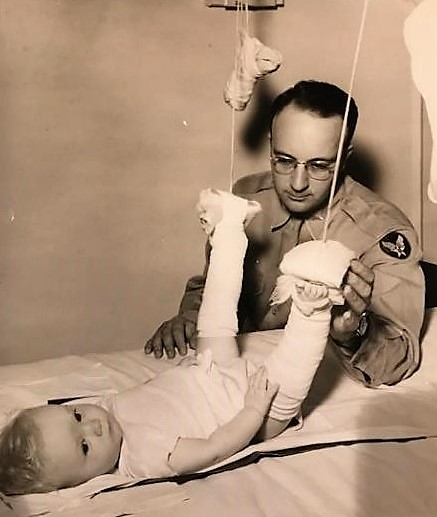
Using the details that Wendy provided, we were able to locate several news stories that appeared around the time of the incident. Long story short, the child was 18-month-old Bryce L. Taylor, Jr., the son of an Army Air Force fighter pilot who flew 50 missions in Europe. Bryce Sr. and his wife were staying at the Lord Tarleton hotel in Miami Beach in March of 1944. They placed the child on the window sill and he fell out through a loose screen window, tumbling eight stories into some bushes. He broke his leg and injured his neck but was otherwise okay. 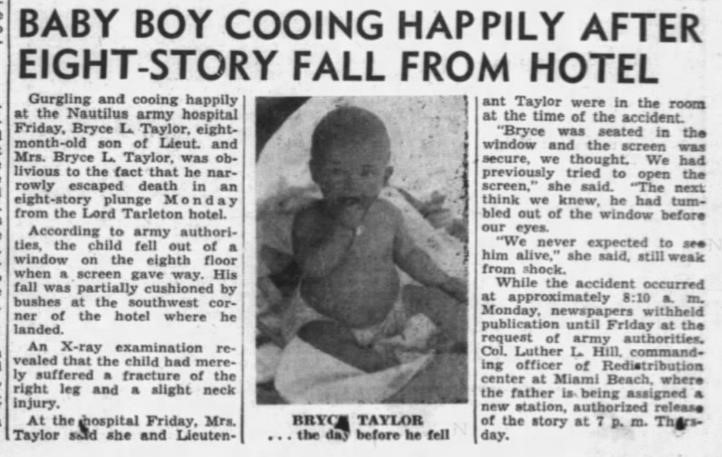
The photograph that was used in the news reports showed an army nurse, Lt. Vera Brown, with the baby. Her photo won out in the published accounts over the one of the doctor, though the shots were clearly taken around the same time. 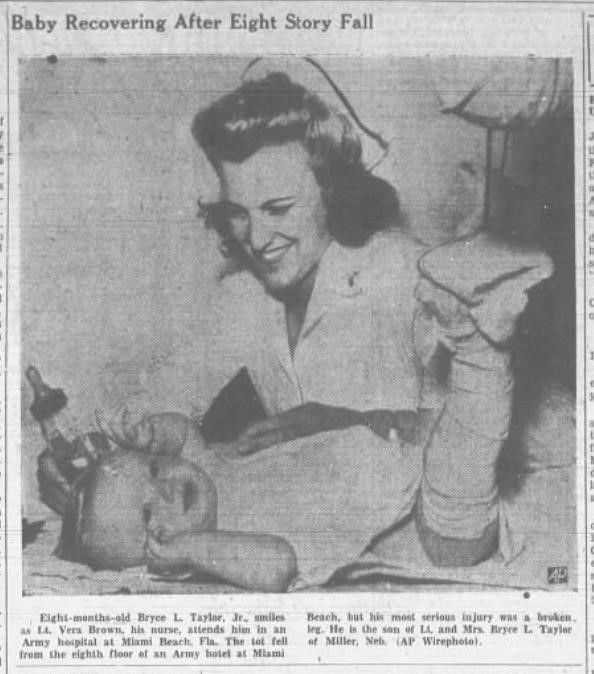
Further digging showed that Bryce Jr. died in 2008 at the age of 65. Wendy hopes to find some relatives to share the story with. If you knew Bryce or the Taylor family, please contact us and we will put you in touch with Wendy. |
Does a ball thrown straight up take the same time to go up as it does to come down? |
This question came in from a correspondent who thought that the ball should take less time to come down. It turns out, after consulting several reasonable Internet sources, that the opposite is true.
|
The role of friction is the differentiator. As quoted from the Harvey Mudd College source: "The ball is generally moving faster on its way up than at the corresponding point on its way down, because in the descent phase, the frictional force is opposing the force of gravity, rather than pulling in the same direction (as they do when the ball is rising)." |
What should a general do if his overloaded balloon is falling? |
This question comes from a student who shall remain unnamed: A general is in a balloon with many people. It is falling because of the heavy load. What should the general do? |
Our response: The first action would be to take stock of the situation:
|
This last option (i.e., ordering people to jump) is probably the moral question your teacher was looking for your reaction to. Ordering others to jump is not leadership. That's why all other options should be explored first. Then, if no other options remain, the general could choose to sacrifice him or herself. Others could make the same personal decision. While it's true that generals may in the course of warfare make decisions that could lead soldiers to almost certain death, they do so with the expectation that their sacrifice will benefit soldiers or civilians in some way. In this case, the occupants of the balloon are all facing death, and so while the sacrifice of some could possibly benefit others, it is hard to imagine an order that the general could give to a sub-group in the balloon that would work in this situation ("All privates jump first! Corporals second!"). | Perhaps others with more military experience could provide a perspective on this. Do students at military academies have to wrestle with this type of moral dilemma in their philosophy classes? If so, please send us an e-mail. |
When should the pilot drop a flour sack to get it to hit a target? (Revisited) |
Wayne Altman writes: "At an airspeed of 110 knots at 1000 feet above ground, no wind how far out would the pilot drop a 2 pound sack of flour to hit a target?" | Our response: This is the second flour sack question submitted to the Questions page. (Here's the link to the first one. The first question was about a drop from 100 feet and an aircraft traveling 140 miles per hour. From 1,000 feet the time it would take a human to fall would be about 9 seconds. Assuming that 110 knots is about 127 miles per hour, then in nine seconds, a flour bag starting at 127 miles per hour would travel forward about 1,600 feet. How fast would it slow down? Hard to say, but it would probably slow down fairly quickly. Even if its forward motion had stopped after nine seconds, it still would travel 800 feet. In all likelihood it would still be going at least 60 miles per hour, so let's split the difference and drop it about 1,200 feet from the target. |
Wayne provided two photos (see below): The first is the trophy given to the winner of the contest he competes in and the second is his aircraft, a 1962 model Nanchang CJ6, a Chinese military trainer.

|
|
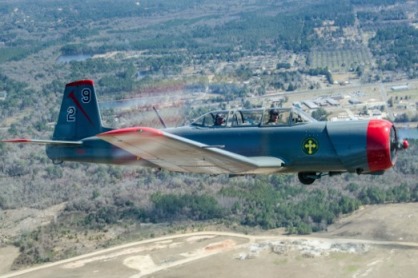
|
A sad footnote to this question is that the competition Wayne referred to never took place. There was a mid-air collision during formation practice and a pilot was killed in the crash. |
Would pushing off a wall help you survive a three-story fall? |
Jim writes: "For the purposes of telling a story, I have an 8 year old boy, a skinny 35 year old man, a very overweight 45 year old and a slightly overweight 24 year old man dropping down from their grip on the edge of the roof of a three-story building. If they were to push off the wall of the building about halfway down (or so), thereby creating some friction and a new force in a different direction to work against the pull of gravity would this group of people be able to survive relatively unscathed if landing on grass and rolling into the fall?" | Our response: The ages and weights shouldn't make too much difference for a fall of this short a duration, and pushing off of the wall is probably not going to be a very effective strategy. Keep in mind that a 20-30 foot fall would only take a second and a half. These folks should be more concerned with landing feet first and doing a skydiver's parachute landing fall where they distribute the impact between feet, calves, thighs, hip and shoulder. (This may not be very realistic for the plot of your book, but if they land and tumble down a grassy slope they may be doing basically the same thing, but without planned intent.) | For all four people to walk away unscathed is not very likely for a fall from that height, but the damage (if they fall feet first) might not be much worse than a couple of sprained ankles and some bumps and bruises. If this fall were from higher (or if they were jumping from the roof instead of hanging from it), the risk would be more significant. |
How far would the wreckage of an aircraft be spread if it blew up at altitude? |
Anthony writes: "A buddy and I were arguing about where the wreckage of plane would land or end up if it had been destroyed, going about 250-300 MPH, and about 20,000-25,000 feet in the air. Basically how far would the spread be. Let's say I was directly beneath it at the time it exploded, where would the wreckage end up, how far away from me would it be when it hit the ground? Because my friend was saying it would end up 20 miles away in the next town and that can't be possible." | Our response: Hard to say. Don't think it would be twenty miles, but it could be five or ten. | A jet aircraft travels at around 600 miles per hour. If it were to blow up at 30,000 feet, the wreckage (presumably no longer airworthy) would take less than 3 minutes to reach the ground. If the wreckage were still traveling forward at 600 miles per hour (about 10 miles per minute) for that entire period of time, the wreckage would fall 30 miles from where you were standing (directly below the explosion). But it doesn't continue at that speed. It would slow down significantly, and probably very quickly. Just how quickly, not sure, that would require a math or physics expert to calculate. | News reports about the Malaysia Airlines jet shot down over the Ukraine in July of 2014 note that the wreckage was scattered over a 15 kilometer (9 mile) area. That's significant, but not quite 20 miles. The Malaysia Airlines jet was a Boeing 777, whose cruising speed is around 550 miles per hour. It was around 30,000-35,000 feet high when it was hit by a missile. You and your friend were talking about an aircraft going half that speed and at a lower altitude. If that's the case, then the wreckage would be spread over a much smaller area, but even so, it could be a couple of miles from the point of explosion. |
What's the best material to free fall into? |
A correspondent writes: "If I was free falling from the sky without a parachute (from let's say a height that allows me to achieve terminal velocity) and I could land in any substance (foam, packing peanuts, jello, anything) what substance would guarantee that I would not be injured? Given the conditions that it can only be one substance and there is no requirement for span or depth of the 'pool'." | Our response: Liquid foam sounds like a good choice, but it's hard to imagine how you would create a foam pool that would be deep and wide enough to allow a safe landing and yet would be escapable (in other words, it would be sad to survive the fall but drown in the foam). Also, there can never be a guarantee of lack of injury. You could make a beautiful foam pool to fall in and then be blown off course and miss it. | The closest related story is one about a wing suit diver who landed without a parachute. He chose to construct an immense pile of cardboard boxes for his landing spot. See YouTube for a video of this landing. | Of course he wasn't free falling...and he also chose (wisely) to jump from a helicopter instead of an airplane so that he could carefully control his starting altitude. Even so, it was a very risky undertaking. | Does anyone have a substance they would rather fall into? Keep in mind that this would involve free falling from 2,000 feet or more. If you have an idea, please write. | Note: Luke Aikins, the daredevil who jumped from an aircraft at 25,000 feet without a parachute, would certainly say that a large net would be preferable to foam (or any other substance). His net was twenty stories high, suspended from cranes, and backed up with a secondary net. |
How did experts figure out how long it took people to fall from the Twin Towers? |
A correspondent writes: "I have articles that have said for those who fell or jumped from the Twin Towers their fall lasted about 10 seconds and they struck the ground at just under 150 mph. How exactly was this determined? I would think if you fell in a normal freefall position you may have reached speeds between 110-120 mph but I don't know about 150 mph unless you went head first and in that case it could be faster. The North Tower was 1,368 feet and the South Tower was 1,362 feet. Your falling math has a person who fell for 10 seconds would fall around 1,138 feet reaching speeds of around 113 mph and 11 seconds from falling 1,309 feet and reaching speeds of around 116 mph. Did most of the people who fell or jumped reach freefall speed because you have that you would have to fall 12 seconds or 1,483 feet to reach freefall speeds of around 118-120 mph?" | Our response: Not sure how others determined speed. We doubt that they did the math or studied the physics. They probably just found a source like ours and used it. 150 miles per hour is probably not too far off for someone falling feet or head first from more than 1,500 feet. And it's true that it would take somewhere around ten seconds. Maybe they watched the footage of people falling and measured the time. | The 120 mile-per-hour figure quoted by Bud Sellick in his book "The Wild, Wonderful World of Parachutes and Parachuting" (and used in the graphic on the Free Fall Research page) is for an average-sized person in a stable free fall position (face and chest down, arms and legs spread). The World Trade Tower jumpers fell less than 1,500 feet and we don't think many were likely to be in a stable free fall position. These factors tend to balance each other out. The less distance you fall, the less time you have to accelerate to terminal velocity, but you fall faster if you aren't in a stable free fall position. | In a stable free fall position their speed would be somewhere around 115 or 120 miles per hour after falling 1,300 feet. Given that they probably weren't in a stable free fall position, we think it's likely they were falling at a speed of 120 to 130 miles per hour (but that's a guess on our part). We think the fall would have taken about 12 seconds. Knowing their weight and the position they fell in, a physicist might be able to calculate their speed and falling time more exactly if it were required. | The topic of the Twin Tower jumpers has generated a number of previous questions: |
What are the boundaries of terminal velocity? |
Ricky Zechariah sent in this series of questions and we've done our best to respond, but as we told Ricky, our resident expert is basically an amateur historian, and to get real answers to these questions he needs someone who understands higher math or physics (or both). | For background, please refer to the Falling Math page. Also, there are formulas for calculating some of what Ricky is looking for in a book called "University Physics" by Sears and Zemansky, but be forewarned: the math is complex (we gave up). |
Here are Ricky's questions:
|
If you were traveling only 10 feet off the ground in a straight line, how fast would you have to travel to get into outer space? |
A very interesting question, and one that we may need help from a rocket scientist to get a proper answer to. Let's start with a clarification of the question, because if you were consistently only 10 feet off of the ground you'd only circle the earth, never getting into outer space. We'll assume that while the person starts at 10 feet, eventually the curvature of the earth means that the ground would drop away and the person would be headed toward outer space before too long. | According to Wikipedia, the 'escape velocity' from earth is 40,270 kilometers per hour (25,020 miles per hour), which seems really fast, given that jet airplanes cruise at hundreds (not thousands) of miles per hour (mph). NASA notes that the Space Shuttle needs to attain a speed of 17,500 mph just to get into orbit and a Scientific American blog puts the fastest earth-relative rocket ship velocity at 36,000 mph, so if we assume that this person can find a vehicle that goes (at least) a bit faster than 25,000 mph, then they should be able to get into outer space. | Yet one thing isn't entirely clear. If breaking free from gravity can be achieved at 25,020 mph, does this velocity need to be directly opposite from the center of the earth? If that is the case, it might mean that a person would need to be going faster than 25,020 mph if they enter the atmosphere at an angle. | So a good guess at the answer to this question is that the person would need to be going at least 25,020 mph, but if the angle of departure makes any difference, the velocity might need to be even higher. If any rocket scientists see this message, maybe you can provide a fuller answer. Please write to us. |
What is the survival rate of a sixty foot free fall landing on concrete? |
We don't have an exact answer to your question, but here's our opinion. | A sixty-foot fall is very long fall. Some people say that 30 feet is the point at which half of the people survive and half die. This may or may not be true, but it seems reasonable. This web site only reports on incidents where the person survives a fall of more than 100 feet. The people who survive such falls typically land on something that absorbs the shock of the fall, for example, a metal roof or the hood of a car. In general, falling 100 feet onto concrete is not survivable. | However it is possible that a small percent of people could survive a 60-foot fall onto concrete. The survival rate would probably be less than 30% and it could be less than 5%. And it goes without saying that the survivors would probably be very seriously injured. | Two previous questions submitted to the Free Fall Research Page cover some of the same territory: Note: After responding to this inquiry, we learned that the question came from a gentleman who had survived such a fall in the 1980s. For more on Jon Troutner's story, click here. |
Is this site peer reviewed? |
No, this site is not peer reviewed. The person who asked this was wondering if he should trust the information on this site. Not quite sure how to answer. This material is posted here free of charge for your amusement. You don't have to trust it. Sometimes we get things wrong, but for the most part we believe the information to be mostly trustworthy. If the Free Fall Research page had a slogan it might be something like "98% accurate and worth every penny you paid." In fact, our sponsor, Green Harbor Publications does have a slogan: "Interesting Stuff...No Advertising" |
When should the pilot drop a flour sack to get it to hit a target? |
Dan Schiffer writes, "I will soon be in a competition flying a WWII fighter and we will be flying at 100 feet above ground level at 140 miles per hour. We will be dropping a 2 lb. bag of flour that is 6" x 3" x 3" in size. The goal is to hit the center of a target. How far from the center of the target do I need to be when I drop the bag for it to land on target?" | Our response: There are equations that would accurately calculate the speed and drop rate of the flour bag you describe, but you'll need to talk to a mathematics or physics professor for that. However, here are some estimates that may be useful. If a human were to jump from 100 feet about ground level, it would take about 2.5 seconds before they hit the ground. (See the Free Fall Research Page Speed-Time table for details. In that 2.5 seconds, an aircraft traveling at 140 miles per hour would cover about 200 feet. If that person had jumped from that plane, their forward motion would slow as soon as they left the plane, so they would hit the ground some distance behind the aircraft. How far back? Not sure, but it would be less than 200 feet. The drop rate of a human and a bag of flour should be comparable from that height so that at least provides 200 feet as a top limit. It is likely that the bag's forward motion will slow down fairly quickly, so dropping the bag about 100 feet from the target would get you close. |
Note: The contest is coming up soon and we will report whether this advice proves to be of any use to Dan, who, by the way, is flying this beautiful F4U Corsair.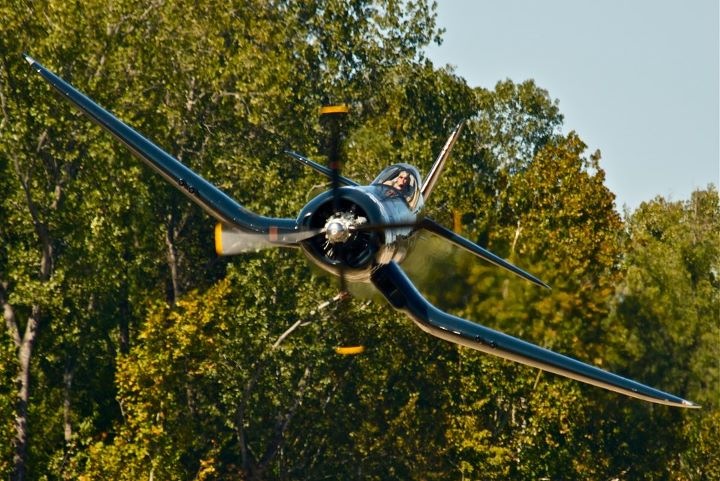
|
Does it matter how long the rope is for a parachute? |
A reader asks" "Does it matter how long the rope is for the parachute? Is it better if it's longer or shorter? Why?" | Our response: Yes it does matter (not that you should be asking us, since our method of answering this question is to find Internet research from people who know more than we do). One rule of thumb is to make the length of the lines equal to or somewhat larger than the diameter of the open parachute. With too little rope the parachute may have a greater tendency to collapse and also swing the occupant back and forth. With too much rope the added weight of the lines will make it fall faster. It also would take somewhat longer for the parachute to open and there may be a greater risk of tangling of the lines. There are formulas for calculating the proper line length. Check out Richard Nakka's Experimental Rocketry Web Site (see step #11). This question and answer from the Schlumberger Excellence in Education Development web site provides another view of the same topic, but without as much math. | And if you were wondering, this question came from a student in a class whose assignment was to perform an egg drop experiment (where you drop an egg from a height with a parachute and/or some type of protective packaging to prevent it from breaking). Someone who recently conducted such an experiment recommends that the student refrain from using a parachute, as it was their experience that other methods of egg protection were more effective. |
How long would it have taken to fall from the top of the Twin Towers on 9/11? |
One correspondent wonders, "What would have been the longest possible fall from those who fell or jumped from the Twin Towers on 9/11? I was thinking around 11 seconds but could be wrong." | Our response: You are right. It takes about 11 seconds to fall 1,300 feet and that's about how tall the Twin Towers were. The Falling Math page has a table that provides information on the time it takes to fall a given distance. Another question related to 9/11 is: Did the people who jumped from the World Trade Center towers die instantly? |
Could a hot air balloon withstand the impact from above of a human falling at terminal velocity? |
Don't think so. There's a valve right at the top of hot air balloons and if someone hit there they would probably tear straight through the balloon, destroying it. Even if the person hit to the side of the balloon I think the damage would be severe. Terminal velocity for a human is around a 125 miles per hour. It doesn't seem likely that someone would just bounce off without doing any damage. That being said, we aren't familiar with any examples of this type of accident. If anyone out there does know of one, then please write to us. |
Would someone die from a nine-story fall onto cement? |
A reader writes, "If someone were to fall from a 9 story building would they most likely die? I know that the outcome would vary depending on how they landed and what surface they landed on. But if someone were to fall onto cement would they have a likely chance to live through it?" | Our response: No, they would probably not survive. A fall onto cement from nine stories is generally not survivable. In cases where people have survived falls from this height they have fallen onto slanted roofs, cars, garbage piles, vegetation, or something softer than concrete. | Note: When the Free Fall Research page receives a question such as this, we always include the following in our response: "Why do you ask?" They might respond that they had seen a newspaper article about a similar incident or perhaps a friend of theirs had died in such a fall. In this case, we did not receive a response to our question, and that is concerning because it is also possible that a question like this has come from a depressed person considering suicide. To any such person we would encourage you to seek the counsel of a good friend or a family member or a minister or a professional therapist. Life can be very painful, but it can also be sweet. Don't jump. |
How long does an 830-meter fall last? |
If someone jumped from the top of an 830 meter high building (approximately 2,772 feet) how long their fall would last? The short answer to this question is 19.5 seconds. There is a link to a table on the Falling Math page that helps solve this. | The slightly longer answer (from the table) is that after 12 seconds an average size person in a stable free fall position (face down, arms and legs extended) would have fallen 1,483 feet. From that point on they would fall at a rate of 174 feet per second. Adding 174 per second puts the time between 19 and 20 seconds to get to 2,772 feet. | Note: This is a question that comes from an author working on a science fiction story. Other authors with plot lines involving falling may wish to refer to our Tips for Authors. |
What graph would best represent the velocity of a cat falling from a 100-story building? |
Aman writes "A cat falls from the top of a 100-story building. Which graph best represents the relation of its velocity with time?" | It's an interesting question, Aman, but since you didn't send pictures of the graphs we will have to guess what the right one looks like. | First of all, for the shape of the curve it doesn't matter really whether it's a cat, a human, or some object. If it falls far enough, eventually its velocity should level off. A 100-story building isn't quite far enough for a human to reach its "terminal velocity" but it's probably far enough for a cat. | So, if velocity is the vertical axis and time is the horizontal one, then the curve should start at 0,0 and then rise rapidly. After some period of time (probably around 10 seconds) the curve will begin to level off until the time at which the cat hits the ground, at which point the velocity will rapidly return to zero. The full curve would look something like this: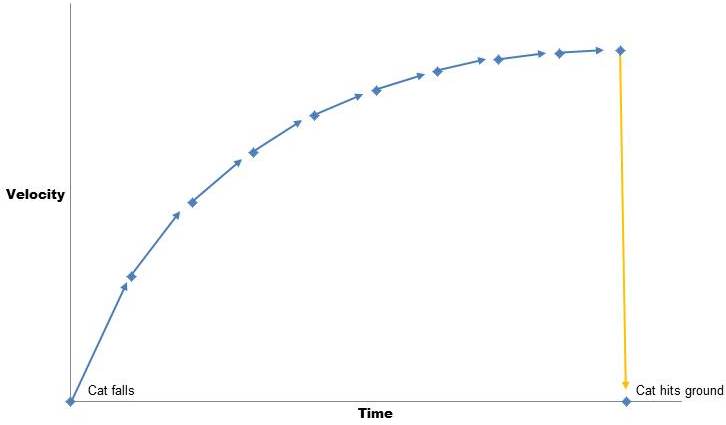
|
Can you blow up a balloon in free fall? |
A reader from Australia writes: "Was wondering if it is possible to blow up a balloon in free fall if rotated facing the sky?" | Our response: Not really sure. At best it would be extremely difficult. Kind of like trying to light a cigarette in similar circumstances. The wind and cold would make it hard to hold the balloon, though there wouldn't appear to be any reason why the person wouldn't be able to blow into it. | Does anyone have any experience with this? If so, please write. | Note: Here's a list of crazy things done while skydiving, but it doesn't include balloon blowing. |
From 20,000 feet, how long until you hit the ground? |
Julia asks: "A skydiver jumps out of a plane at 20,000 feet. He falls to the earth at 150 feet per second. How long until he hits the ground? Please answer quickly." | Our response: 150 feet per second is about 100 miles per hour. 20,000 feet is 3.78 miles. At 100 miles per hour it takes about 2.27 minutes to go that far. I hope this was quick enough... (The e-mail came at 6:47 pm and was answered by 8:04 pm. She responded as follows at 11:40 pm: "Thank you for answering my question. You answered With great speed too. Lovely precision. Sincerely, Julia.") | Note: The general assumption for the terminal velocity of a human is 125 miles per hour, but that would depend on the size and weight of the person and the position in which they were falling (someone falling feet first would fall faster than someone in a stable spread eagle skydivers position). |
What is the largest number of people ever saved by parachutes from a damaged aircraft? |
Dr. Robert Lyman asks whether there has ever been a group of more than 20 who successfully parachuted from a damaged aircraft. Here is his question in his own words: "I am researching the loss of USAAF Flight 12420 on 2 August 1943 over north-eastern India. The C46 was flying the Hump route to China, when it developed engine failure and came down over the village of Pangsha in north eastern India. There were 21 people on the aircraft. 20 parachuted, and survived. The co-pilot appears to have jumped too late. His body was found in the wreckage, with his parachute partly deployed. My question is whether you think that this might be the largest ever group of amateur parachutists (i.e. none had ever jumped before) successfully exiting an aircraft?" | Dr. Lyman adds: "There were some very interesting folk on the plane, not least of all Eric Sevareid of CBS; John Paton Davies ("Jack") of the State Department, and Stilwell's political adviser; and Duncan Lee of the OSS, who also happened to be a Soviet spy..." | Our response: That's a fascinating account. We know of nothing quite like it, though we can't confirm that it was the largest such incident. There were plenty of incidents in World War II in which the entire air crew of a B-24 or B-17 parachuted out of a damaged aircraft (and most of those were amateurs by Dr. Lyman's definition) but that would not have exceeded 12 airmen. It is possible that a mid-air collision between two bombers would have resulted in more than 20 parachuting, but of course that would involve two aircraft, and in fact the mid-air crash incidents that we know of were generally fatal to a high percentage of the crewmembers. | Perhaps someone reading this knows of another such incident. If so, please write us! |
Why does a cat falling from a 50 story building hit the ground at the same speed as its friend who fell from the 20th story? |
(A high school junior named Julia submitted this question after her weekly physics lab.) | If this estimate on the speed of falling cats is accurate, then the short answer is that cats must reach their terminal velocity (i.e., the highest speed they go before air resistance keeps them from accelerating faster) after less than 20 floors (say 200 feet or so). | Humans reach terminal velocity after about 2,000 feet, but what about a cat's terminal velocity? Presumably it would be less than a human's and therefore would take them less time/distance to achieve it. Would it take as little as 200 feet for a cat to get to terminal velocity? Maybe. One reference on the Internet suggests that cats reach terminal velocity after 60 feet. Could be. Perhaps someone out there knows of a reliable source regarding cat terminal velocity... | Note: A cat falling in a feet-down position falls more slowly than one that is tumbling. The similar type of thing holds true for humans. A human in a skydive (arms and legs out, body horizontal, face down) falls slower than someone falling feet or head first (less air resistance). |
Can a person survive a nine-story fall into a fireman's net? |
An author in the middle of writing a piece of fiction asks: "If a person fell from a nine story building into a net, would they survive or suffer any injuries? Also, with that question, what if there was another person falling with them that landed on the bottom. Would the affect be different?" | Our response: It's hard to say. For one, these types of incidents are quite rare, and also, the Free Fall Research Page does not typically track falls less than 10 stories. That being said, it's still a very long fall, even into a net. They might survive, but there would likely be some injuries depending on how the person hit the net (head first, for example, would be very dangerous, perhaps fatal). If someone fell at the same time and they landed on them, the injuries would probably be even worse for both parties. |
A couple of Internet a bit resources provide some additional information:
|
Note: Fiction writers struggling with similar long-fall dilemmas may wish to consult the Free Fall Research Page's 'Tips for Authors' (offered over the years in response to a range of questions). |
Could a soldier with a malfunctioning parachute slow his fall by firing his weapon at the ground? |
Brandon Schill writes with this intriguing question: "Could a U.S. soldier equipped with a standard M16 employ it in a manner that would save his life in the event of a parachute failure? If the first answer is a no then what about an M249? or an M240B? (Brandon sent along a link to a site that did some similar work.) | Our response: It's an interesting idea but we don't see how it could work. Would the soldier put the rifle to his shoulder? He'd just spin when he fired. Would he put it to his chest? Based on the link you provided it does not appear that an M-16 would be enough to do much. Could it work with more significant fire power? Maybe, but part of the problem is that if the weapon is powerful enough to slow his fall it's probably powerful enough to break his rib cage or worse. | The opening of a parachute is a jarring experience, but it benefits from the fact that the jumper is wearing a harness and the parachute doesn't open immediately. Using a weapon to slow your fall would be much more sudden and the force of the weapon's firing would be focused on a small area of the jumper's body. Perhaps another way to think about this is in regard to fighter aircraft. Do they slow down significantly when they are firing their weapons? Even a relatively slow fighter aircraft, such as a World War I biplane (a Spad, for example) continues to fly when firing a machine gun, and their forward speed was virtually equivalent to the speed of a falling body at terminal velocity. | So all in all, we just don't think it would work, though if we were in that position we would certainly try it. |
Which would hurt more, ground or water, when falling from 10,000 feet? |
This correspondent asks us to keep in mind the surface tension of water and change momentum due to that (which, as he notes, should make water elastic in nature). Another request: Please answer according to physics as well as in practical world. | Our response: Perhaps others can add more in regard to the physics part of your question, but if you were falling in a feet-down position you would have a much better chance of entering the water without major bodily injury than if you landed on flat ground. The problem is that 10,000 feet is a long, long way to fall. Chances are you would be knocked unconscious and would subsequently drown. This is why so few of the documented cases of long-fall survival have happened on water. Given the ideal situation, after 10,000 feet you would be better off falling into tall trees and landing on bushes or snow. | The Free Fall Research Page gets a lot of questions about falling into water. Here are two that might be of interest: |
How fast would you be falling (in miles per hour) after you fell 5,000 feet if there were no air resistance? |
An interesting question for a mathematician, which we here at the Free Fall Research Page do not claim to be, but we'll take a shot at it. | First off, we'll assume that this is taking place in an extremely tall vacuum cylinder on earth. That way we can use the acceleration associated with earth's gravity. Here's the basic formula for distance fallen: |
|
Note: We used this Physics Class Room page as a reference. You may find it helpful. | Using 32.2 feet per second (9.8 meters per second) squared as the acceleration, it would take a little more than 17 seconds to fall 5,000 feet: |
|
The next step is to calculate the velocity: |
|
Using 17.6 seconds, the velocity is: |
|
567.5 feet per second can be converted to miles per hour as follows: |
|
So to answer the question, we believe that after falling 5,000 feet in a vacuum, you would be going about 387 miles per hour. Of course, in real life, in about 12 seconds you would accelerate to close to 125 miles per hour after 2,000 feet or so, and would not go any faster thereafter because of air resistance. | January 2015 update: Oh boy. It has been pointed out to us that our original answer (7,000 miles per hour) was way off the mark. Only by about 20X. We should have resisted the temptation to take a stab at the math. The issue was that we forgot to take the square root of time squared. This error was gently pointed out to us by Margo Schulter (the same person has contributed an excellent explanation of how acceleration works on the moon). Thanks Margo! |
Have there been any Wreckage Rider incidents with more than one survivor? |
We are familiar with three Wreckage Rider incidents in which there were two survivors:
|
Can a 200-lb. man jump out of a 17-story window and land in a pool that is 35 feet from the base of the building? |
A correspondent asks (hypothetically, of course) whether a 200-lb. man can jump out of a 17-story window and land in a pool that is 35 feet away. The correspondent reports that this question was generated from a "silly, verbal bet between some friends." The friend said that he could long jump 20 feet when he was younger, and with the added falling time and distance he could make it easily. | Our response: Don't count on it. Presumably the long jump the friend is talking about is a running long jump, the world record for which is around 29 feet. Simply jumping from a standing position there would be no hope of making it to a pool 35 feet away, and even with a running start it is unlikely that the 17 stories to the ground would add very much distance. | Here's how one way to figure it: A fall of 170 feet (approximately seventeen stories) would take between three and four seconds. (See the Free Fall Research Speed-Time table. If you covered the first 20 feet before falling too far, you would need to cover at least another 15 feet before you reached ground level. How much forward motion do you need to cover 15 feet in three and a half seconds? Only about 4.3 feet per second or a measly 3 miles per hour (a leisurely walking pace). While that doesn't seem like a lot, keep in mind that your forward progress has slowed down dramatically, in part because your feet are no longer touching the ground and propelling you forward. Say that you are sprinting at a 4-minute mile pace when you leave the 17th story. That's basically 15 miles per hour (about 22 feet per second). How fast would your body be traveling after 20 feet in the air? Would you still have a fifth of your forward motion? We don't know for sure, but we doubt it. And we certainly wouldn't want to risk our lives on it. In addition, if by some chance you made it to the pool, an even bigger concern would be the depth of the water. From 170 feet you would not want to land in the shallow end. Even a depth of 8 to 10 feet might not be enough to avoid a fairly hard collision with the bottom of the pool. FINA (Federation Internationale de Natation), the international swimming regulatory body, recommends a minimum depth of five meters for a pool where 10-meter platform diving is conducted. That basically means that diving from about 32 feet they want a pool that's at least 16 feet deep. | If anyone can shed any light on this question, please write. | This is the 100th question answered by the Free Fall Research Page since 2003! |
Do you know anything about the Rip Cord Club of the World (RCCW)? |
Not before you asked this question, however an old newspaper letter to the editor provides an excellent definition. In short, it says that the Caterpillar Club and RCCW are similar, in that they are populated by folks who have survived a parachute jump, but they differ in the type of jump. To quote the New Castle News (Friday December 8, 1933, letter from George Loudon): | "To become a member of the C. C. [Caterpillar Club] a person must make an emergency jump, saving his or her life by the use of a parachute, while to become a member of the R. C. C. W. one must make a volunteer jump, either after graduating or under the instruction of a graduate of the Chunate School of Parachute Rigging." | He goes on to say: "The R. C. C. W. has thousands of members all over the world, where ever the United States maintains an air corps station. The Caterpiller Club has 563 members at the present time." | On a further search, it appears that it's the Chanute (rather than Chunate as the newspaper states) School of Parachute Rigging. There is a Chanute Field in Illinois. Here's a link to an image of an R.C.C.W. pin. See What is the Caterpillar Club? for a response to an earlier question. |
Who pulls the ripcord when supplies are dropped? |
David writes: "When you send anything by parachute, (i.e. food, emergency equipment, etc.) who pulls the rip cord to slow the chute down? (I am curious having seen supplies being dropped in war torn countries, and war films on television.)" | Our response: Have you seen those World War II movies where the paratroopers clip a line onto something inside the plane before they jump? The parachute is pulled out by that line once the jumper is outside the plane. The same thing can be done with supplies before they are pushed out of the plane. It's called a 'static line jump.' There are also safety devices today that can automatically activate a parachute at a particular altitude, but those are unlikely to be used for supply drops. |
Can you help me with some mathematical calculations related to a 10,000-foot fall without a parachute? |
In a question that sounds suspiciously like a class assignment, we are asked: "You have just fallen out of an airplane flying at 10,000 feet without a parachute. Calculate (a) how long it will take you to reach terminal velocity (~ 120 mph), and (b) how far you have fallen in that time. Finally, calculate (c) the total time required for you to splatter on the sidewalk." |
Our response: The short answer is "No, we can't help you calculate this (the math is too hard for our brains)." However, the answers to your questions are all on the Falling Math page. Here's a quick summary:
|
How far would I have to fall to reach the speed of a head-on car collision? |
We received this question: "Ten years ago I survived a head-on car accident [which resulted in multiple serious injuries]. It's been a difficult time recovering and people don't understand what I've been through and can't relate to the force that my body went through. I still have that crushed feeling and often have trouble breathing. I'm still on painkillers for chronic pain. | "Since then I've often wondered how I could get others to relate in some way. People in wheelchairs have a visible disability and there's some level of understanding but for me, my injuries are invisible and I look like my body should be normal like everyone else. I thought if they could picture my car crash to be like me falling from a building, maybe they could have a better level of understanding about the forces my body has been subjected to. | "My accident occurred while I was driving at a speed of at least 60 km per hour. Another car was also travelling at about 60 km per hour towards me before they clipped a third car that was crossing over the road, whose driver didn't see them coming (so could have been speeding) and consequently came onto my side of the road and we crashed head-on. I don't have any memory of the accident or the minutes that led up to it. I woke up two hours later in hospital. | "I'd like to know, what is the force equivalent to? For example, if I jumped out of a tall building, how high would I be to gain the same force that I experienced and survived?" | The writer provided her weight and height, in case they were needed for any calculations, but the logic suggested below does not require those details. | One of the first questions that comes to mind is whether the speed of such a collision should be that of the car the woman was traveling in, or perhaps, the combined speed of the two cars. Based on some car collision references it appears that, in essence, a head-on collision of two cars going the same speed is equivalent to a single car hitting a brick wall at that speed. That means that the basic question is "How far would I have to fall to reach a speed of 60 kilometers per hour?" | A couple of tools on the Free Fall Math page will help us find the answer to that, but first we need to convert 60 kilometers per hour into feet per second. Using the speed conversion table it turns out that 60 kilometers per hour is about 55 feet per second. Now we can use the Free Fall Research page 'speed-time' table to see how far you would have to fall to reach an equivalent speed. Using this table, it is clear that an average-sized person would have to fall about 90 feet (about 27 meters) to reach a speed of 55 feet per second. | A fall of 90 feet/27 meters is about nine stories, which is a long way to fall and is rarely survivable. Of course, a person falling nine stories is generally not falling inside a car, and they also do not have the benefit of a seat belt and air bag. A car might fall somewhat faster than a human, but I think it's fair to say that your accident is comparable to falling inside a car nose-first off of a seven- or eight-story building. | All you mathematicians out there, does this look about right to you? If not, send us a note. |
Would a person falling from space hit the ground faster than someone falling from an airplane? |
Erik Gage writes: "If one person jumped from a plane with no parachute and the other person jumped from space with no parachute, would they hit the ground at the same speed? Would it matter if they were in skydivers position or feet first? (Pretend that the guy from space won't burn up...)" | Our response: (1) Yes, they would hit the ground at the same speed if they were similar in weight and height, and were falling in the same position. (2) If one of them was falling feet first and the other was in the skydiver's position, the one falling feet first would fall faster. Now this is the typical response we give since it's true that after a couple of thousand feet of falling, it doesn't matter where you started. If you are of similar weight and height, and are falling in a similar position, you should be falling at about the same speed. Yet Erik's question was based on the idea that someone falling from space might accelerate to the speed of sound in the emptiness of space. He and his friends wanted to know if the atmosphere would slow that person up enough to ultimately match the speed of the person who jumped out of an airplane. It's an interesting puzzle, and one to which we don't have a definite answer. How many thousands of feet of earth atmosphere does it take to slow down a parachute-less person from space? Our hunch is that the earth's atmosphere is thick enough, and the person would travel through it for long enough, that by the time they reached the earth they wouldn't be going any faster than someone jumping out of a plane at 10,000 feet. Imagine a bullet being shot into water. In the air it would travel at high speed for a long distance. In water it would slow down relatively quickly. It should be about the same for this question. In space there would be little to slow the person's fall, but once they reached the atmosphere they would continually slow down. Would tens of thousands of feet of atmosphere be enough to slow someone down who might be going the speed of sound when they first hit thicker air? We think so. | Does anyone else have an opinion on this? If so, let us know. See this link for a related question. |
How much force is created by someone jumping from a 5-foot high surface onto their hands? |
A reader writes: "I'm wondering how much force would a 175-lb man have if he were to jump off of a 5-foot surface. This might sound weird but I'm able to leap down from my hands to my hands. For example, I can handstand off a pool table and land remaining in a handstand. My highest drop is 4 feet seven inches. I have been working on 5 feet but feel like arms are not strong enough...so I feel I need to strengthen them. I think if I can figure out how much force (in pounds of pressure) is hitting the ground then I can work with that weight in the gym to make my goal achievable." | Our response: Interesting question. We don't know the math that would help answer your question, but maybe someone else does. Can anyone help us? |
How fast was I falling? |
Mary Hall writes with some questions about an experience she had in the 1970s at Kakabeka Falls in Canada (near Thunder Bay). "The local kids (young adults?) were jumping off the falls. Pretty soon my Girl Scout buddy and I (after some coaching) were jumping with them. I recently looked up the statistics on Kakabeka and was surprised to see that it was higher than I had remembered. [Note: One source cites it as 40 meters/130 feet.] I can still remember flying through the air and the exhilarated feelings during the first jumps and the peace of the later jumps on that day. I have been wondering a few things. How long was I airborne (at the time I weighed about 100 lbs)? How fast was I falling? How far did I plunge into the water after I hit the surface?" |
Our response: There are a couple of items on the Free Fall Research page that will help:
|
September 2020 update: Mary writes "I saw your web page with my questions and noticed that you were wondering if I might have been mistaken about the height of the jump. I really don't think I was mistaken. You see I didn't tell you all of the details. I jumped all afternoon until the sun started to go down. Since I had to climb back up to the top after each jump, that took some time. Only when I was ready to make my last jump did I do it the way the locals were jumping. They gave me a bottle of wine with the cork removed and then the cork lightly replaced in the bottle. I ran. Jumped. Kept both arms straight in front of me. Pulled the cork out of the bottle. Took a swig. Jammed the cork back into the bottle. Grabbed my nose closed and hit the water. I do know that the fall was long enough to feel like an eagle in flight. A sensation I can still feel when I want all these years later. When I graduated from high school, I wanted to experience the world. I'm still working on that." | She adds, "When I first saw those young Canadian locals jumping that day, I ran away from the falls in horror. The risk they were taking jolted me. As the morning wore on, I would leave the new friends Aimee and I had made – they were curious about life in the states – and I would wander back to the falls. I got used to watching them. I was curious. By early afternoon I was ready to jump. Just once I said. I can still think about it and again experience (physically feel the air rushing around my body) that first jump. The exhilaration. It was life changing for me." | In a follow-up e-mail she wrote: "I have studied Google Maps I looked up the dates changes to the hydroelectric plant that could have altered the river/falls. My memory keeps telling me that we jumped off of those falls. It happened in August of 1972." (Note: Here's the Google Maps view of the falls.) |
Mary even drew a map with her recollections.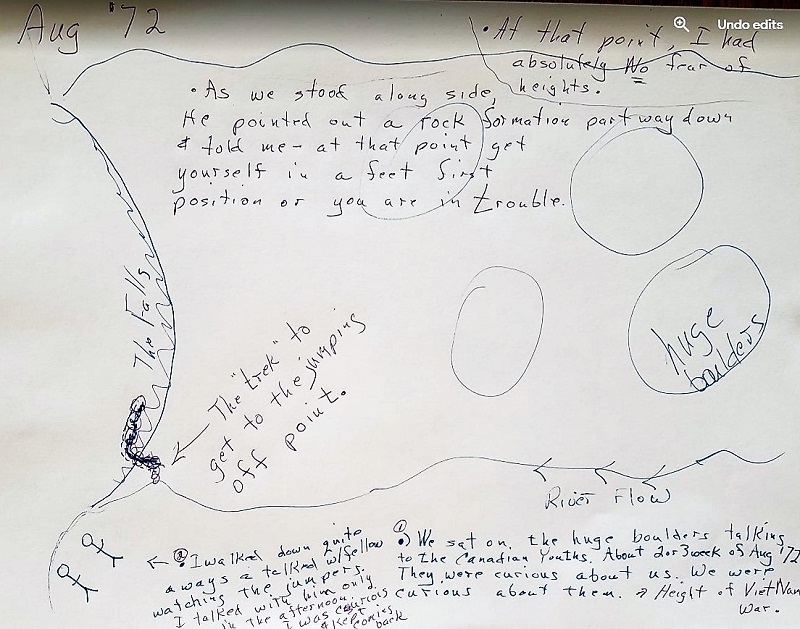
|
Our follow-up response: Mary's experience is about the thrill of doing something exciting and potentially dangerous. One thing about her experience is puzzling however. Jumping from the top of Kakabeka Falls the way it looks today doesn't seem like it would be feasible. It is hard to imagine where you could jump the full distance from the top of the falls without hitting the rocks below or being carried away by swirling waters. That's not to say it didn't happen as she describes it, but unless the geography has changed (which it might have), it seems more likely that her jump occurred further downstream or perhaps near the falls, but upstream. | One interesting tidbit that supports the height of her jump is her comment about the wine bottle. Try this experiment yourself next time you have a glass of wine: Put the cork back into the bottle so that some of it is still sticking out. Have someone time you pulling the cork out of the bottle, taking a swig, and reinserting the cork. Our guess is that is will take you around three seconds (at best), which is about the same amount of time it takes to fall 130 feet. | We would love to hear from anyone who knows the Kakabeka Falls area well and can tell us whether there is a ledge nearby that locals have used as a jumping off spot, and also whether it has changed over the years. If you can help, please send us an e-mail. |
Will a mouse survive a one-story fall? |
A "worried dropper" (LJT) writes: "I dropped a small mouse my cat brought into the house off of my balcony (1 story) before my cat got it. Is it safe to assume that the mouse survived?" | Our response: Hard to say. What's below your balcony? You could be more optimistic about the mouse's survival if it's grassy lawn rather than a stone walkway. "Worried" notes that the mouse fell on dirt covered with a thin layer of leaves. That's in its favor, and certainly better than a concrete sidewalk or asphalt driveway, but it's no guarantee of survival. Faced with a determined house cat though, I think the mouse's chance of survival was greatly improved by that fall off your balcony. |
If you were one inch tall, would you survive a fall off a 3-foot table? |
It depends. Say that I'm a perfectly formed human being, but only 1 inch tall. If I were 6 feet tall, that fall off a 3-foot table would be comparable to a fall of more than 200 feet. I would be very unlikely to survive that. But if I really were just an inch tall, I'd weigh a lot less and I might benefit from that by not accelerating as quickly. Imagine a mouse falling off a table top that high. Depending on how it hit the ground, it might just be a little stunned and not too much worse for the wear. Given that a mouse is more compact and better padded than a 1-inch-tall human, I'd give the human about a 50/50 chance of survival. Even from that height, landing on my head would likely be fatal. | Note: This question was asked because of the scene in the movie 'Beetlejuice' where the title character drives a toy truck off of a table. |
How fast was Joe Kittinger falling? |
Annette writes with a question about the speed calculations for Joe Kittinger's fall. She wonders how his maximum speed could have been 614 miles per hour (as recorded) when his average speed would appear to be much less. (The same question could easily be asked of Felix Baumgartner, who is said to have broken the speed of sound, 768 miles per hour, during his recent free fall.) | According to the Wikipedia page on Joe Kittinger he was in free fall for four minutes and 36 seconds (a total of 276 seconds). He jumped from a height of 102,800 feet and his parachute opened at 18,000 feet. That means he fell 84,800 feet during those 276 seconds. This works out to a little more than 300 feet per second or about 190 miles per hour, which is nowhere near his maximum speed of 614 miles per hour. How is this possible? | Though there is not enough information on the Wikipedia page to know for sure, it's unlikely he fell at 614 miles per hour for very long. Working backwards, it is likely that he was falling at around 125 miles per hour when his parachute opened, and he was probably falling at around that speed from 35,000 or so feet. As for his starting speed it's possible that the balloon was still rising when he jumped but for our purposes let's assume his starting speed was zero. It's also likely that it took him a couple of thousand feet of falling to reach his maximum speed. Making the assumption of a zero start and a 125 mile per hour finish, it is then an exercise to estimate what speeds he might have fallen at in between. Dividing his 84,800-foot fall into twenty segments, you can assigned a mile-per-hour speed to each. If only one of these segments is 614 miles per hour, then it is easy to see that a sub-200 mile per hour average is possible as long as he decelerated fairly quickly from the maximum. (We'd be happy to share our Excel calculations with anyone who is interested.) | Perhaps someone with more information on Kittinger's or Baumgartner's fall can explain more fully how they decelerated from their peak speed. | Note: See the Free Fall Speed Conversion table for feet per second and miles per hour conversions. See also the Falling Math page for more information. |
How is the free fall of a skydiver such as Felix Baumgartner stopped without wrenching his body violently with the opening of the parachute? |
Richard Winslow writes in with a timely and interesting question relating to Felix Baumgartner who is attempting to break Joe Kittinger's free fall record. See the Red Bull Stratos page for more on this. |
Our response: In our opinion there are really two answers to this (others are welcome to join the dialog, so please write us):
|
Can two people use a curtain as a make-shift parachute to slow their fall from 100 feet? |
Blaine Morgan writes: I am a writer and am currently doing research for a fantasy novel. In my story I have an 11 year old and an 18 year old trapped in a town by their pursuers. The 18 year old is quite badly injured and losing consciousness. To escape they have to drop 100 feet onto a solid uneven surface. Would it be plausible for them to use a curtain held between the two of them as a sort of make shift parachute to slow their fall? How fast would they be falling, and how much would the curtain reduce their speed? What is the likeliness of their being an injury? Are there any other plausible ways in which they could survive such a fall? | Our response: We don't think it is believable for your two characters to use a curtain to slow their fall. Of course, that hasn't stopped other writers from using a similar trick, most notably Dan Brown's "Angels and Demons" (see the Fictional Falls page). Brown used a tarp and had his character fall into a "churning" river. First off, we don't think it would work, and second, if it were to work you would need two people of similar weight with the hand strength to hold on to the curtain against forces that would make this very difficult to do. Dropping from 100 feet (or about ten stories) is a long way. Unfettered your characters would be falling at about 40 miles per hour by the time they hit the ground (see the Falling Math page's Speed-Time graphic) and would likely be badly injured or killed. Rather than jumping from the window we'd suggest knotting a few curtains together and climbing down them as far as possible to shorten the fall. Or aim for an awning or roof that would slow the descent. If you don't mind sacrificing the 18-year-old you could conceivably save the 11-year-old by having the older jump with the younger in his/her arms. Having the older one hit the ground first could protect the 11-year-old (who would still probably be injured). Good luck with your book! |
Is falling a long distance on a square wooden platform feasible? |
Harper MacDonald writes: "If four adults weighing 150 lbs. each and two children weighing 75 lbs. each were all hanging onto a 20 ft. square wooden platform, falling from 6,500 ft. (approximately), could they survive falling into a body of water, or would the impact shatter their platform and kill them all? Note that the board is very large and rigid, and that this is a long way to fall, so it may spin a bit and not behave quite like a parachute. And what if they were falling into snow or trees instead? And (one more question) about how long would this fall last? I apologise in advance for all of the odd specifics, but am grateful for any assistance you can provide and only hope you'll bear with me." | Our first response: I'm afraid that I can't help you very much. I don't know how fast such a configuration would fall. I doubt it would be stable, and that's probably the more important point. If it tumbled rather than spun it would be very hard for anyone to hold on. The Myth Busters team did a lower altitude single-person version of this with a workman and a piece of plywood (see Free Fallershttp://dsc.discovery.com/tv-shows/mythbusters/videos/mythbusters-plywood-bui lder.htm). As for how long such a fall would take, all I can say is that if it were just a single 150-lb. person falling from 6,500 feet without a parachute, the fall would take about 41 seconds. | Ms. MacDonald responds: "That's what I was afraid of -- too many variables to accurately predict what would happen. In the specific configuration I had in mind, the board is actually a piece of thick flooring, with curved projections poking out of it which would make it possible (if difficult) to hang onto. I suspect that the board would be tumbling; I've experimented a bit myself with dropping boards of various sizes, weights, and with weights attached to them at different points, from heights of 100-200 ft., and the majority tumbled, especially if they were unevenly weighted (as I think my fictitious board would be). Nonetheless, the link you provided and the rest of the information on your website have been very helpful. This question came up because the situation outlined occurs in a novel I'm writing. I'd rather not let my protagonists be smashed to bits, but I also believe in sticking to credibility." | Our second response: I think if your contraption were somehow enclosed it would be more believable. There have been a surprising number of people who survived falls inside plane wreckage (see the Wreckage Riders page). If you then had it landing in trees or on slope or in deep snow, it would be more believable. Water is not very forgiving. Yet if Dan Brown (in "Angels and Demons") can have Robert Langdon survive a long fall by jumping out of an exploding helicopter holding a tarp over his head (see the Fictional Falls page), then I think you don't have to hold 100% to plausibility...good luck with your book. |
Do you have any information on Roger Andreyev who appears to hold the world record for free fall? |
John Thackray writes that a number of web sites quote this line: "On November 1, 1962, the Russian Roger Andreyev takes the world's free fall record with a 'pure' ripcord jump from 80,325 feet. He is the official record holder, because he did not use a drogue to slow and stabilize the fall." This is in reference to Joe Kittinger who jumped from more than 100,000 feet and is typically cited as the record holder. John has searched around and can't find any more information on Andreyev. Our hope was that the Federation Aeronautique Internationale (FAI) would have some information but there was no mention of Andreyev on their site. Does anyone know where to find more information on Andreyev? | For some other Kittinger related questions, see: |
From how high must something drop in order to fall for sixty seconds? |
The short answer: about 9,800 feet. | The long answer: have a look at the Falling Math page for a speed/time chart that helps make a quick estimate of this kind of stuff. The chart only covers the first twelve seconds of falling, in which an average-sized human would fall 1,483 feet. Over the next 48 seconds they fall at a relatively constant rate of 174 feet per second, which adds another 8,352 feet for a total of 9,835. Because of wind resistance it matters whether the object you are talking about was a feather or a rock, so this is just an estimate. | Note: This question comes from Adam Stovall, who is working on a screenplay in which falling for sixty seconds is involved. You can follow Adam on Twitter at @adamstovall. For that matter, you can follow the Free Fall Research Page at @freefallreport. |
Shouldn't the survivors of Uruguayan Air Force Flight 571 be included on this site as Wreckage Riders? |
Lindsey writes: "I am surprised to learn that the Uruguayan Air Force Flight 571 is not included in the "Wreckage Riders" section of your website. Sixteen people survived a crash in the Andes Mountains more than two months after the incident, finding shelter in the remains of the fuselage. | Our response: The book 'Alive' describes how the aircraft crashed after hitting a mountain top. The resulting survival of those on board is certainly amazing, and their will to live in the days after the crash is a compelling story. However the Free Fall Research page is about surviving falls, not about surviving airplane crashes. To date all of the 'Wreckage Rider' stories are about aircraft that broke up in mid-air. Most of these were a result of military encounters or mid-air collisions. The people who survived these incidents then fell long distances inside the wreckage. Flight 571 didn't break up in mid-air. It split apart once it hit the mountain. It appears that the collision with the mountain and the break-up of the wreckage happened in quick succession, followed very shortly thereafter by the aircraft coming to rest on the mountainside. If a long fall had been part of the description in the book, this incident would have been included on the web page. | The Wikipedia description of the crash says that the fuselage traveled considerable distance horizontally and vertically after striking the first peak. If, as the Wikipedia page implies, the aircraft hit the mountain peak at 13,800 feet and came to rest at 11,800 feet, then a 2,000-foot fall in wreckage should certainly be included on the Free Fall Research page. If the fuselage slid down the mountain instead of falling in mid-air, that's a different story. | If anyone has insight or additional details, please contact us. |
How far would you have to fall to crack the sidewalk? |
Josh Roy writes: How high would you have to fall to crack the sidewalk and is it likely this could happen by falling from an average skyscraper? This happened in a movie called "The Other Guys" and I wonder if it is actually possible. | Our response: I really don't know. It would depend on the size of the person, the thickness of the sidewalk, how far they fell, and how they hit. I don't know of any equation that will help this. I suppose it's possible, though it seems a bit unlikely to me, even for someone falling from ten or more stories. |
Do you think this video is real? |
Mat from Australia writes: "I ran into your site after searching about info on a specific vid. I've been looking for something like your FAQ for the past 6 years or so, way to go on being the one to finally do it! [Thanks Mat!] So anyway the vid I was searching for info on, I think you might be interested in. You may have even seen it, is a clip of a Russian man (looks maybe a bit under 6 feet tall) who jumps off of a building that is claimed to be 14 metres high and lands on some dirt or grass and although he does land with a little bit of a splat he essentially rolls, gets up limps a tiny bit and runs away pretty much unscathed. I've watched it countless times and I'm finding it truly hard to believe. It seems impossible to be unharmed after such impact, but at the same time it's really hard to prove that the video is a hoax because he seems to fall at a constant speed and there are no obvious 'cuts' in the footage. The only thing suspicious about it is that it is filmed so far away and there is no audio. But it looks like he has filmed it with a tripod and so would have no choice but to film from a distance. Please review the footage and let me know what you think of it. I can't seem to find ANY info about this video anywhere and so your opinion would be greatly valued and appreciated." | Our response: We're a bit suspicious about this one. The moment that bothers us is the sequence in mid-air. It seems like he's doing a cannonball (in the U.S. that's a term we use for a jump off a diving board into water). The cannonball part seems to be artificially extended to me. I think this is a clever combination of a couple of shots, one of which is a person jumping into water off of a high dive or a cliff. Maybe somebody can tell us whether or not this is a hoax, but our hunch is that it is. | Note: Mat has compiled an impressive video called "Best freerunning and street stunts from 2011" that we recommend you have a look at. We liked the acrobatic quality and artfulness of it. Mat, keep up the good work and be safe with whatever you try! |
Is there a better substance than water to fall into? |
Freddie Morrison writes: "I have read quite a few of the answers on your site and something that frequently crops up is that water (considering how safe it usually feels), is generally bad to jump into! My question is: assuming that the victim is able to hold their breathe for any amount of time (so the answer to this question could be a toxic gas or perhaps porridge), what is the best possible substance for a nude human (as little air resistance as possible) fall into from terminal velocity on earth? Perhaps 1,000 metres of liquid polystyrene? Or maybe a super dense gas? I am pretty sure it is to do with the structure of water which allows it to form a skin. The structure water forms is why it is less dense as a solid than a liquid. I understand the fear of having an early death drowning in such a strange grave, but assuming it doesn't matter if you don't resurface I was just wondering if there was anything that absorbs a fantastic amount of energy, thus allowing you to happily jump into it from any height? | Our response: It's a very good question, but I'm afraid I have no answers for you; only more questions. What is the characteristic of water that makes something float to the top easily? Would you float to the top of porridge? I rather like the image of falling into butterscotch pudding but I fear I might never resurface. Perhaps an expert in surface tension or viscosity or buoyancy will see this and provide a suitable answer. |
What is the name of the first Navy Seal to jump with dog from 30,000 ft, and could you do it without oxygen? |
Is this a test? If so, I failed. I didn't know the name of the first Navy Seal to jump with a dog from 30,000 but I did find it with a quick web search. It's Mike Forsythe. His dog is named 'Cara.' See these two links: I don't think it could be done without oxygen, and as you see from the pictures at the links above, both man and dog have oxygen masks. I think you could do it from 20,000 feet without masks, but you could get in trouble much higher, particularly if you didn't fall long enough before deploying your parachute. |
Should skydivers avoid falling feet first? |
Here's a bit of clarification from the person who asked this question: "Someone once told me that skydivers shouldn't fall feet first because pressures build up in and around your head. Is this true? If not, why is it that I cannot seem to find footage of people doing so? Surely falling feet first will accentuate the "feeling of falling." I'm under the impression that "falling" and "skydiving" must feel different for psychological reasons. Do you think that's true?" | Our response: We've never heard the point about pressure building up around the head. That doesn't sound right, but perhaps a skydiving expert can clarify this for us. We're guessing it may be harder to stay in a controlled fall for more than a short period of time in that position. When you are in a stable free fall position (falling belly down, arms and legs out) it would appear to us that you have more ability to maintain your position. | But...that's a long way of saying 'we don't know.' As for whether the feeling of falling is different than the feeling of skydiving, we're not so sure either. We'd feel more confident if we had a parachute, but would the sensation of falling be different if we were panicky knowing we didn't have a parachute. It's an interesting conundrum, and one that will likely remain unanswered, as how would you ever be able to test it? |
Can you answer four questions about falling? |
I can try.
|
Is there a word for what happens when a skydiver forgets he's falling and believes he is flying and falls to his death? |
Not that I know of. There is something called 'target fixation' where skydivers become so focused on their target that they forget to pull their ripcords. Luckily, this is something that the technology in an automatic activation device (AAD) can prevent by releasing the parachute at a specific altitude. But with target fixation it's not like these people think they are flying, so maybe you are thinking of something else. Can anyone help? | Target fixation comes up in David Carkeet's humorous piece called "The Unplanned Freefall," which if you haven't seen yet, is definitely worth reading. |
How many feet of "slow down" do you need at terminal velocity to land safely? |
Jesse writes: "If falling at 120 mph how many feet of slow down do you need to safely land every time? As is you had a very tall trampoline, how tall would it have to be to land safely on your back every time?" | Our response: A very interesting question. Our honest answer is "we don't know." Is there a trampoline fabric that is strong enough to withstand being hit by a 150-pound human going 120 miles per hour? A typical trampoline would probablhy rip under that kind of impact. Can you imagine a trampoline that's 50 yards long on each side? How high would the frame have to be off the ground to prevent the unfortunate faller from hitting the earth? And if he or she bounced back up, would she have to hit the center to assure that the next time he/she would hit on the trampoline? | The closest thing we can think of is a group of firemen holding a net for a suicidal jumper. They can only hold it a few feet off the ground and if the person hits the net hard enough, chances are one or more of the firemen won't be able to hold on. But even if one fireman drops his side it's better than hitting the ground with full force. | One other thought: When we first read your note we thought you said something about snow (i.e., how many feet of snow would you need). Of course we misread it, but after giving it some thought it's basically the same question. Would twenty feet of soft fluffy powder be enough to safely catch a faller from 2,000 feet? A Hollywood stuntman would be most likely to know about that, though we doubt they ever do jumps from much more than a few stories. | Jesse added the following clarification when asked why this question was of interest to him: "I actually asked myself a different question while not being able to sleep and somehow thinking of an impractical parachute alternative which consisted of three long legs. These legs are thin and made of some very strong material. When they hit the ground (soft ground, wet ground, or sand) after freefall they push into it like a sword. At the top of these three tapered legs are is large circle/ring and in that ring there is a material, affixed to the ring like a drumskin/membrane. The characteristic of the membrane is like that of a seatbelt. It gives way upon great force but does not return to its previous shape as trampoline material does. So we have a ring falling to earth with legs attached to it extending toward earth and in the middle of that ring, on a membrane, a person. When the legs hit the earth they push into the earth and when the legs have stopped pushing in and the ring stops, the person is then pushed into the seatbelt-like membrane. Quite a contraption? The main variables as I see it are the softness/friction of the ground, the length of the legs, and the elasticity of the membrane. And the last variable: "How much distance would a person need to slow down, while in the optimum position, to avoid injury?" I think it's less than one might think. | "So in my contraption, the ring/membrane is the net, the legs are the firemen, and they whole thing is falling to earth together, rather than waiting on the faller." |
Would it be possible to survive the free-fall depicted in the TV series Sherlock by the BBC? |
Charlotte explains: "The character seems to have fallen approximately four stories onto solid pavement.
|
The character appeared to be perfectly fine, judging from his face. The camera shot didn't show the lower body, but he appeared to be standing. His appearance was about a week after the fall, after his own burial... Dad says he might have been just a ghost, but I don't think so since he's Sherlock Holmes and they're producing the next season. Hypothetically, he did have the resources to fake certification. I'm not sure how he could have faked the head injury, or if it was real... there was maybe two pints of blood around his head on the sidewalk, but they didn't show his face." | How did he survive? I am aware that it is a television show and the actor was wearing a safety harness, but is it hypothetically possible to survive a straight fall from a four-story building?" | Our response: It is possible to survive a 4-story fall onto pavement. The person would likely break bones, and it would be best to land feet first, but it is survivable. Regarding the BBC Sherlock Holmes, it's important to keep in mind that an English building's fourth story is really more like five stories in the U.S. (see this question and response). Either way that's a long fall and unless Mr. Holmes had some trick up his sleeve (like a bungee cord) I think it's stretching the truth to suggest that he wouldn't have been hurt. | As for the recent Sherlock Holmes movie (Part 2: A Game of Shadows), I don't think they would have been able to kill him with an atomic bomb. |
Do you reach terminal velocity after falling 38 feet? |
Jerry Morris writes "A man told me he fell from a 50-foot roof and survived but his doctor said that after 38 feet he reached terminal velocity and that he could have fallen from an airplane and not fallen any harder. Is this true?" | No, it's not true. It takes much longer than 38 feet for an adult male to reach terminal velocity. It's more like 1,500 feet. After 38 feet they will only have accelerated to twenty miles per hour or so. That's fast enough to get badly hurt (or even killed, depending on how they hit the ground) but it's not terminal velocity. That would be closer to 120 miles per hour. There's some good information on the Falling Math page and you should also have a look at our speed-time chart, which shows about how far and fast someone would fall after a given amount of time. |
Can I jump from a plane or cliff with a wingsuit and slow down enough to dive into a lake or river? |
The chance of surviving a fall into water depends a lot on the position in which you hit the water. People have survived vertical falls of 200 feet or so but they generally have entered the water feet first. From 200 feet your body would accelerate to about 60 to 70 miles per hour. | I'm no wingsuit expert but I assume that they don't slow your fall very much. Instead, they must convert some of your downward velocity into horizontal velocity. Someone using a wingsuit would be jumping from higher than 200 feet since such a short fall would only last 3 or 4 seconds and would leave no time to deploy a parachute. (Just so everyone knows, a typical wingsuit jump ends when the person deploys the parachute that allows them to land safely.). | Someone jumping from a plane in a wingsuit would be going much faster than 60 or 70 miles per hour when they hit the water and they would have a difficult time entering it feet first. I think their chances of survival without a parachute would be extremely small (and not really any better than a collision with the ground). |
If I were to go sky diving on the moon would I need a parachute? |
This is a truly mind-boggling question. Would you need a parachute in an environment that has no atmosphere and 1/6th the gravity of earth? I'm not sure it would do any good. I don't think the parachute would inflate. Besides that, how would you get to skydiving altitude? An airplane needs an atmosphere as much as a parachute would. I think your basic question is whether a jump from a significant altitude (let's say 2,000 feet) would cause injury on the moon. Perhaps a mathematician or physicist will see this question and can accurately calculate the velocity of a human falling 2,000 feet on the moon, but let's assume that it would be about 1/6th of what it would be on earth. That would put your landing velocity on the moon at about 20 miles per hour. I don't think that's too much faster than your landing velocity with a parachute on the earth. So to get back to your original question, no, I don't think you would need a parachute to skydive on the moon. | February 2012 update: Margo Schulter has written with an excellent explanation of how acceleration works on the moon. The description is so good that we are giving it its own page. In very understandable language she walks us through the acceleration formulas. Thanks Margo! | In short, it turns out that while a parachute might not be any good for you on the moon, you would definitely need some kind of braking device for a long fall because even though you don't accelerate as fast as you would on earth, you are still accelerating to the point where you would very likely be injured without some method of slowing your fall. Of course, the farther you fall, the more you accelerate. | In addition, we had almost forgotten that there was another similar moon question that was asked a while back. How far would you have to fall on the moon to be killed? And now, with Margo's response we have a good answer. |
What is the most survivable way to hit the ground? |
Alex writes: "If you are falling without a parachute from a plane above 5000 feet, obviously At first you want to lie flat in skydiving position to slow you down. but when you are about to impact, is it better to remain horizontal so that your whole body can absorb the impact? Or is it better to change into a standing position at the last moment with knees bent to let your legs absorb the impact and protect your upper body? Which is more survivable?" | Our response: From that height I don't think your position matters too much if you hit on solid ground. Hitting trees, a slope, snow, or some combination of those things is what has helped the few people who have survived such long falls. I do think, however, that coming down feet first in those situations is beneficial. One big factor is protecting your head. Coming down in a horizontal position or head first is more likely to result in fatal head injuries. |
If someone jumped from the moon "hypothetically speaking" into the deepest part of the ocean would they go deeper than someone jumping from an airplane 30,000 feet in the air? |
As readers of this page know, once someone has fallen 2,000 feet or so they reach terminal velocity. Falling further doesn't make them go any faster. So hypothetically the distance someone would go into water would not be different whether they jumped from 2,000, 20,000, or 200,000 feet. I suppose that if you really 'jumped' from the moon and your lifeless body was desiccated by the sun's rays and you fell as one dense mass into the water then your body might never come back to the surface, and therefore go deeper than a typical human body would. But I suspect that wasn't what you were asking. |
When skydiving, what is the maximum speed the plane can be traveling? |
Mike Callahan writes: "I understand that your forward velocity is canceled out by gravity, and when you exit the plane the only forces that immediately act upon you are the drag from the wind and gravity. In a vacuum I would guess that it wouldn't matter at all how fast the plane was traveling. But I'd also guess in the real world the faster that plane is traveling the higher that wind drag will be. So there has to be some sort of maximum speed for the plane. But I also wouldn't be surprised if I have some error in my logic and I'm completely wrong." | This one stumped us. We assume that a skydiving aircraft slows up to lessen the chance that the skydiver will be flung against the aircraft or its horizontal stabilizer. But what if colliding with the aircraft is not an issue? Is there a maximum speed? Perhaps a skydiving expert can provide an answer to Mike's question. If so, please write us. | January 2012 update: Douglas Tobin writes: "Jets are out, unless one goes out in an enclosed vehicle. Fast props have to have a back door that would be used to airdrop equipment, but anything over 200 mph would be a hoot for any normal person. Sidedoors, no more than about 100 mph." | November 2012 update: Dennis Adair writes that he and others jumped out of a DC-9 as part of the World Free Fall Convention in 2005 and 2006. You can see pictures from a jet jump (July 29, 2006 over Rantoul, Illinois) on the Sky-Chaser web site. The site reports that after exiting the plane at 15,000 feet the jumpers experienced a wind blast of about 150 knots (approximately 175 miles per hour). The writer compares this to a true airspeed of nearly 225 mph. The participants left the DC-9 by jumping through a rear exit located underneath the tail. Special permits had to be obtained from the FAA to proceed with the jump. Dennis adds that the jet made two passes. The first was at 225 mph and the second pass was even faster (250 mph). |
Would someone jumping off the tallest bridge in the world (1,550 feet high) reach terminal velocity? |
They would reach terminal velocity (or very close to it) though it would depend on a couple of factors, the most important being the position they were falling in. They might reach terminal velocity faster falling head or feet first. Sources (see the Falling Math page and our handy speed-time table) indicate that an average-sized adult in a stable free fall position would reach terminal velocity after 1,483 feet. |
Is there a speed limit for ejection? |
Robin writes: "If you are in a military plane and eject at a high subsonic speed (i.e., 650 miles per hour plus) will your body be subjected to significant damage from the wind blast? Is an eject limit of say 1,500 miles per hour, for example, enough to prevent death from wind speed?" | Our answer: The speed of sound is 1,126 feet per second. That's 768 miles per hour. The Wikipedia entry on ejection seats says that six pilots have ejected at speeds greater than 810 mph. Although there is a section on pilot safety it doesn't say anything about a maximum speed limit for ejection. Perhaps someone with a greater knowledge of ejection will be able to provide the answer. If you are that person, please write us. | April 2012 update: Andrew Bell writes that the speed record for the fastest successful ejection (Mach 2.67) is held by a KM-1 equipped MiG-25. (See this comparison of the Mig-25 FoxBat versus the SR-71 Blackbird.) | Andrew also pointed out a relevant quote from the FAS Military Analysis Network site: "Engineers and scientists from the Air Force Research Laboratory's (AFRL) Human Effectiveness Directorate and the US Navy's Air and Surface Warfare Centers first evaluated the K-36D ejection seat in 1993 as part of a foreign equipment comparative testing program sponsored by the Office of the Secretary of Defense. Tests were conducted using Russian test facilities including a windblast facility, a vertical ejection tower, a rocket-propelled sled, and a MiG-25 aircraft. The K-36D seat was ejected from the rocket sled at speeds as high as 730 KEAS and from the MiG-25 at speeds up to Mach 2.5 and altitudes up to 56,000 ft. Additional tests were then conducted at the Holloman AFB NM sled track to demonstrate performance at low speed and adverse attitudes. This program, which included 17 successive, successful tests, demonstrated that the performance of the K-36D seat at these test conditions was superior to ejection seats used in US aircraft." | As a general explanation of the physiology/dynamics of high speed ejection as well as Jon 'Jughead' Counsell's ejection from an f-15 at over Mach 1, Andrew recommends this discussion from f-16.net. | Thanks Andrew! |
Did the people who jumped from the World Trade Center towers die instantly? |
Here's some background from the person who submitted this question: "During 9/11 around 200 people jumped or fell from the WTC Towers. The top floors of these buildings are as follows: (1) WTC: 1,355 ft and (2) WTC: 1,348 ft. I expect that most people fell from around 1,200 to 1,200 feet above the ground so I presume they never reached terminal velocity but my question is did they die on impact instantly?. Would you feel or experience pain would your brain remain alive for some seconds so you were aware of what has happened?" | Our response: This is a tough question. I don't think that anyone really knows the answer. Falling from that height the victims would accelerate to speeds of around 100 and 120 miles per hour. (See our table on how far an average skydiver falls over a given period of time.) That's not quite terminal velocity but it's awfully close. And yet people have survived parachute-less falls from higher than the top of the World Trade Center towers. So, though I believe that most of the people who jumped from the World Trade Center died quickly, there's no real way to know. A lot would depend on what they hit on the ground. Someone falling into trees or bushes would have a better chance of surviving (if only for a short time) than someone hitting concrete. (Note: We had a similar question a while back: Were the World Trade Center jumpers conscious?) |
After a modern-day combat jump, are the parachutes left behind? |
The person who submitted this question later noted: "I had been talking to a Ranger who, while a bit evasive, seemed to say they can easily pack the chutes so their presence is more secure, plus they make for good bedding in the sand box." | We didn't know if a paratrooper handles their own chute so we reached out to a current paratrooper who said: "We roll up our chutes and take them with us after a jump. They are re-rolled by professionals before they're used again however. In World War II that wasn't the case, everyone rolled their own parachutes." |
January 2012 Update: We received the following information from a former Army static line jumpmaster: "Recovery of equipment depends on the tactical situation and mission of the individual units. We used three basic methods:
|
"In training, commanders have to balance realism and the training objectives with the potential losses or damage to equipment as well as safety issues (lost parachutes being sucked into helicopter rotors, etc.) Therefore, troops in training rarely do a 'hop and pop' because of the expense of lost or damaged parachutes and the effort to recover them. For tactical training jumps (the jump is followed immediately by a field exercise) units will generally do a Bag and Go, with a support unit coming through after the exercise to recover the bagged parachutes. For administrative training jumps (the unit jumps, assembles, and goes back to the barracks) units will generally do a 'Bag and Drag', which is the easiest way to recover parachutes." | "In combat, the tactical situation will dictate. Troops with an assault mission on the drop zone may do a Hop and Pop while those assembling to attack an objective farther away may do a 'Bag and Go', for instance. There are also considerations like an airfield seizure or follow on helicopter assault where the parachutes may be a hazard to incoming aircraft." | "Rolling up your parachute is not the same thing as packing it. Parachute packing (rigging) is done by specialized and dedicated Parachute Riggers (Motto: Be Sure Always). Every parachute has a log/record book stowed in a pocket in the risers, and the Riggers annotate their name and date in this book every time they pack the chute. If this book is missing or damaged the parachute is considered to be unserviceable and is taken out of service until it is inspected by a senior rigger. In addition, a rigger can lose his certification if he/she refuses to jump a parachute they rigged. Speaking of riggers, there is always a rigger (called the malfunctions officer) on the drop zone during a mass-tactical jump. His job is to provide an expert witness as to exactly what kind of malfunction led to your demise or disfigurement." |
How long does it take a parachute to open? |
Spyros from Greece writes that he and his friends saw a video in which a rock climber had no safety rope but instead wore a parachute (this particular climber is at about 3 minutes and 20 seconds in the video). Spyros wonders how long (in time and distance) does it take a parachute to open. | Our response: It's about three seconds, though some types of parachutes may open faster than others. See this link for some related information. This source states that 80 or so feet is the minimum that a paratrooper could jump from and survive. Without a parachute you would fall about 80 feet in two to three seconds. Yet hitting the ground at the same time that your parachute is opening is not ideal either. Even jumping from as low as 500 feet would be considered very risky. (Note: A foot is equal to 0.3048 meters. So 80 feet is about 25 meters. 500 feet is about 150 meters.) |
If you skydive from space could you make it back to earth safe and not burn up? |
Matt writes us with an interesting question. After a little thought, we think you could. You'd need some kind of space suit with oxygen. And you'd need to find a way to start with a low velocity. And you'd need a way to get into outer space near the edge of the atmosphere. But it would be very dangerous. There are lots of complications with trying such a high altitude jump, which is why (to our knowledge) no one has ever parachuted from higher than Joe Kittinger. It has been explained to us (we're not scientists) that the reason space ships heat up on re-entry is at least partly because they are going so fast when the hit the atmosphere. So if you started slowly we think you might be able to enter the atmosphere without burning up. | Here are links to a couple of previous questions that help shed some light on this topic: Perhaps someone with greater knowledge of outer space will be able to answer this question more definitively. If you can help, please write. | February 2012 update: Turns out we were quite wrong! H B writes: "Unfortunately there are several reasons why a person won't survive a freefall from space. One of them being that the air at certain altitudes is very hot and at other altitudes it's very cold! Because the thermosphere exists out of very little matter, whatever heat and friction that's built up, there's not enough material to cool yourself down with, and surrounding gasses are glowing hot. Since there is so little matter in the thermosphere, and much radiation, you'd just die of radiation in the long term, as well as heat in the short term. Now, if you'd be jumping from ~100 kilometers, you'd freeze to death after a few seconds. The temperature reaches about minus 100C or minus 150K at 90 kilometers! Even if you'd jump from 50 kilometers, where the temp is just below freezing, the beginning of the troposphere again is close to minus 60 degrees C, so again you would not burn, but freeze. Freefalling is only doable a few kilometers from the surface." | Thanks H B! For additional information on the layers of the atmosphere check out this page from the National Weather Service web site. |
Would dropping passengers into water from a low flying airplane be a better survival method than a water crash landing? |
This question requires a little background: Recently a military plane crashed near the Juan Fernandez Islands off the coast of Chile. This isolated spot more than 400 miles out to sea is a particularly dangerous destination because if you are not able to land because of weather conditions a small plane may not have enough fuel to return to the continent. As a result, the only option would be either to land on water with waves that normally are about three meters high. Now to the question: Would it be possible instead of crash landing in the water to fly the plane at the lowest speed and altitude possible and have the passengers jump into the water? | Our answer: It is doubtful that jumping, even from a very low and slow moving airplane, would secure a better survival rate than a water landing. Assuming that the aircraft would need to be going 70 or 80 miles per hour at a minimum to keep from stalling that would mean that the jumper's collision with the water would very likely cause significant injuries and possibly render the jumper unconscious. With a life jacket perhaps some of the jumpers would survive, but water is not a very forgiving surface to land on. In addition, the pilot (or pilots) would not be able to save themselves in this scenario without a very reliable autopilot that could keep the plane flying level and slow. | This is a particularly troubling incident. One wonders why the aircraft was not warned of poor landing conditions before it reached the point of no return (i.e., the spot at which its fuel supply would no longer allow a return to the mainland). In addition, why not use a larger aircraft with a fuel supply that would allow a return even when the airport is inaccessible. (It appears that the runway is not long enough to support such aircraft.) And lastly, what about parachutes? Particularly for military passengers who might have experience with parachuting it would seem that having parachutes on board would save more lives than a water landing or a low-altitude jump into water. |
If a caterpillar was thrown out of a first floor window would it die? |
We are quite sure that the caterpillar would survive, particularly if it landed on grass but even if it was on bushes or a sidewalk. You would survive a jump out a first story window, wouldn't you? And caterpillars, the fuzzy ones for sure, will have a lot of body area and fuzz to slow them down. | Note: First off, pardon the patronizing/patriarchal tone of this response. When this question arrived, we envisioned a guilt-ridden child who wondered whether the caterpillar they had innocently dropped out of the window had survived. There is a bit more to the story. Here's how the questioner described it in a follow-up e-mail: "Our dog jumped out of a first floor window. Fortunately it was perfectly alright. This led to a discussion as to why it didn't hurt itself and what would happen to various creatures if they fell from that sort of height and was it something to do with size, weight etc. Having discussed the dog we moved on to smaller creatures, hence the caterpillar. I was interested to know the answer as two thought it would live and two that it would die, so put it into Google and your site came up about people falling from great heights so thought you might know the answer." | And there's even more to this. Our condescending tone relates back to a mistaken assumption that hinges on the fact that we are U.S.-based. A first-floor window here is about four or five feet off the ground. It's not much of a fall. Then we realized that the question came from the United Kingdom where there's a ground floor below the first floor. Their first floor is our second floor. The 'first floor' window the dog jumped out of is more like fifteen feet off the ground. Still, we stand by our initial response. We think the caterpillar survives. Of course, even with the caterpillar's survival assured, it's best not to make a habit of throwing them out the window... | And so to the questioner, who prefers to remain anonymous, thanks for searching us out! And thanks for your faith in hoping that we might have the answer. There are a couple of related discussions on the Questions page, specifically about terminal velocity and also numerous entries about falling cats and their stories of long fall survival. |
Does the "Flying Squirrel Configuration" help cats survive long falls? |
Roger Fancher writes: "I'm not sure whether it's been proven or not, but it has been claimed that when it's raining cats and (you know the rest), they DON'T hold their legs straight down in a fall of indefinite duration, but they default into a flying squirrel configuration. There have been hotly disputed claims that falling cats have a survival curve based on distance to impact, and some attribute it to the flying squirrel configuration. Some say that 'spreads out' the area being impacted, but I strongly question if there is such a thing. High area impact only benefits the one hitting the high area surface, not the surface itself. Back to raining cats and dogs, the survival curve being disputed claims that feline fatalities increase in falls up to a certain distance, where it peaks, then drops off thereafter. The flying squirrel configuration has been claimed as the reason. They (allegedly) sprawl their legs outward. The claim is that their bellies provide a cushioning. It could be that the sprawled nature of the legs also keeps them from 'telescoping' or being driven into the cat's bodies, because they were held stiff. If there IS merit to this survival curve, could it be that the flying squirrel configuration benefits the falling cat aerodynamically? Maybe it might lower the cat's terminal velocity below what it would have been if it stuck its legs straight down. The flying squirrel configuration may even live up to its name if horizontal motion enabled the precipitating puss to produce a portion of lift, further reducing its descent rate, even more so its landing impact, somewhat like a wingsuited skydiver. Again, the claim is highly disputed, nobody can actively put it to the test, but there must be some forensic data out there somewhere." | Mr. Fancher adds: "From what I've seen, the sprawled flying squirrel configuration I mention hasn't been alluded to in this article. It's completely different from the standard shortfall position (legs pointed down). The position, alluded to elsewhere in high-rise syndrome related matters, is more like a freefalling skydiver. You correctly alluded to the fact that cats can survive impacts after very long falls. I was alluding to the controversy that a cat's survival aspects actually start improving with increased height. If that's true, it's something small body mass alone can't explain." | This question relates to an earlier entry about falling cats and raises some interesting points. Maybe the flying squirrel configuration helps cats when they hit the ground by spreading out the area of impact (and also limiting the possibility that the cat's legs get driven into the body, further injuring it). Maybe there is some benefit to a position akin to a flying cat wing that could provide some small amount of lift and thereby limit the cat's downward velocity. There's another reason, though, that could explain why cats falling from higher heights seem to have a better survival rate, and it doesn't have anything to do with the flying squirrel configuration or the flying cat wing. It's that pet owners don't tend to bring dead cats to the veterinarian. The few cases of cat long-fall survival must surely be dwarfed by unreported cases of cat long-fall deaths. |
Is there a standard altitude for calculating terminal velocity? |
Roger Fancher writes: "Your freefall chart (see description at the bottom of the Falling Math page) assumes an impossibly uniform atmospheric density over nearly 10,000' of altitude. Masses falling through an atmosphere do NOT accelerate to a terminal velocity, then keep holding. They accelerate to terminal velocity, then start slowing gradually as they encounter denser air." | You are correct. A body falling from a great altitude will accelerate to terminal velocity and then decelerate slightly as the body reaches the denser air that exists closer to the earth's surface. So the starting altitude does matter for those who want to calculate this exactly. We don't know of any standard for this calculation. The figures in the chart are based on calculations for skydivers, who typically jump from 2,000 to 10,000 feet. A note alongside the chart states that after about 12 seconds the person falls no faster, which is basically correct (at least it's close enough for the general approximation that the table is intended to provide). The body's position also matters, as it will fall faster in a diving position as opposed to a skydiver's spread position. | Your question reminds us of what David Carkeet's said about this topic in his piece, The Unplanned Freefall: "Think of the pluses in your situation" |
How long would it take for you to fall from one side of the earth to the other through a hole that goes through the center of the earth? |
Hasan writes: "When we were in high school a teacher said: 'Suppose the earth is hollow from the north pole to the south pole. A man dives into the hole, and without air and any friction, his head would just rise above the earth from the other pole!' I know this is a tale but suppose it happened? Can anyone calculate the period of this fall? How long it would take to travel from one pole to the other?" | In terms of free fall questions, this one is a little like "How many angels can dance on the head of a pin?" It involves a lot of assumptions (like no air resistance) and no impact of the extreme heat at the center of the earth, not to mention the impossibility of actually digging such a hole. It can't happen so why even worry about it? Well, people do, and as it turns out there are many who have put their considerable knowledge to solving this problem. The consensus (see links below) appears to be that a one-way trip from one side of the earth to the other (through a hole drilled through the center of the earth) would take about 42 minutes. Given that the diameter of the earth at the poles is about 7,900 miles that turns out to be an average speed of about 11,000 miles per hour. But shouldn't air resistance matter? Terminal velocity of a human above the surface of the earth is about 125 miles per hour. Why should this technicality be ignored below the surface of the earth? If anyone can explain, it would be much appreciated. |
Have a look at how some have calculated/explained this problem: http://hyperphysics.phy-astr.gsu.edu/hbase/mechanics/earthole.html http://www.metafilter.com/25299/Hole-through-the-earth http://www.pbs.org/wgbh/nova/sciencenow/dispatches/080624.html |
What's the best way to fall? |
Alex writes: "I know there's no "good way" to fall but what's the best way to fall (with the least injury). Would it be like a push-up style, or hand, or feet first or what? And if possible is there a way to keep from breaking your legs (so you could get help if you fell in a remote area)?" | The first step is not how you fall, but what you hit on the ground. Clearly, a slope, trees, snow, mud, grass, water, or sand are better than hitting pavement. Even then, though, you are likely to be injured and so it's a question of which kind of injury is most survivable. Avoiding hitting your head is best, but if your head does hit the ground a blow to your face is preferable to a blow to the back of the head. Taking the brunt of the fall through the shoulder or chest is not a bad scenario. Hitting feet first is good too, and I believe that is the reason why two Golden Gate Bridge jumpers survived recently. This is also why streaming parachutes help skydivers survive since that helps orient them with their feet down. | Landing in a remote location is definitely an issue. Julianne Koepcke faced this when the airliner she was in broke up during a storm over a rain forest in Peru. (See Wreckage Riders.) Luckily she fell still strapped to her seat and her injuries were relatively minor. She was able to walk out of the jungle, though it took 11 days. |
How long does a parachute jump from 400 meters take? |
An active duty paratrooper writes: "We jump from 400 meters (I weigh 90 kilograms and my gear weighs another 40). My question is: If it takes 3 seconds for the main chute to deploy (during which time were in free fall) how long before we hit the ground? I believe we fell at 5 meters a second. They said 40 seconds but that doesn't add up. The first three seconds aren't a complete free fall due to the drag of the opening parachute but we can still probably assume one falls about 50 meters during that time as opposed to the 60 it would be in a complete free fall." | Here is our response: There is a table on this web site that shows how far an average skydiver falls over a certain period of time. This table suggests that in three seconds that average sized person will fall 138 feet (or about 42 meters). See our reference on this. | That leaves another 358 meters to cover if you jumped from 400 meters. Another reference on the web site puts the landing speed of an average skydiver at 14 miles per hour (or about 7 meters per second). At 7 meters per second you would cover the remaining 358 meters in about 51 seconds for a total of 54 seconds, which is slower than what you said. | Of course it's possible that you are coming down faster or slower than 7 meters per second. You said you thought it was 5 meters per second. If that were the case it would take more like 75 seconds to land. To get down in 40 seconds (based on our calculations) you'd have to be going about 9 meters per second under a parachute (assuming that you free fell for 3 seconds). That's about 20 miles per hour, which is not unreasonable. As for how fast you are falling we think it would depend more on wind resistance than your weight. So if you are tall or your equipment is particularly bulky, it would impact how fast you fall. The position you are falling in is a factor too. You will fall slower in a stable free fall position than you will falling feet or head first. | If anyone can add to this discussion, please write. |
Is it possible to catch up to and put on a parachute while in mid-air? |
Novelist Steven James (www.stevenjames.net), author of The Bowers Files Series, is doing research for a new book and wrote to us with the following query: "I have a scene in which I would like the hero (who is an escape artist) to be handcuffed and thrown from an airplane. The bad guys toss a parachute before throwing him out of the plane (or it could be after, it doesn't matter). I have two questions. First, my hero can get out of the cuffs easily, but I'm wondering if he could catch the chute, put it on, and survive (like Schwarzenegger does in Eraser). If so, what's the longest time span that could pass between the chute being thrown out of the plane and his departure?" | An interesting question. It would definitely be possible for someone to catch a parachute and put it on in mid-air. There are several stories of WWII airman who left the plane holding a parachute and attached it in mid-air. There are even stories of those who came across parachutes while falling without one. A great example of that is Robert Sorenson, whose full story is on the 303rd Bomb Group's web site. | As for the point about the timing. I think the faller and the parachute would have to leave the plane at about the same time. Depending on wind resistance, the faller and the unopened parachute would likely fall at about the same rate. By going into a dive position (rather than a typical stable free fall position) the faller could accelerate his rate to catch up with the parachute, but don't forget about the movement of the plane. The longer the time is between the parachute and the faller leaving the plane, the greater the horizontal distance that the faller would have to cover to catch up to the parachute. You would have to be a pretty good free faller to accomplish that. | One last point that may be difficult to work into the plot line. How would the faller see the parachute? Without goggles he would have a hard time seeing anything. See this earlier question about that topic. | I'm sure you can work it out in the plot somehow, but I would recommend that the faller have some skydiving expertise, that he be falling on his back (so the wind is not buffeting his eyes), and that the parachute gets kicked out (or maybe surreptitiously pulled out by him) right after he goes out the door. Or, you could have the parachute hit him in the chest entirely by accident, though I suspect you want some level of skill involved rather than pure serendipity. | Note: Mr. James expects that this novel, the sixth in the series, will publish in the summer of 2012. When it does, you can be sure that we will post it on the Fictional Falls page. |
September 2011 update: Some astute readers of the Free Fall Research Page have made some important points, which I have added below:
|
Does running while jumping off of a building make a difference in how far away from the building you land? |
In another question about forward motion, Odis writes: "If you were to run and jump off a building would the height of the building make any difference in the distance away from the building you would land if all other factors were the same?" | This question really needs a physic expert, but I believe that the quick answer is "yes." By running you would build up some forward momentum that carries you away from the building. The longer you are able to maintain that forward momentum without hitting the ground would be time that you would move further forward. The higher you are off the ground the longer that time would be. The fall would be like an arc. After a bit you would not be moving very much further forward, but you would be moving forward a little. | Imagine lying on the ground and shooting a rifle. After some distance the bullet will succumb to gravity and hit the ground. If it only has to fall a few inches, the collision with the ground will happen soon, much sooner than if you shot the same bullet off of a 50-story building. For a person running and jumping I don't think the added distance gained would be a lot (say from one story compared to 50 stories), but maybe a couple of feet. Really, how far is the average person's running long jump anyway? On a flat surface maybe they travel in a jump as far as they are tall. Could they double that distance if they jumped from higher? Perhaps. That's where we need a physicist. Any takers? | March 2013 update: Daniel Naylor writes with the following observation: "Something overlooked, but I think is significant, is if the building is not only tall but also say, a city block or more large, is that there may be some windshielding, actually reducing the distance. Let me explain. Assuming there's no wind, and sea level, and normal conditions, a fall would be more or less parabolic if you tracked it. So some extra height will help the distance, but not much, as you can imagine. | "Now this is where it gets interesting. if you could imagine a very narrow platform, like a pole, and a 20 foot platform perched on it, and someone got a decent start then a running jump, the wind would matter much more at high elevation. A strong enough wind into someone's face might even send them backwards relative to the direction they started at a high enough height. Conversely, a strong tailwind might add another 20 or so meters from a high enough height. That same jump into or with a strong wind from a height of say 10 or 12 meters only won't change the distance much, but will obviously change it some. | "But now say you're jumping from a building. There is a large mass potentially stopping a tail wind. If you are directly across the street from another large building this impact could be mitigated, but it almost ensures you won't have a tailwind at the minimum. I don't know enough to model this with any confidence, but it's just something to think about. In a distantly related story, the old Giants stadium used to open their giant doors at one end of the endzone when their opponents were kicking towards it, for reasons very similar to the above." |
What injuries might one sustain from a 10-foot fall through a trapdoor onto a mattress? |
Mark Strecker writes: "I am doing research for a book on the history of shanghaiing, that is, the act of forcing a seaman to sail on a ship against his will. Shanghaiing stories often involve a sailor standing on a trap door, falling through it, and landing on a mattress. So far as I have been able to tell, such stories are just that; I have found not one legitimate account of this actually happening. But it begs an interesting question: if a number of people fall through a trap door, what are the chances of the majority of them landing on a mattress without being hurt? Let me give you some hypothetic parameters. In trap door stories, the victim is inevitably drunk or drugged, meaning his muscles are likely to be more relaxed than a sober person. Since the average height of a room is about ten feet or so, let us say that is the height at which most people would fall. Such a victim would land onto a standard mattress of the type you sleep on, not the sort a stuntman would use. I suspect if someone did set up a trapdoor to capture men, a good percentage of them would be hurt in one way or another, and one or two might hit the mattress in just the wrong way so as to die instantly or become paralyzed. (Those falling through a trap door might, I would suspect, also hit the lip of the opening through which they are falling, hurting themselves that way as well.) If you have any ideas, insights, or answers, I would deeply appreciate them." | Note: Mark is the author of Smedley D. Butler, USMC: A Biography | Ironically, the day this question came in there was a story in the Boston Globe that nicely mimics a trap door fall. This man fell 30 feet and broke both legs badly. In the scenario you describe, 10 feet is not that long a fall, but you could easily be injured. We think a sprained or broken ankle is the most likely result but that assumes you fall feet first. Landing on your knees or your head would be even worse, and as you suggest, hitting the edge of the trap door could be worse than the fall. On top of that, we wouldn't like the idea of falling onto an 18th century horsehair mattress on a hard floor. The logistics of luring someone to a specific spot so you can use a mechanical process to capture them (and probably injure them) seems more appropriate to Hollywood than reality. A couple of thugs would do the same job quite nicely. |
Is weighing less an advantage for a free faller? |
The recent incident in which a high school student jumped off the Golden Gate Bridge has raised some interesting questions including one that came in from a Stanford University student named Charlie and his friend Kent who wondered about the role of weight and its impact on velocity, air resistance, and the risk of injury for two identical falls, one with a 120-lb. person and one with a 200-lb. person. Here's our response: | There is probably a Stanford physics professor who could give a more authoritative answer, but we think that the weight difference shouldn't matter at all. If we remember our high school physics correctly a brick and a feather would fall at the same rate in a vacuum, so the real factor is air resistance. Would a 200-lb. person have more surface area and more air resistance? Possibly, though it would depend on the position in which they fell. Would the 200-lb. person's extra weight act as protection? Maybe. We think the position in which this lucky student entered the water has more to do with his survival than his weight. If he had done a belly flop he'd be dead no matter how much he weighed. He must have entered the water virtually perfectly, vertically aligned and feet first. We suspect that he was wearing a backpack or a jacket (i.e., something that would have kept him upright and perhaps slowed his acceleration). If anyone can confirm this aspect of the story, please let us know. | March 2012 update: Mathias Svensson, a student of Computer Science at Copenhagen University, has sent us a detailed description of the influence of weight on terminal velocity. We have given his explanation its own page. The short answer is "Yes" it does matter. The heavier you are, the faster you will fall. |
How far forward would you fall out of a jet airplane at 2,000 feet? |
We received an e-mail with two questions related to falling from a jet aircraft traveling at about 2,000 feet high and at a speed of about 200 miles per hour. The questions were: "How far forward would the person travel?" and "What would the condition of the body be?" | The Free Fall Research page tends to focus on vertical drops yet of course there is a horizontal component when someone leaves an aircraft at high speed. Below is a rough estimate, but keep in mind that it would take a mathematician to accurately calculate this. | This situation brings to mind the case of Delvonte Tisdale, who fell from the wheel well of a jet airliner headed for Boston in November of 2010. In that case it's not known how high the airplane was when he fell, but a height of 2,000 feet is probably not far off and the speed would have to be at least 200 miles per hour. Given the height it would take about 15 seconds for the body to fall 2,000 feet. (See the Falling Math page for details, including the graphic on Speed, Time, and Elapsed Distance Fallen.) If we assume that he was moving forward at 200 mph (about 290 feet per second) when he left the plane, and he continued to move at that speed for another fifteen seconds, he would have covered about 4,350 feet (a little less than a mile). Assuming that his body would have decelerated some, the actual distance might be closer to half a mile. Accurate calculations would need to take into account the person's weight and the position in which they fell. The estimates used here are for a 150-lb person in a stable free fall position. Tisdale was described as 'slight' in build, so he probably weighed less and he certainly was not falling in a stable position. These factors would tend to cancel each other out (i.e., being lighter would make you fall slightly slower while falling in an unstable position might increase your rate of descent). | As for the injuries, they would be consistent with someone whose vertical and horizontal speeds were faster than 100 miles per hour, in other words, they would be devastating and fatal. | If anyone can shed additional light on this topic, please let us know. Specifically it would be good to know at what altitude a jet approaching Logan airport might put down its wheels. Also, what is the typical speed of a jet aircraft as it approaches an airport for landing? | March 2020 update: Dick Hamilton responds to our question: "There are a lot of variables (type of plane, weight of plane, airline & airport procedures, and the approach chart), but a typical jetliner (737, etc.) will be going over 140 knots, and maybe as high as 190 knots or more.* The altitude is probably no lower than 1,500 feet, but could be as high as 3,000 and in some rare cases higher. That probably means you’ll hit terminal velocity (vertically, not to mention pretty fast horizontally) before you hit the ground." | *The aviation world generally uses knots rather than miles per hour to measure speed, for reasons that probably have to do with the connection between navigation by air and navigation by sea, which typically measures speed in knots. One knot is equal to 1.15078 miles per hour, so the speeds above 140 and 190 knots, are roughly equivalent to 161 and 219 mph respectively. |
Is "going limp" a good free fall survival strategy? |
Allison writes, "I'm looking for an article I know I saw on Yahoo within the last two years; it described a skydiver whose chute didn't open, and attributed his/her survival to the fact that he/she passed out and went limp. I hadn't heard of this theory before and was discussing it with some people online today and now am unable to find the article. Have you heard of this before?" | In looking over the recent incidents there is nothing I could find that mentions going limp as a survival factor. Yet, some folks seem to think that Michael Holmes benefitted from that but I don't think it's likely to help much. This 2006 incident happened a little earlier than you recall, but it could be the one. |
What are the effects on metal screws and plates for broken bones at high altitudes? |
Mark writes, "I have a friend who is in the special forces and recently broke his ankle, he seems to think that his jumping career is over due to the metal that will be in his ankle and that it will not work in the extreme cold and altitude, any answers on this?" | Can anyone help on this? There certainly have been plenty of people who survived long falls with badly broken bones and then went back to jumping, but I don't know if they had metal screws or plates in them (or whether they were jumping at altitudes as high as 25,000 feet). If you know the answer to this, please write us. | March 2012 update: Duncan Reynolds writes: "I broke my hand badly in 2007 and had to have a metal plate (about an inch and a half long) and 4 screws attached to my 4th metacarpal, it is all very close to the skin and you can feel the plate and one of the screw heads through the skin. I have subsequently completed my skydiving A licence in Taupo, New Zealand in 2011. I have about 40 jumps from between 13,000 and 15,000 feet AGL (Above ground level). Taupo itself is at about 1500 feet ASL (Above sea level). Though neither of these heights is close to the 25,000 feet that you had in this question, I never wore gloves and never had any problems with my hand." |
If I jump from 200 feet or more into water how deep would it have to be and what is the worst that can happen? |
From 200 feet you would likely die no matter how deep the water was. There are some examples of professional divers entering the water feet first from about 170 feet, but even they risk severe injury. Cliff divers in Acapulco dive head first from around 140 feet into water that is about 12 feet deep (depending on the tide and waves). They are also skilled enough to curve underwater to avoid the bottom. Overall, I think from 200 feet the water would need to be 15 to 20 feet deep to avoid hitting bottom, but it might not matter at that point anyway. And of course jumps from lesser heights into water can be extremely dangerous too. |
For more on this topic check out:
|
Would your heart explode and/or would you bounce? |
USAF SSgt Andrew Hogue writes: "I have had the debate in my office about if you jumped out of a plane at 12,000 feet and your chute didn't open would your heart explode on impact? And would you bounce when you hit the ground or would you just land flat?" | We don't think your heart would explode. Not sure why it would but maybe a doctor could explain that better than us. The fall could do a lot of other damage, of course. As for bouncing, it depends on what you hit. Eddie Szula bounced four feet according to a Ripley's Believe It or Not cartoon. There's also the term unbounce anniversary that some long-fall survivors use to describe the day of their survival, presumably since they didn't bounce. It seems likely you could bounce and survive, or bounce and not survive. As for not bouncing, there's a good story in the Incident log about someone who made a "body shaped crater" and survived. |
If you are falling while standing on a platform (a large square board, etc.) and you jump right before you are about to hit the ground, could you save yourself? |
It wouldn't do any good. First of all, it wouldn't be like jumping under normal circumstances. It would be more like jumping on a planet whose gravity was much stronger than Earth's. The faster you were falling, the harder it would be to jump. The conventional wisdom regarding falling in an elevator seems to be that you should lie down so that the impact of the fall would be spread out horizontally. I suspect there is some truth to this but it also puts your head at increased risk. I might prefer broken legs to a fractured skull. A Yahoo or Google search on "how to survive an elevator fall" provides a lot of interesting results, including a bombastic video from Spike's Manswers and an article from eHow. |
Is there a name for the running man phenomenon? |
Mick from Toronto says that there is a proper name for the running man phenomenon, i.e., the legs churning descent of the Hollywood stuntman. He's searched high and low for this term but can't find it. We can't help so if you can, please send us the answer. | Note: Mick reports that a famous example of the running man reflex was one of the drop-line handlers of a lighter than airship (the USS Akron) who was carried aloft by a gust of wind as the airship was landing, He held on to the rope as long as he could and then fell to his death from around 300 ft. His fall was caught on film by a newsreel cameraman. |
Would you break both legs really badly if you fell 80 feet into the snow? |
Chad writes with this question: "If a person fell from a height of around 70 to 80 feet and landed feet first onto snow, would both their legs would break? I was watching a movie called "Frozen" and some people get trapped on a ski lift and one jumps. It can't be more than 80 feet to the snow-covered ground and both his legs break with the bones sticking out of them. Is this realistic? I read that snow is one of the best things you can land on from a high fall." | Here's our response: Eighty feet is a long way. That's about an 8-story fall. If the person were falling into ten feet of powdery snow, maybe they'd be okay but a foot of snow with frozen ground beneath would likely cause very badly broken bones. Serious injury could easily happen from 30 or 40 feet, or even lower. Whether the bones would be sticking out is another matter, but that subject would be better addressed by an emergency room physician rather than by the Free Fall Research page. |
What's the LD50 for falling off a building? |
A physics teacher named Tim Chaney writes: "I was reading a book a few years back and it made reference to the LD50 (lethal dose for 50% of people) of falling off a building. I think it was the 6th floor. In what I have read on your site it seems like 30 feet or the 3rd floor is just as lethal. Do you have any idea what floor is the LD50 for falling out of a building?" (Note: The book is a novel entitled "Beat the Reaper" and it's by Josh Bazell.) | We wish we knew for sure. Here is a previous attempt to answer to a similar question. If anyone has a better response, please let us know. | November 2010 addition: Walter Simonson writes that a long time ago he saw a diagram in a book (perhaps one on ballooning) that showed three zones: a safe zone, an injury zone, and a death zone for a human being hitting the ground. The diagram had a horizontal axis with the horizontal speed and a vertical axis with the vertical speed, which brought out the fact that a combination of a high rate of descent and high horizontal speed can be dangerous, if not fatal. He can no longer find the diagram and was wondering if we could help him find it. Can anyone identify the source of this diagram? |
How long does it take to fall and how fast were they going? |
We frequently get questions about specific incidents in which the questioner would like to know how fast and how long the person fell. So, the Free Fall Research Page has created a graphic to help anyone with such a question. In the most recent incident, the 39-story fall in New York City (see Thomas Magill under Recent Incidents), a logical question would be: how fast was he falling when he hit the Dodge Charger? Assuming that each story in a building is about 10 feet high, that means that Magill fell a little less than 400 feet. According to data that skydivers typically use, it would take between five and six seconds to fall that far, and, the person would be falling somewhere around ninety miles per hour. We have posted a link to this graphic on the Falling Math page along with other information on falling. |
If a 150 lb. woman fell into the water off of a boat, how deep would she go before starting to resurface? |
Jackie from Iowa sent in the following question: "If a 150 lb. woman fell into the water off of a boat approx. 2 foot off the surface of the water, how deep would she go before starting to resurface?" | The quick response: It would depend on what position her body was in when it hit the water. If she landed flat on her stomach or back I think she might only go a foot or two under the surface. If she went in head or feet first she would go a lot farther, maybe 8 or 10 feet. | Asked for some clarification, here is what Jackie replied: "This happened to me about 3 summers ago. I was standing towards the front of our pontoon boat grilling food. My husband was at the helm and the 3 boys were on the float behind the boat. We were moving very slowly forward until the line was taught. As soon as the line went taught...my husband heard me call out and turned to see my feet going over the front of the boat. I am NOT a swimmer and of course (DAH) I did not have a life jacket on. I know I had my hands above my head when I surfaced because I came up between the pontoons on the bottom of the boat. Hubby said he cut the engine as soon as he saw me go in. I think the boat just floated over the top of me with the current of the water. When my husband saw me surface behind the boat he shouted to me to "float on my back" as I can handle that in the water. My oldest son swam up to me and cradled me in his arms and got me over to the ladder. AHHH Safe & sound. This question has been on my mind since the incident....How deep into the water did I actually plunge?" | The follow-up answer: Too bad there's not a formula I can give you to calculate it, but I'm afraid the easiest way to figure it out would be to repeat the experiment, and I doubt you have much interest in that. Have any friends about your size? Summer's coming up. All they have to do is fall in the pool from a low diving board. You can just watch and measure. | If anyone has a more specific answer, please let us know. Note: Jackie wrote that she fell in on her side. |
Is there a rescue device that could help someone survive a long fall over water? |
Bruce Rogers writes: "I've often wondered if there could be some sort of simple capsule for water entry. I imagine a pointed round capsule that at least your lower body (perhaps the whole body) fits into, and that is padded so the reduced impact on your body won't break any bones or even bruise your flesh. The idea being that the deceleration would be such that it would be easily survived. You and the capsule would go down quite a ways at terminal velocity, but perhaps with holding onto some small tough air balloon, you would shoot up to the surface quickly (you would immediately separate from the entry capsule) with no chance for the bends or anything like that." | We haven't heard of anything quite like it, but who knows? Could this be the kind of thing that NASA has considered as an emergency escape procedure for the space shuttle (the problem in the case of an airborne disaster is that there is no guarantee that someone would come down over water). It's also possible that the deceleration would be too rapid, and could be fatal even if the wearer were protected from the initial impact. Water is, after all, a pretty hard surface. | The question is an interesting one. Is there anyone out there who has heard of anything like this? |
September 2011 update: Mark Baker saw the question and added the points below, noting that such a device would need:
|
Are you more likely to survive a 10,000-foot fall than a two-story fall? |
A correspondent named Laura writes: "I've heard humans are more likely to survive a fall from 10,000 ft than a 2 story fall. Is that true? It doesn't seem logical but I can't find anything to debunk/prove that." | It isn't true. Thousands of men fell without parachutes during World War II and there were only a few who survived. Most people (certainly well over 50%) would survive a fall from a second story window (it's no more than 20 feet). Somewhere someone suggested (I haven't been able to find a valid source) that 30 feet is the height above which people are more than likely to die in a fall (in other words it would be 50/50 live/die at that height). It seems logical but I don't have anything to support it. | You should also have a look at the responses to these questions: How long does it take to reach terminal velocity? and Approximately what percent of people actually survive a freefall? |
How far would you have to fall on the moon to be killed? |
Scott Mendzer wrote us with a great question, but we can only guess at an answer, so if someone knows the answer, please help us out. | Since the pull of gravity on the moon's surface is about 17% that of earth's (source: 'moon' entry in Wikipedia) it seems possible that you'd have to fall about six times as far to reach terminal velocity (which happens after about 1,500 feet on earth, see the Falling Math page). The problem is that the drag coefficient (see 'terminal velocity' entry in Wikipedia) would be different too (no significant atmosphere on the moon), so how would you know when the downward force of gravity equaled the upward force of drag? | Of course you could calculate how long it would take to reach terminal velocity (or any speed), but what you will never know is whether that speed would kill you. The other factors here are moon dust and sloping craters that could help someone survive a long fall that they might not survive if they fell on solid rock. Then again, a rip in your space suit would likely do you in so maybe you wouldn't need to be falling that fast after all. | Can anyone help us? | February 2012 update: A similar question came in recently: If I were to go sky diving on the moon would I need a parachute? and we now have a good answer. |
At impact with the ground, what is the velocity of something dropped from a height of 30 feet? |
Farrel Krall asks "If something is dropped from a height of 30 feet, disregarding drag, what would be the velocity at impact with the ground?" and also wonders if there is a table that would provide this information. There is a good table in "The Complete Book of Sky Sports" by Linn Emrich (pages 40-41) and also on page 120 of Bud Sellick's "The Wild, Wonderful World of Parachutes and Parachuting" but they don't have the exact calculation Farrel is looking for. These tables state that a 170-lb. jumper with two chutes in a stable spread position would fall a total of 16 feet in the first second and would have fallen 62 feet by the end of the second second. 30 feet fits somewhere between the two. We can assume that it would take maybe a second and a half and would have a velocity of somewhere around 50 to 60 feet per second by the end (assuming a 170-lb. person...). 55 feet per second (see the Free Fall Research Page Speed Conversion Table) is 37 miles per hour. | When asked why 30 feet is important, Farrel replied, "There is a USDOT regulation that requires fuel tanks on trucks to be able to withstand a 30 foot free-fall drop test without leakage ...I have since calculated that the impact velocity is between 29 and 30 mph. (For more information on Farrel's area of expertise, see www.kralltrucksafety.com.) |
What is the maximum speed at which a skydiver can land without risk of injury? |
This question comes to us from Travis, whose e-mail address would not accept a reply, so we're hoping he'll see it here. Travis, you won't like the answer: it's zero miles per hour. Above that there will always be some risk. Even a parachutist coming down cautiously under a full canopy can be injured by a bad landing. Depending on their weight and the type of parachute they have they would be falling at around 15 miles per hour. (See the Falling Math page). That's certainly a safe landing speed for a skydiver, but it doesn't guarantee that they won't get injured. Without a parachute they would be falling at something like 110 mph. That's very likely to cause injury (and probably death), but as you'll see from some of the stories on the site, even some of those folks survive because of the trees, snow, or slopes that they fall into. | Since this type of question comes up frequently, you should also look at some other of the answers on the Questions page such as What is the survivable terminal velocity of a human? |
Who was the guy who fell without a chute but caught up with a fellow crewmember in mid-air and both came down under the same chute? |
Michael Asten asked this question to confirm something he had heard in the 1960s from an RAF navigator who spent five years in a German prisoner of war camp. He wondered if it could be true. It is. The airman was Joe Herman. (See the Other Amazing Stories page for more details.) It was one of many amazing survival stories gathered in a German prison camp by Paul Brickhill, author of "The Great Escape." |
Who was the F8 Crusader pilot who survived a free fall into the ocean? |
A former naval aviator writes: "Do you have reference to an F8 Crusader pilot who experienced flame-out, ejection, chute deployment (no?; yes, but shredded in thunderstorm?) and subsequent free fall into the ocean?" | This sounds like two stories merged together. One for sure is William Rankin who in 1959 had to eject at 47,000 feet from his F8U jet over Norfolk, Virginia due to an engine failure. He parachuted into the middle of a severe thunderstorm that carried him over 65 miles to Rich Square, North Carolina. The trip took over 40 minutes. Rankin wrote a book called "The Man Who Rode the Thunder" in which he describes this event. I call him a "Lucky/Unlucky" skydiver because he was lucky that his parachute worked, but something else bad happened to him. See other examples in this category at the bottom of the Unlucky Skydivers page. | The other sounds like Cliff Judkins who in June of 1963 was in an F-8 Crusader jet fighter that caught fire over the Pacific Ocean during refueling. His ejection seat failed and he was forced to bail out manually (something that no one had ever done successfully from an F-8). Judkins leaped from the aircraft, but his parachute did not open. He hit the water and was pulled out alive about two and a half hours later. He returned to flying after a six-month hospital stay. For more, see this newspaper article on Judkins' fall. | Both were in F8's, but only Judkins ended up in the ocean. Two very good stories. The big difference is that Rankin's parachute worked and Judkins' did not. | In response, the naval aviator wrote: "Thank you for your prompt reply. Judkins' incident was the one I was seeking. Both are lucky aviators. I retired after 21 years as a naval aviator, flying F3 Demons and A4 Skyhawks. No ejections; however, my room mate on our last cruise punched out twice.....I consider that he took one for me." |
What Is the physiology/neurology of a free fall? |
John Thackray writes with the following question: "Can you point me to any sources that will yield a good picture of some of the physiology and neurology that is likely to occur in a free fall? What interests me is the brain's cortical activity in a long fall, and any changes of mental performance." | Is there anyone out there who can help answer John's question? | Editor's note: John has included some interesting references to research on the experience of falling that we've posted on the Recommended Reading page. |
At what maximum height would a person in an unexpected fall onto water not be expected to hurt himself? |
Afraid I don't have a good answer for you because there are so many factors involved, not just the height, but the way the body hits the water, whether the person loses consciousness, the availability of a nearby rescuer, etc. I don't think there is a good rule of thumb for this. I'm guessing it would be pretty low. Maybe 10 feet? On the other hand, I think that 150 feet would be a height that would not be survivable except by a skilled diver (or jumper, since chances are you'd want to go in feet first from that height). I'd wager that most people falling accidentally into water from 150 feet would die. The problem with water, as stated elsewhere here, is that even if you survive the fall you may drown before you are able to save yourself (or someone else is able to rescue you). | Editor's note: Someone actually asked this question (or a slight variation on it) before. See What is the maximum distance you can fall into water and survive?. |
What is the survivable terminal velocity of a human? |
If your question is "What is the maximum velocity that someone can fall at and hit the ground and be guaranteed survival?" then there is no easy answer. Someone could trip and fall, hitting their head on the floor and die from a slow velocity fall. There are no guarantees. An extremely small percent of people survive a fall without a parachute. Their terminal velocity is somewhere between 100 and 150 miles per hour. The key to survival has less to do with their terminal velocity and more to do with what they hit when they land: snow, trees, an inclined surface, etc. (and sometimes a combination of a few of these factors). No one survives a 125-mile-per-hour fall onto a hard surface. | Editor's note: See How long does it take to reach terminal velocity? |
What is the oldest incident that you know of? |
This information came to us in an e-mail from Clark, who said he had enjoyed the web site and pointed out an interesting incident from the 1600s in which a powder magazine blew up on the Kronan, one of the great Swedish warships of the era. The explosion launched several people into the sky. One of them, an Army major named Anders Sparrfelt, survived. He flew over two enemy ships to eventually land in the sails of friendly one, a frigate named Draken. There is some information on Anders Sparrfelt in a book by Nigel Pickford called "Lost Treasure Ships of the Northern Seas." | The Sparrfelt story is the oldest one we've come across, and we thank Clark for sending it our way. Second place goes to a 1909 incident in New Hampshire by a man named George Bushor who jumped with an early parachute from a balloon, but the parachute didn't work properly and he survived a long fall into a pond. See Unlucky Skydivers and a transcribed article from the Manchester Union about Bushor. |
Who was the guy who survived a long fall and later recovered to run a marathon? |
Craig Fedor wrote that he had read about an individual whose parachute either failed completely or partially. His legs were badly broken and he was told by doctors that he would be lucky if he ever walked again, yet eventually he ran a marathon. Craig wanted to know if this was a fable or a true story. We confirmed that the story is true and that the man is Roger Reynolds. See this People magazine article for more details. |
How long does it take to reach terminal velocity? |
We are frequently asked how fast someone would be falling if they fell from a certain height. Alternately we are asked, how long does it take (in feet or in seconds) for a falling person to reach terminal velocity. There is more detail on the math of falling elsewhere on this web site, but in short the best answer can be found in a book called "The Complete Book of Sky Sports" by Linn Emrich. It turns out that the math you need for calculating the speed of falls is calculus, and calculus is hard. The Emrich book has a couple of handy tables that remove the need for difficult equations. One table covers the time it takes to fall certain distances in a spread skydiver's position. A recent question came in about a construction worker who fell 300 feet to his death. How fast was he falling? The Emrich table states that it would take about four seconds to fall 242 feet and five seconds to fall 366 feet. Given that the construction worker was probably not in a skydiver's position, he may have fallen a little faster, so four seconds is probably a pretty good guess for how long he fell. Another table in the Emrich book notes that a person would fall about 104 feet during that fourth second. 104 feet per second is about 70 miles an hour. (See the feet per second to miles per hour and other conversions table.) Since the construction worker would have continued to accelerate during that last second, it is likely that he was falling at about 80 to 90 miles per hour when he hit the ground. The exact speed would depend on how much he weighed. Emrich's calculations are based on a 170 pound skydiver wearing a main parachute and a reserve. | Terminal velocity for a 170-lb person is around 120 miles per hour and it would take about 12 seconds or 1,500 feet to reach it. One other point about terminal velocity is that it only represents the fastest speed at which a person would fall. We don't know of any source that suggests there is a height above which someone will be more than likely to die in a fall. Some people have suggested that height might be 30 feet. It's possible, but we haven't seen any research to support such a claim. | How long would it take to fall from 10,000, 20,000, or 30,000 feet? The Emrich table states that it would take about 60 seconds to fall 10,000 feet. The next 10,000 feet would be somewhat faster, since you wouldn't be starting from a standstill, so a fall of 20,000 feet would probably take around a minute and 50 seconds. A 30,000 foot fall, therefore, would take around two minutes and forty seconds. |
At what height does the pull of gravity no longer apply? |
The fascination with Joe Kittinger continues (see previous questions: Why didn't Joe Kittinger burn up? and Why isn't Joe Kittinger's lengthy free fall included somewhere on this web site?). Now Ross Douglas writes with the following question: Joe Kittinger jumped from a height of 102,800 feet. How much higher could he have gone and still fallen? | The problem with this question is that I don't know the answer. I am posting this here in the hope that someone who does know the answer will respond. At what height does the pull of gravity no longer apply? If you know please write us. | Thank you to Jorrit Godeke who provided this response: "The earth's sphere of influence stretches out towards an altitude of about 462,065 miles, that's way beyond the moon. From that point you start accelerating towards earth with G increasing from 0 to about 10 meters per second squared, do the math, I estimate it's very fast, and because there is no air, you will not reach terminal velocity. you will keep accelerating until you slam into the atmosphere and probably burn up, or break into pieces due to extreme deceleration and then burn up. If you miss the earth, you'll probably be slingshotted at an angle and skid off into the solar system. If this happens inward (or if you start outside earth's sphere of influence) you will fall towards the sun, again accelerating with no terminal velocity, until you splash into the boiling plasma of our star. :) I'm going to try this out in my Orbiter space-sim (google it) sometime, to see what the speeds will actually be. Hope this helps. Kind regards, Jorrit" | October 2009: As promised, Jorrit ran this in the simulator using a spaceship, because you need oxygen to witness the fall to the last moment. Here is what he wrote: "I started out 918,000 kilometers (let's talk metric) above the Earth, a few hundred kilometers inside Earth's sphere of influence (SOI), to be sure Earth's gravity would get a hold on me, and not the gravity of the sun. (which is what would happen outside Earth's SOI) The sun dominates all space in the solar system outside the SOI of a planet. It also works inside it, but the gravity of the planet has more influence there (hence the name, sphere of influence). Anyway, starting at 0 vertical speed I slowly started being pulled in by the Earth, very slowly accelerating at about 1 meter per second per 1000 seconds. I saw the moon pass by in front of me...thought I was going to hit it, but I was going to slow for that. About 18.5 days from the start things got more interesting. I was at 202 kilometers altitude, with a speed of 10,818 meters per second. 11 seconds later: 80 kilometers at 10,921 meters per second. Very shortly after that the ship reached critical temperatures and exploded. At this altitude we were doing about 34 times the speed of sound. :) | December 2009: A correspondent who prefers to remain unnamed wrote to say that the answer to the question "at what height does the pull of gravity no longer apply" is correct for all practical purposes, but is not technically correct. Here's what he said: "It's true if the question is: 'At what height does the earth's pull of gravity cease to be the primary factor, in relation to other forces?' but the correct answer is that it NEVER ceases to apply. Every particle in the universe attracts every other particle. The amount of the attraction can be calculated by a formula (see the relevant entry in Wikipedia) that says the force between any two objects is equal to a gravitational constant (that basically works out the dimensions) times the product of the two masses, divided by the square of the distance between them. So if you are standing on the surface of the earth, the distance between you and the earth is half the earth's diameter. If you double your mass, you will weigh twice as much. (Duh!) OR, if you doubled the mass of the earth, you would weigh twice as much. (That's why you would weigh so much more on Jupiter, but much less on the moon.) If you doubled your distance from the earth, you would weigh 1/4 as much. If you increased your distance by a factor of four, you would weigh 1/16 as much. So, if you were a million miles from an object, by the time you square that distance and divided the product of the masses by that amount, the force becomes pretty negligible. But it never becomes zero. Again, you can set up a criteria where you say, 'If the force on this object due to gravitational pull becomes less than a certain amount, we will ignore it,' but that force never goes to zero. Even a grain of sand on earth would exert a gravitational pull on a grain of sand 100 light years away. But again, at some point the forces involved become pretty meaningless." |
Do you want to aim for the water when you fall, or is it better off looking for trees instead? |
Given the choice you should aim for trees. To quote David Carkeet the Norfolk Island Pine would be a good one to hit, though you should cross your legs first. This is what skydivers do if they know they are coming down in trees. |
What is the maximum distance you can fall into water and survive? |
There is no specific distance but here's a range. It really depends on the position your body is in when you hit the water. There are skilled athletes who can jump (feet first) into water safely from 150 to 200 feet. Others (trying to commit suicide) have survived jumps off of the Golden Gate bridge, which is around that height. Those who survived likely hit the water feet first. And then there were others who fell into water from much higher heights, but were slowed by a streaming parachute, which gave them another benefit in addition to being slowed down: they went into the water feet first. See the story of Lois Frotten on the Unlucky Skydivers page and the story of Cliff Judkins under Other Amazing Stories. | The highest intentional jump into water that we could locate was by a man named Dana Kunze, who leapt from a 172-foot platform. See the video. Kunze landed feet first after doing a triple somersault. | Of course these jumps are very dangerous and you will find examples of people dying from jumps into water. In July of 2008, Sean White of Prescott, Arizona jumped into Lake Mead from around 90 feet and hit "awkwardly." His body was found two hours later. | Here's an interesting site that calculates the height of a fall based on a video. The writer was unable to conclude whether the person had died or not, but they were clearly knocked unconscious (and they went in feet first from around 90 feet). If anyone knows who this person was and whether they survived, please let us know. | In June 2011 there was a Mythbusters episode looking into the difference between hitting pavement and hitting water. This after-show clip includes some of the footage and provides answers to viewer questions.. The Mythbusters folks used (dead) pigs for their test and, based on post-fall x-rays of the pig carcasses, concluded that hitting water was not as bad as hitting pavement. The falling pigs were stabilized by a drogue parachute so that they hit the water in a belly-flop position. For more on the topic of the hardness of water, see What role does the surface tension of water play? |
If you do fall into water, what position would be best? Hitting the water on your side, or going feet first? |
If you are heading for water it's a good idea to go in feet first. Dr. Richard Snyder (see the Recommended Reading page did a study of people who survived falls (or jumps) from the Golden Gate Bridge. Going in feet first helped. You do too much damage hitting head first or sideways. The cliff divers in Acapulco are skilled enough to handle a head first dive from 136 feet however their hands hit the water before their heads do, which helps to protect them. |
What's the name of the girl who survived a long fall and then walked out of the rain forest? |
The girl you are thinking of is Juliane Koepke. The movie's English title was "Miracles Still Happen: The Story of Juliane Koepcke." Here is a link for it in the Internet Movie Database (IMDB). There was also a more recent Werner Herzog documentary on her called "Wings of Hope" (see www.wernerherzog.com). For more details on Juliane see the Wreckage Riders page. There is also a book for young readers on Juliane entitled "Crash in the Jungle" (Jim Alderson, Nelson Thornes, Ltd., 2001). |
My teacher wants to know why Joe Kittinger didn't burn up when he jumped through the atmosphere. Was it his clothes? |
He didn't burn up because he didn't re-enter the atmosphere in the way a space capsule would. He was high up but he wasn't that high up. Burning up was not his concern, the cold and lack of oxygen were his problems. He did have a special suit, but that was designed to keep him warm and provide breathable air. During one point he lost a glove and injured his hand, but he survived without serious injury. | Note: The Wikipedia entry on Joe Kittinger is pretty good if you are looking for more information on him. | By the way, some guy was trying to beat Kittinger's record in the summer of 2007. He was going to jump from a balloon in Canada but it didn't happen. Now it looks like it's off until 2008. (See the April or May issue of the New Yorker for a good article on this.) | Note: He tried again in the summer of 2008 but didn't have any better luck. His name is Michel Fournier. See his web page for more information. | October 2009: The following comment came from a correspondent who prefers to remain unnamed: "Keep in mind that re-entering spacecraft et al have problems with atmospheric heating because they are ALREADY travelling much much faster than terminal velocity. The fact is that a heat shield is lighter than the rocket fuel that would be required to slow them down to a speed where atmospheric heating wouldn't be a problem. At a theoretical level, it would require just as big a rocket to leave orbit and land if they weren't able to use atmospheric drag to slow down." |
Can you explain how to compare various speeds? |
Given the nature of this web site, there are frequently times when a speed figure is given in miles per hour, kilometers per hour, feet per minute (or second), or meters per minute (or second). This is why we've created the Free Fall Research Page Speed Conversion Table. This is a device that allows you to see comparable values in miles per hour, kilometers per hour, feet per minute (or second), or meters per minute (or second). Two quick conversions are worth keeping in mind: (1) multiply miles per hour by 1.61 to get kilometers per hour and (2) multiply kilometers per hour by 0.62 to get miles per hour. |
Could the article by David Carkeet really help someone? |
This question came with the following explanation: "I was reading your articles and stories after I found "Survival Tips for an Unplanned Freefall" by David Carkeet. I am in Grade 8 and am interested on doing a speech using this article and some of your stories. I have a question: Could the article by David Carkeet really help someone? I know that it is meant for humour and that it is missing some things (ie. how would you see without goggles?) but if I wanted to make my speech funny AND helpful, could I use it? You see, I want to use humour and tie in some mystery and fate and was hoping to use the article. I just don't want to have a hilarious speech that actually wouldn't help someone a little bit-speeches have to have SOME research and information in them!" It was signed "Sincerely, A Speech Writer" | The quick answer to your question is "no." If someone were really falling from thousands of feet, there is not anything in that article that would help the person to survive. You could remind them to carry goggles every time they get on a commercial airliner so that if they fell they would have a better view on the way down, but all in all that's not very helpful. | Even so, we encourage you to speak on the topic anyway because if you can give an interesting and funny speech, that in itself is very helpful. People like to be entertained. In addition, it is a true gift to be able to make people laugh. Why not take this opportunity to find out if you have that gift? We wish you good luck with your presentation no matter which topic you choose. |
Approximately what percent of people actually survive a freefall? |
The survival rate can only be guessed at, but it is certainly well under one percent. Here is one way to look at it. In World War II there were a lot of people jumping or falling out of damaged airplanes, probably tens of thousands of them. Unless these people had a working parachute, they almost certainly fell to their deaths. I know of a handful of cases where the person miraculously survived without a working parachute. If there were 10,000 such cases of people thrown out of planes without parachutes (and this is a guess), then maybe three survived. That would make the chances about 3/100ths of one percent. | In the U.S. 8th Air Force during World War II, more than 26,000 men died. To assume that a few thousand of them fell unconscious or without a parachute when their aircraft was destroyed is not too far-fetched. In addition there were many other allied and enemy airmen in other regions who may have died that way. Those who survived are part of a unique and fascinating club, but we should not forget the many others who died. |
I was talking with a friend recently about the World Trade Center jumpers. I would've thought they would've lost consciousness prior to hitting the ground. Would this be true or would they have been alive and conscious up until impact? |
They might have fainted from fright, but we think it's likely they were conscious. The fall itself wouldn't make them pass out. Skydivers fall much further and are still conscious and able to pull their ripcords. | The choice that the people in the World Trade Center had to make was really the same one that faced Nicholas Alkemade (see the Freefallers page). He chose death by falling over death by fire, but through an odd combination of circumstances, he survived. None of the WTC jumpers had that kind of luck. |
What are the different names for parachutes? For example, what do you call the old World War II style round parachutes and what are the rectangular, wing-like ones called? |
Note: This answer comes from skydiving instructor Jim Phillips. Thanks Jim! | There are two main types. The most common reference to either is "round" or "square." Rounds are still used by quite a few outside of the regular sport. Most pilot's rigs contain rounds. The military of course. The sport started phasing them out in the 1980s. The biggest reason for the change was directional control. A round is much more susceptible to the winds and far more difficult to be accurate with. Where you get out over the ground had to be much more precise or you might not land where you wanted to. | It may not have been a design goal, but another large difference in the square and round is the ease of packing. A round required much more space and sometimes different tools to pack. I don't need anything to pack a square but the space in my living room and a shoestring. You can pack a square, using care and doing it safely, in less than 10 minutes. | So now we have squares, or to be technical, ram-airs. They are not actually square though. They were close to square in the first few prototypes but now are mostly straight on the leading edge and tapered on the tail. The leading edge is open. | This open edge allows the parachute to pressurize and become more solid which in turn enables the chute to take on the shape of a wing and be able to produce lift. This lift has allowed the soft landings we now have as opposed to hitting the ground like a sack of rocks the way the military does. | There are many models and dealers to choose from. The largest difference between models is the size and how tapered the tail is. The larger the parachute and straighter the cut of the tail, the more docile and safe a canopy is. The smaller and more tapered you go, the more responsive, fast and controllable a wing gets. The choice should foremost be made by your experience level but rarely is. To fly safely and conservatively, it is recommended that you have 1 square foot of canopy per pound of your exit weight. They recommend that you don't fly a heavily tapered wing, which is called elliptical, until you have at least 500 jumps. As you get more experienced, you desire more speed and performance. To date, the smallest parachute landed was 39 square feet. |
Why does the military still use round chutes? |
This is a follow-up to the previous question and again is answered by Jim Phillips. | There are a couple of reasons the military still uses the round chutes. I don't know their official stance but I would imagine the main reason is the altitude at which they exit. Combat jumps are made around 800 feet. Even with a static line, a square takes more time to open than a round. These jumps are also made with a lot of gear on. It would take a much larger canopy and quite a bit more training to handle a square that quickly with everything else going on. Another thing is, if you were to put out hundreds of jumpers over a field on squares they would have numerous collisions under canopy. Under a round a canopy collision is often uneventful. Under a square a collision generally ends in collapse. Perhaps with extreme proficiency you could manage a square in that kind of traffic, but military jumpers often don't have many jumps under their belts. To get 50 jumps in a four year career would be a lot. The cost of a round is also much less than a square which to our government is surely a factor. Now special forces types do use squares. They are in much smaller groups and have considerably more training. They also tend to exit much higher. | Dave Sterling wrote in with the following additional point: "One key reason that the military uses round chutes is because that type's relative lack of maneuverability significantly increases the chance that the 'stick' will land close together. That's important as the time it takes to get organized once they are on the ground can easily mean the difference between life and death in a combat situation. (Note: A stick is the group of jumpers who leave a plane during a single pass over a drop zone. This could be the entire planeload or a part of it depending on how big the drop zone is and how many troops can exit at once without some of them missing it.)" | January 2012 update from a former Army static line jumpmaster: "In general, the military conducts two types of parachuting (not counting ejecting from aircraft). Static line parachuting, conducted mainly by the conventional forces, and Military Free Fall (MFF), conducted mainly by special operations forces (SF, SEALS, PJs, some Rangers, Long Range Surveillance, etc). I don't know much about free fall, but it is intended to infiltrate small teams or individuals into very precise areas over long distances while avoiding detection. It requires a higher degree of skill, training, and specialized planning and resources (oxygen masks, special aircraft and crews, etc). Keeping MFF teams trained and certified is expensive and time intensive. Free Fall jumps can be High Altitude/Low Opening or High Altitude/High Opening." | "Static line parachuting is intended to get a lot of guys with a lot of equipment to the ground quickly (and safely) close enough together that they can rapidly assemble into an effective fighting unit. Training jumps are made at 800-1,250 feet, and modern combat jumps (like Grenada) have been made as low as 500 feet. For perspective, a mass tactical jump involves a C-130 or C-17 putting out one jumper per door per second, in other words, 100 jumpers on a C-17 can exit in about 50 seconds. The troops will land about 75 yards apart. A typical Airborne Brigade Combat Team A (Assault) echelon (the guys jumping directly into the fight) can be seven or more C-17s, dropping both troops and heavy equipment like HMMWVs [humvees] and howitzers. The lead aircraft will be at 800 feet, and the following chalks will be stacked at slightly higher altitudes to help avoid collisions. [Note: A chalk is the full aircraft load of troops. A stick is a sub-group of a chalk.]" | "The parachutes used are designed to carry the paratrooper and all of his equipment (up to 360 pounds total). They are not very maneuverable, and they make for a hard landing (20-22 feet per second [note: about 15 miles per hour, see the Free Fall Research Page Speed Conversion Table]). They take 4-6 seconds to open (4 seconds on a C-130 or 141 and 6 on a C-17 because the Army lengthened the static line on a C-17 to allow the jumper to drop below the wingtip vortex created by the aircraft before deploying the parachute). At 800 feet, a paratrooper has about 6.5 seconds to activate his reserve with enough altitude for it to do any good. Considering that he has already waited about six seconds (one thousand, two thousand...) for his main parachute to deploy, this leaves him with 2.5 seconds or less (or the rest of his life) to get in the right body position, clear a path for his reserve, and pull his rip cord. In fact, the Field Manual states that troops should jump without a reserve in combat since it is unlikely that it will make a difference in the event of a malfunction at 500 feet, and it is just one more thing to get in the way when trying to get out of the harness under fire once on the ground. For the jump into Panama, the decision was made to issue reserves to the troops anyway because of what it might do to morale when that fact was explained to the troops." | "The conventional Army doesn't use truly steerable parachutes for a few reasons. For one thing they take longer to open, but considering the scenario I outlined for you above, you don't want hundreds of 18-year-old privates zooming around the sky picking out just the right spot to land. That said, the T-10 parachute can be slipped from side to side to avoid obstacles on the ground, and the MC-1 has a slight forward thrust (there is a big hole in the back) and can be turned, which offers rudimentary steering (my group rarely jumped MC-1s when I was there). The new T-11 parachute cannot be steered at all, but it offers a slower descent and softer landing. Last I heard, though, use of the T-11 had been suspended because an investigation into a recent fatality showed that the riggers were packing them wrong." | "Landings are done using the Parachute Landing Fall (PLF), which is a technique that dissipates the energy of the fall into a roll. The jumper keeps his feet and knees together with his knees slightly bent and his chin tucked into his chest to protect his head. He rolls into the fall with his feet, knees, thighs, butt, and shoulders hitting in sequence, followed by kicking his legs over. In reality, most jumpers execute a FAH (Feet-Ass-Head) landing." |
What is an unbounce anniversary? |
An unbounce anniversary is like a re-birthday in a sense, it's the annual celebration of the day that the person survived the long fall (rather than bouncing, we suppose, though it seems that you could do both...) |
Why am I alive? |
This is the question from an e-mail to this site: "I have been waiting for over 7 years to find out some answers about why I am alive. I think you are the most qualified to tell me. Could you help me answer some questions?" | This question comes from a man who jumped (or fell, it's not really clear) from the 14th story housekeeping balcony of the Bonita tower of the Disneyland Hotel in February of 1998. He fell about 110 feet and landed on the roof of the lobby entrance. He survived with a dislocated left shoulder, a collapsed right lung, and facial injuries. He didn't break any bones. He wanted to know why he was alive, and specifically how fast he fell and what contributed to his survival. He had heard from security guards that nine people had committed suicide from that balcony. He wanted to know why he had survived and they did not." | Here's how we responded: "Someone falling from that height will be going 50 to 60 miles per hour by the time they reach the ground. That's fast but survivable depending on how they hit the ground. If they fall head first they die. If they fall feet first they break a lot of bones and may die. If they fall on their sides, as it looks like you did, their shoulders and chests absorb the worst of it. Maybe the worst of the fall gets distributed even further from knees to hips to shoulders. It may also be better to take some of the hit on your face, as opposed to busting the back of your skull." | "As for the other nine people, who knows? You did fall an awfully long distance but we have seen at least one other story like yours (eighteen stories we think). We're sure most people who fall that far die, but a few (one in ten or one in a hundred) will survive for one reason or another." |
There are some other interesting points in regard to his question:
|
If you fell out of a plane could you really see anything? |
Thanks to Travis Brown who wrote the following, presumably after having read David Carkeet's The Unplanned Freefall: "Something you never mentioned is that if you are falling unexpected you will not have any eye protection. I know it was mostly meant to be humorous, but if you really were in a plane that broke up midflight you would not be seeing very much on the way to the ground unless you happened to have some goggles hanging around your neck. Think of it like riding 120 mph on a motorcycle with nothing to shield your eyes from the wind ..." | We countered with the following: " It's an interesting point but you could just look up. You'd have a nice view of the sky at least." | Travis, a skydiver and a realist, wrote back: "Flying on your back is easier said than done..." |
My high school physics teacher told me that theoretically a person could survive a free fall by diving head first straight toward the ground, and at the last second tipping his hands up slightly. This would cause the diver to curve past the ground and actually rise up momentarily before falling again, sort of like a piece of paper. If timed perfectly the person could land feet first unharmed. He said that German skydivers had experimented with this technique (at altitude of course), and got some encouraging results. Have you ever heard of this? |
We've never heard this story, but there are some bits and pieces that sound a little familiar. There were barnstormers called Batmen who jumped out of planes in special suits with fabric between the arms and legs. They were able to use those outfits to swoop around a little, but they still needed parachutes. There is also the story (see below) about the Russians dropping soldiers from planes into snow banks without parachutes. We are also investigating a story about a Russian guy who fell out of a helicopter and used his coat like wings to slow his fall. It's the point about reversing direction that is particularly bothersome. Seems like your teacher was pulling your leg. |
This is our web site so we're going to submit our own question: We get a surprising number of e-mails from people who take David Carkeet's The Unplanned Freefall seriously. Engineers write to question his math. Scientists scoff at his physics. College students from foreign countries ask serious questions about his discussion of "five-point" landings. Our question is this: Is there a group of people out there wandering the Internet for whom humor is a foreign language? |
The sampling of e-mails we have received suggests that there are a lot of humor-deprived human beings in the world. David's article is one of the funniest things we've ever read, which is why we were so happy that he agreed to let us post it here. If you are bothered by the math or physics or whatever, get a hold of yourself. If you want to write us an e-mail, fine, but just remind yourself that it's a humorous piece. Okay? | By the way, the "guy" who said "Failure is not an option" was Gene Krantz, flight director for Apollo 11 and 13. He wrote a book by the same name, which if you go by reviews on Amazon.com is a must-read. |
Why isn't Joe Kittinger's lengthy free fall included somewhere on this web site? Note: On August 16, 1960, Joseph Kittinger, then an Air Force Captain, rode a helium balloon to an altitude of about 100,000 feet. He jumped and fell for more than four minutes. His parachute opened at about 18,000 feet. His jump showed that astronauts in pressure suits with oxygen could survive an ejection from a very high altitude. |
It wasn't included it on the site (until now) for one simple reason: his parachute worked. The stories that are included on the Free Fall Research page generally involve someone who fell with no parachute, or, someone who fell with a parachute that failed. | There are a couple of exceptions to this rule. These are stories of people whose parachutes worked, but who had something else bad happen to them. (See the bottom of the Unlucky Skydivers page.) Fortunately for Kittinger, his jump went almost exactly as planned. |
Did the Russians ever make soldiers jump out of low-flying planes without a parachute? We don't know. We really doubt it, but there are some who state that they did. These stories show up on the Internet with no sources quoted. |
Here is how the story goes: When Leningrad (now St. Petersburg) was under siege by the Germans in World War II, the Russians planned an airdrop of soldiers and supplies, but (imagine this) they were out of parachutes! The situation was so desperate that they asked for volunteers to test whether a reasonable number of soldiers could survive a jump from a slow-moving, low-flying plane into a snow bank. According to the story, they did such a test and found that about half survived the jump in good enough condition to fight. (Another version notes that the Russians didn't have enough rifles for everyone anyway, so it didn't matter if some percentage were killed or injured.) Yet another story notes that the Russians dropped soldiers with no parachutes during the Russian invasion of Finland. The Finns, however, had some inkling that the Russians might try this and painted the rocks white in suitable landing areas. | If someone can confirm whether there is any truth to this story, we'd be interested in hearing from them. The story seems like a combination of a joke, a myth, and an anti-Russian slur. We just don't see how a commander would make such a decision given other possible options. There certainly must have been somewhere within a couple of hundred miles of St. Petersburg where they could have landed solders and then marched them to where they were needed. Also, the story about the Finns painting the rocks white only makes sense if they knew the Russians had done this in the past. The problem is, the siege of St. Petersburg happened after the invasion of Finland. Were the Russians supposed to be so desperate about invading Finland that they would throw lives away to do it? |
How far can someone fall and still survive? Someone could trip and fall and die. On the other hand, Chisov, Alkemade, and Magee all fell 18,000 feet or more and survived. David Carkeet references a relevant statistic in The Unplanned Freefall. Here is what he says: Much will depend on your attitude. Don't let negative thinking ruin your descent. If you find yourself dwelling morbidly on your discouraging starting point of seven miles up, think of this: Thirty feet is the cutoff for fatality in a fall. That is, most who fall from thirty feet or higher die. Thirty feet! It's nothing! Pity the poor sod who falls from such a "height." What kind of planning time does he have? |
Have any of these people jumped again after surviving one of these accidents? Quite a few of the Unlucky Skydivers have jumped again, including Arch Deal, Dragan Curcic, Glenn Hood, Joan Murray, and Michael Cox. However Arch Deal may be the record holder in this category. He has jumped thousands of times since his accident. |
What is the Caterpillar Club? The Caterpillar Club was founded in 1922 by the Irvin Air Chute Company. Its name refers to the insect's role in producing the silk used in early parachutes. To become a member one's life had to have been saved by a parachute of Irvin design. A few of the incidents described in Other Amazing Stories relate to members of the Caterpillar Club, including Joe Herman and Ken Wright. Herman's story is interesting because he left his plane without a parachute and it was someone else's parachute that saved him. Wright's story is interesting because his parachute did not open fully, but the Caterpillar Club determined that it still contributed to his survival and so they approved his membership. See the Recommended Reading page for information on two great books about the Caterpillar Club. |
Jim, are you a skydiver? No, I'm not. I got interested in this through some research I had done on World War II. I ran across a bunch of these stories: Nicholas Alkemade, Joe Jones, I.M. Chisov, and Alan Magee, and so I thought it would be an interesting project to see how many there were. For more information on "The Writing 69th" and other projects I am working on, visit the Green Harbor Publications web site. |
Could a trained cliff diver survive a fall if he/she maximized drag in a spread-eagle until right before impact assuming a perfect dive position? I don't think that cliff divers jump from high enough to get to speeds of much more than 60 miles per hour. Someone falling without a parachute from more than 2,000 feet or so would be falling quite a bit faster than 100 miles per hour, and although varying their position could increase or decrease their speed, I'm afraid it wouldn't do them much good. The folks who have survived falls into water have had streaming parachutes above them, which probably slowed their falls to the 60-mph range. Having a streaming parachute helps in another way because it aligns the body in a position where the feet enter the water first. |
| There are a few well-documented falls into water. See Unlucky Skydivers for Lois Frotten, Klint Freemantle, and Brett Shabey. See also Cliff Judkins under Other Amazing Stories. |
Can you die from free falling? The problem isn't the falling, it's the stopping. Seriously though, people are not harmed by long free falls. If they start from above 30,000 feet or so, they may lose consciousness due to the lack of oxygen at those altitudes, but they usually come to when they get closer to earth. |
| When parachutes were first being developed, people wondered whether someone would survive a long fall, or even be able to remain conscious long enough to activate the parachute. That is why the first parachutes opened automatically. However it soon became clear that a skydiver could fall a great distance and still remain conscious. |
| It seems natural to think that someone might have a heart attack when faced with the prospect of a lengthy free fall without a parachute, but unless someone's heart was already weak, there is no reason to believe that something like that would happen. |
What role does the surface tension of water play? This question requires a little additional explanation: Assuming that the surface tension of water would make it about as hard as falling on solid ground, what would happen if the surface tension of the water one fell into was broken first, perhaps by a breaking wave or an explosion that churned up the water. Would that help? |
| In response: Perhaps there is an expert on the physics of surface tension who can tackle this one from a more scientific perspective. However one thing is clear after looking at enough of these incidents: There aren't a lot of freefallers or wreckage riders who have survived falls into water. The couple of cases where this has happened, the people have had streaming parachutes that slowed their falls to some extent. Others fell into mud or swampy areas where surface tension probably did not play much of a role. |
| The point is this: If falling into water turned out to be a good survival technique (if you didn't have a parachute), then it's likely that a few World War II aviators would have miraculously survived that way. Some may well have had wreckage or waves to break the surface tension, but for one reason or another (perhaps drowning) few of their stories have come our way. |
| A number of folks have written with comments about the compressibility of water in regard to this question. Here is what a correspondent named Matias had to say: "I doubt surface tension matters at all, what *does* matter is a simple fact about water: it's an incompressible fluid. Even plain earth will compress when hit by a falling body, and if you add grass, etc, it's even 'bouncier'. Basically, falling on water at high speed is like falling on concrete, except concrete won't swallow you after breaking your bones and rendering you unconscious." |
|
Laurent Berillon wrote us to make a point about water's incompressibility: Water is an incompressible fluid but this plays a role when volume stays constant. This is not the case when somebody dives into water. The body of the diver goes into water and some water goes into the air. Water accepts penetration much better than concrete and hence leads to a much smaller shock (imagine somebody diving from 30 meters into concrete!). For the same reasons as snow might lead to a smaller shock, a wave might lead to a smaller shock by reducing the surface tension. Obviously if we consider the case where a person is falling from 500 m height this will however not save her life. |
| Roger Fancher writes: "I can concur that hitting water at full blown terminal has little or no life saving potential. This may seem like splitting hairs, but I have read about people hitting water at or near terminal velocity, & surviving long enough to die by drowning. Early airshow pilot Lincoln Beachy seems to be an example. He performed a lot of "death dives" (among other stunts) from 5,000 feet pulling out at the last second in his Curtis Pusher biplane. At the 1915 San Francisco Worlds Fair, he made the fatal mistake of doing the stunt in a more streamlined monoplane, which could exceed its Vne (velocity never exceed). It broke up in the dive and Beachey came down separate in his seat, presumably hitting San Francisco bay at terminal velocity. Coroners of the day claimed he died by drowning. No other details were given regarding whether or not he would have survived his injuries apart from drowning, or if he would have succumbed to them but he lived long enough to inhale enough water for suffocation to beat his injuries to the punch. This may indicate that hitting water may not quite be like concrete as far as impact is concerned, but the survival aspects, or lack thereof, are the rough equivelant, because the injuies could incapacitate the victim against surfacing and taking in air." |
| Fancher adds one other interesting point: "Since most (or all) commercial planes are moving a lot faster horizontally, than freefalling skydivers are going vertically, a crash in a commercial aircraft at cruising speed seems to be a lot more potentially deadly than falling out of one from cruising altitude." |
Are these miracles? You will see many religious web sites that point to these events and call them miracles. The American Heritage dictionary describes a miracle as "an event that appears unexplainable by the laws of nature and so is held to be supernatural in origin or an act of God". By this definition, these stories are miraculous, but only because they appear to be unexplainable. I think if you look at the circumstances and do the math, then it is not too surprising that a very small percentage of people who fall from such great heights survive. I don't see any divine intervention. Some survivors of such incidents started out as atheists or skeptics, and remain so afterward. People say that these folks should thank the Lord each day that they survived, but really, anyone who believes in God should give thanks each day, whether they survived a lengthy free fall or not. |
| On this topic Thomas McGarry (see Free Fallers) said: "I have no personal philosophy as to why I was spared. The way I look at it is that there were thousands who hit the silk during the war, and it would have been nothing short of a miracle if there hadn't been one or two incidents like this." (From Wings of Adventure by Dale Titler) |
Are cats able to survive long falls? Cats have survived some surprisingly long falls, mostly as it turns out, from high-rise building windows. In 1987 two doctors from Manhattan, Cheryl Mehlhaff and Wayne Whitney, published a landmark study involving 115 cats who fell anywhere from two to thirty-two stories. A significant number (104) survived for more than 24 hours after the fall. If you'd like additional details, see if you can find the Journal of the American Veterinarian Medical Association. If you find it, please share a copy with us! |
Note: Never underestimate the power of your local reference librarian. A trip to the library was all it took to track this one down. (Well, that and the work of the reference librarian who was able to find it for me.) The article's title was "High-Rise Syndrome in Cats" and was published in the December 1, 1987 issue of the Journal of the American Veterinary Medical Association (JAVMA, www.avma.org). It was Volume 191, No. 11. The article is mainly a compilation of the various injuries that cats suffered (a lot of thoracic injuries, pulmonary contusions, and pneumothorax, whatever that is). They conclude that cats are better at surviving these kinds of falls because they are lighter than other animals. | January 2011 update: John Green writes in with this clarification: "One respect in which cats differ from most other animals is the reflex that allows cats to land on their feet. Try dropping Bootsie upside down onto the bed sometime, they can re-orient themselves very quickly, often in less than 2 or three feet. This has the effect of normalizing the injuries observed from cat falls. In fact I remember reading that one of the most common types of injuries seen by vets from falls is a characteristic fracture of the lower mandible (jaw). It also pays to remember that the volume or mass of an object grows as the cube of its size while the surface area grows only as the square of its size. Bigger objects have less surface area in relation to their volume or mass than smaller objects. That may sound a bit complicated but it's a powerful concept to that's really worth trying to understand and explains a lot about our world. The reason tiny shrews must eat nearly their own body mass each day is their tiny bodies have so much surface area in comparison to their mass that they lose most of their energy in the form of heat. For the same reason a lump of lead will drop like a rock but that same lead ground to a fine enough powder will float in air like dust. The same law applies to cats, or any small animal for that matter. So small animals can generally take a considerably greater fall. Large animals like for example an elephant will be killed by a very short drop, though this is for different but related reasons. Back to our shrew. I seriously doubt that there is any altitude of drop that would kill a shrew. Simply stated their terminal velocity (because of the area / volume relation) is so low as to be non-lethal." | While John's points are valid and we're glad to add them here, there are two important counterpoints: (1) It still matters what you land on and the position you land in, even if you are a small animal with a non-fatal terminal velocity. A shrew landing on its head on concrete will surely experience pain and maybe injury or death. (2) Bootsie can maintain that feet-down position when you drop her onto the bed, and it appears she may be able to do so from as high as thirty stories, but those falls last at most only a few seconds. What if she fell from 30,000 feet? Can a cat maintain that posture for a couple of minutes? It seems likely that after a bit she would tire and might lose that ability to land on her feet. | May 2011 update: Christina Dunigan, a former EMT, has provided an explanation for the term "pneumothorax." She writes: "It's air in the chest cavity. It can be caused either by air leaking out of an injured lung or air being pulled in by a hole in the chest wall (a 'sucking chest wound,' which really sucks in more way than one.)." Thanks for the explanation Christina! | On a related topic, have a look at: Does the "Flying Squirrel Configuration" help cats survive long falls? |